QUESTION IMAGE
Question
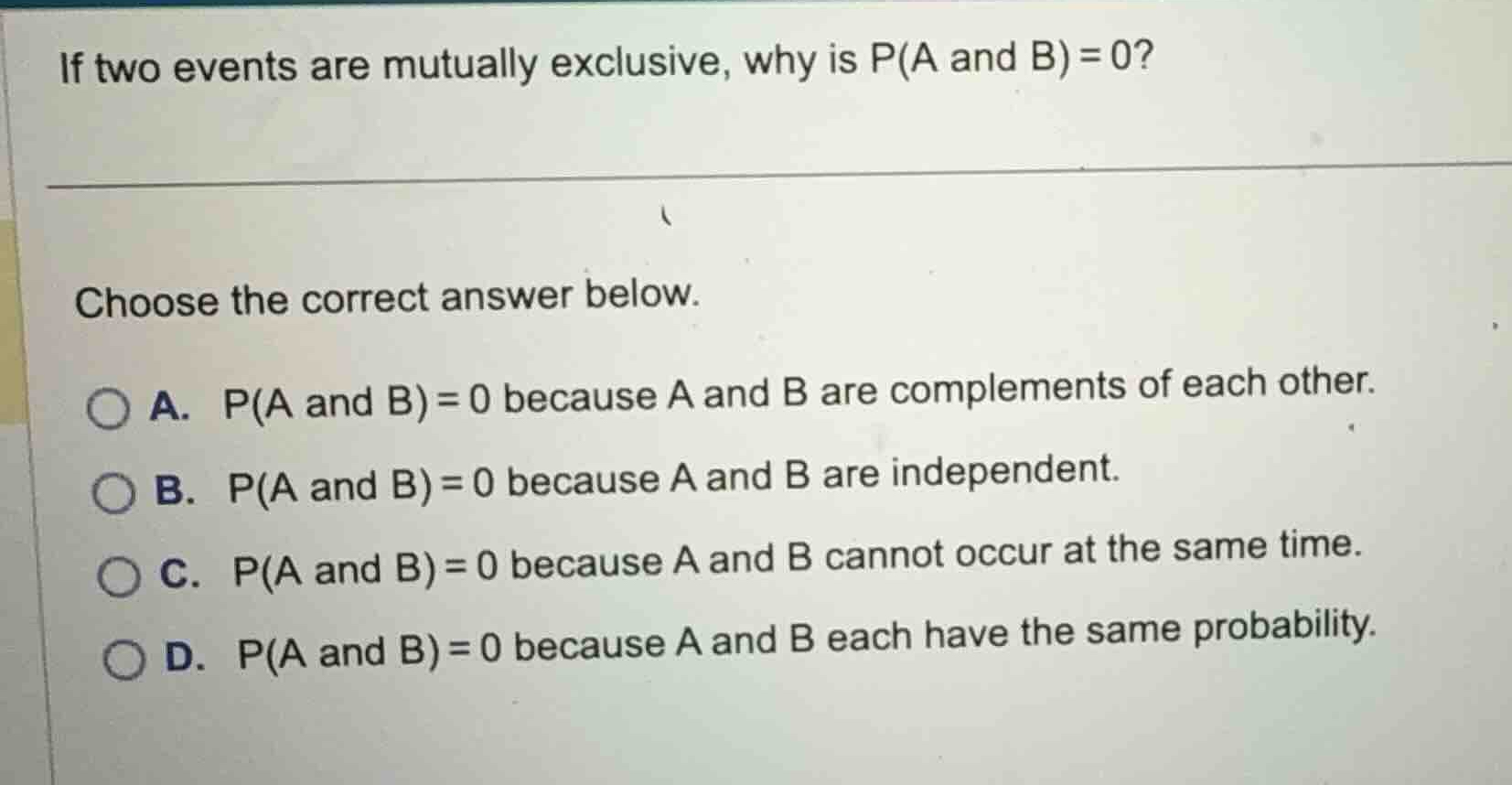
if two events are mutually exclusive, why is \\(p(a \text{ and } b) = 0\\)?
choose the correct answer below.
a. \\(p(a \text{ and } b) = 0\\) because \\(a\\) and \\(b\\) are complements of each other.
b. \\(p(a \text{ and } b) = 0\\) because \\(a\\) and \\(b\\) are independent.
c. \\(p(a \text{ and } b) = 0\\) because \\(a\\) and \\(b\\) cannot occur at the same time.
d. \\(p(a \text{ and } b) = 0\\) because \\(a\\) and \\(b\\) each have the same probability.
Define mutually exclusive events
Mutually exclusive events are events that cannot occur at the same time. If one event happens, the other cannot.
Analyze the intersection probability
The notation \(P(A\text{ and }B)\) represents the probability that both event \(A\) and event \(B\) occur simultaneously.
Connect definition to probability
Since mutually exclusive events cannot occur together, the event "\(A\text{ and }B\)" is an impossible event. Therefore, its probability must be zero:
Evaluate the given options
- A is incorrect because mutually exclusive events do not have to be complements of each other.
- B is incorrect because independent events can occur at the same time; in fact, if \(P(A) > 0\) and \(P(B) > 0\), independent events must have \(P(A\text{ and }B) = P(A) \cdot P(B) > 0\).
- C is correct because it directly states the definition: they cannot occur at the same time.
- D is incorrect because mutually exclusive events can have completely different probabilities.

Snap & solve any problem in the app
Get step-by-step solutions on Sovi AI
Photo-based solutions with guided steps
Explore more problems and detailed explanations
- (A) P(A and B) = 0 because A and B are complements of each other.
- (B) P(A and B) = 0 because A and B are independent.
- (C) P(A and B) = 0 because A and B cannot occur at the same time. (Correct answer)
- (D) P(A and B) = 0 because A and B each have the same probability.