QUESTION IMAGE
Question
your turn
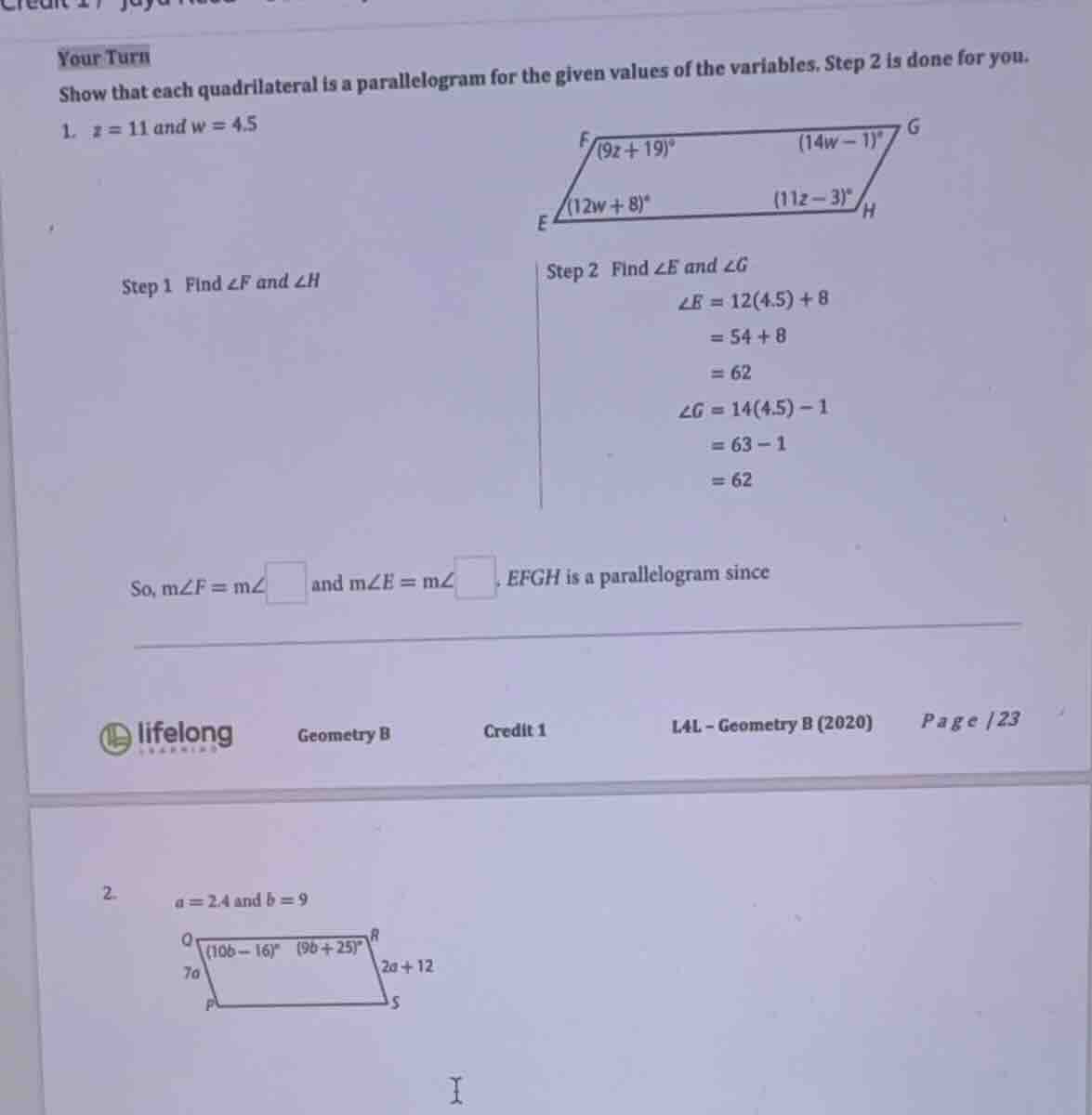
show that each quadrilateral is a parallelogram for the given values of the variables. step 2 is done for you.
- \\(z = 11\\) and \\(w = 4.5\\)
step 1 find \\(\angle f\\) and \\(\angle h\\)
step 2 find \\(\angle e\\) and \\(\angle g\\)
\\\angle e = 12(4.5) + 8\\
\\= 54 + 8\\
\\= 62\\
\\\angle g = 14(4.5) - 1\\
\\= 63 - 1\\
\\= 62\\
so, \\(m\angle f = m\angle\\) and \\(m\angle e = m\angle\\) . efgh is a parallelogram since
- \\(a = 2.4\\) and \\(b = 9\\)
Calculate angle F and angle H
Using the Solving Linear Equations knowledge point
Identify equal opposite angles
Using the Converse of Parallelogram Theorems knowledge point
State the parallelogram condition
Using the Converse of Parallelogram Theorems knowledge point
Calculate side lengths and angles for Question 2
Using the Solving Linear Equations knowledge point
Verify the parallelogram condition for Question 2
Using the Converse of Parallelogram Theorems knowledge point

Snap & solve any problem in the app
Get step-by-step solutions on Sovi AI
Photo-based solutions with guided steps
Explore more problems and detailed explanations
Question 1
So, \(m\angle F = m\angle\) <blank>\(H\)</blank> and \(m\angle E = m\angle\) <blank>\(G\)</blank>. \(EFGH\) is a parallelogram since <blank>both pairs of opposite angles are congruent</blank>.
Question 2
For \(a = 2.4\) and \(b = 9\):
- \(QP = 7(2.4) = 16.8\)
- \(RS = 2(2.4) + 12 = 16.8\)
- \(m\angle Q = 10(9) - 16 = 74^\circ\)
- \(m\angle R = 9(9) + 25 = 106^\circ\)
Since \(QP = RS = 16.8\), one pair of opposite sides is congruent. Since \(m\angle Q + m\angle R = 74^\circ + 106^\circ = 180^\circ\), the consecutive interior angles are supplementary, which proves that \(QP \parallel RS\). Therefore, \(PQRS\) is a parallelogram because <blank>one pair of opposite sides is both parallel and congruent</blank>.