QUESTION IMAGE
Question
true or false 2 points
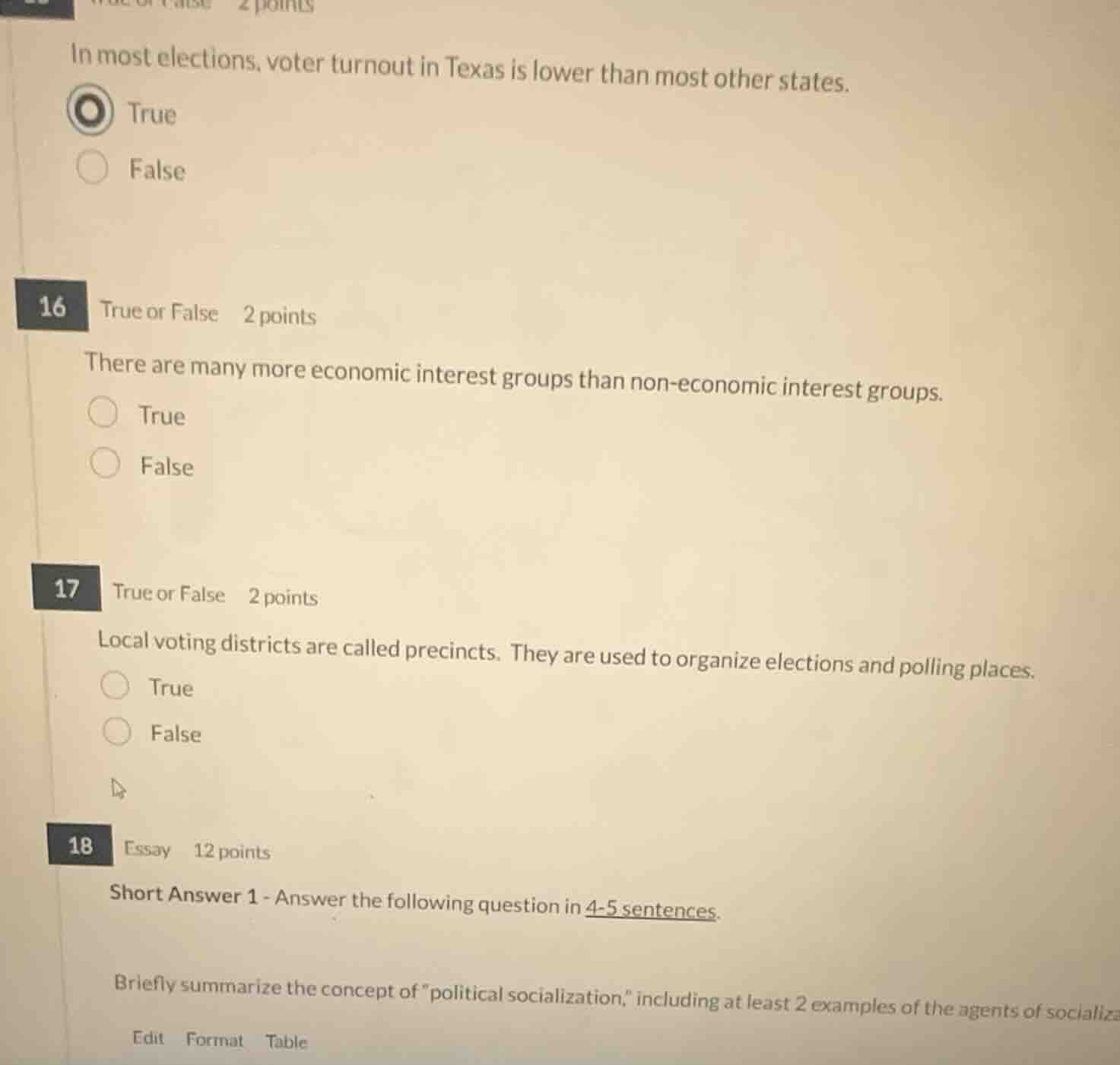
in most elections, voter turnout in texas is lower than most other states.
true
false
16 true or false 2 points
there are many more economic interest groups than non-economic interest groups.
true
false
17 true or false 2 points
local voting districts are called precincts. they are used to organize elections and polling places.
true
false
18 essay 12 points
short answer 1 - answer the following question in 4-5 sentences.
briefly summarize the concept of \political socialization,\ including at least 2 examples of the agents of socialization.
Analyze voter turnout in Texas
The first visible question (partially cropped at the top, numbered as the question before 16) asks whether voter turnout in Texas is lower than in most other states. Applying our understanding of Voter Turnout in Texas, Texas historically ranks near the bottom among U.S. states in voter turnout due to factors like restrictive voting laws, a large young and transient population, and low party competition. Therefore, this statement is True.
Evaluate interest group types
Question 16 asks if there are many more economic interest groups than non-economic interest groups. In the study of Interest Groups, economic groups (representing businesses, labor unions, professional associations, and agricultural interests) are far more numerous, better funded, and more active than non-economic (public interest, religious, or single-issue) groups. Therefore, this statement is True.
Define local voting districts
Question 17 states that local voting districts are called precincts and are used to organize elections and polling places. In the context of the American Party Structure, a precinct is indeed the smallest, most basic geographic unit of social and political organization used for administering elections and establishing local polling locations. Therefore, this statement is True.
Explain political socialization
Question 18 asks for a short answer (4-5 sentences) summarizing "political socialization" and providing at least 2 examples of agents of socialization.
- Political socialization is the lifelong process by which individuals acquire their political beliefs, values, attitudes, and behaviors.
- This process shapes how citizens view the political system and their role within it.
- Key "agents of socialization" are the institutions and individuals that transmit these values.
- The family is widely considered the primary agent, as children absorb political leanings early in life.
- Other major agents include schools, which teach civic values, and the media, which shape public perception of current events.

Snap & solve any problem in the app
Get step-by-step solutions on Sovi AI
Photo-based solutions with guided steps
Explore more problems and detailed explanations
Question 15
- True (Correct answer)
- False
Question 16
- True (Correct answer)
- False
Question 17
- True (Correct answer)
- False
Question 18
Political socialization is the lifelong process through which individuals acquire their political beliefs, values, attitudes, and behaviors. This developmental process shapes how citizens perceive their political system, understand civic duties, and form partisan identities. Various "agents of socialization" facilitate this learning by transmitting political culture from one generation to the next. For example, the family serves as the primary agent, as children frequently adopt the political leanings and civic habits of their parents. Additionally, schools act as crucial agents by introducing formal civic education, while the mass media constantly shapes public opinion and political awareness through news coverage.