QUESTION IMAGE
Question
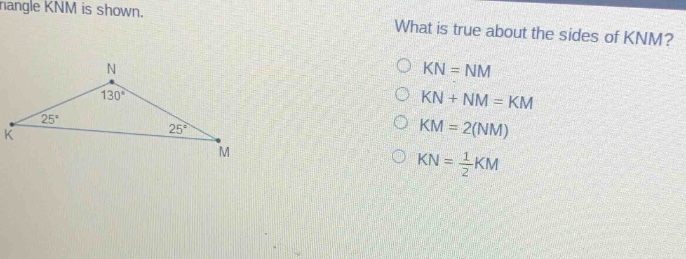
triangle knm is shown. what is true about the sides of knm?
○ ( kn = nm )
○ ( kn + nm = km )
○ ( km = 2(nm) )
○ ( kn = \frac{1}{2}km )
(diagram: triangle with vertices k, n, m; ( angle k = 25^circ ), ( angle n = 130^circ ), ( angle m = 25^circ ))
Step1: Analyze triangle angles
In triangle \( KNM \), \( \angle K = 25^\circ \), \( \angle M = 25^\circ \), \( \angle N = 130^\circ \). Angles \( \angle K \) and \( \angle M \) are equal.
Step2: Apply isosceles triangle theorem
The isosceles triangle theorem states that if two angles of a triangle are equal, the sides opposite those angles are equal. The side opposite \( \angle K \) is \( NM \), and the side opposite \( \angle M \) is \( KN \). So, \( KN = NM \).
Step3: Evaluate other options
- \( KN + NM = KM \): By triangle inequality, the sum of two sides must be greater than the third side, so this is false.
- \( KM = 2(NM) \): There's no information (like it being an isosceles triangle with specific ratios or a right triangle) to support this, and from angle - side relationships (larger angle opposite longer side), \( \angle N = 130^\circ \) is opposite \( KM \), and \( \angle K=\angle M = 25^\circ \) are opposite \( NM \) and \( KN \) respectively. But we can't conclude \( KM = 2(NM) \) from the given angles.
- \( KN=\frac{1}{2}KM \): Similar to the above, no basis for this ratio from the given angle measures.
Snap & solve any problem in the app
Get step-by-step solutions on Sovi AI
Photo-based solutions with guided steps
Explore more problems and detailed explanations
\( KN = NM \) (the first option: \( \boldsymbol{KN = NM} \))