QUESTION IMAGE
Question
triangle congruence worksheet #3
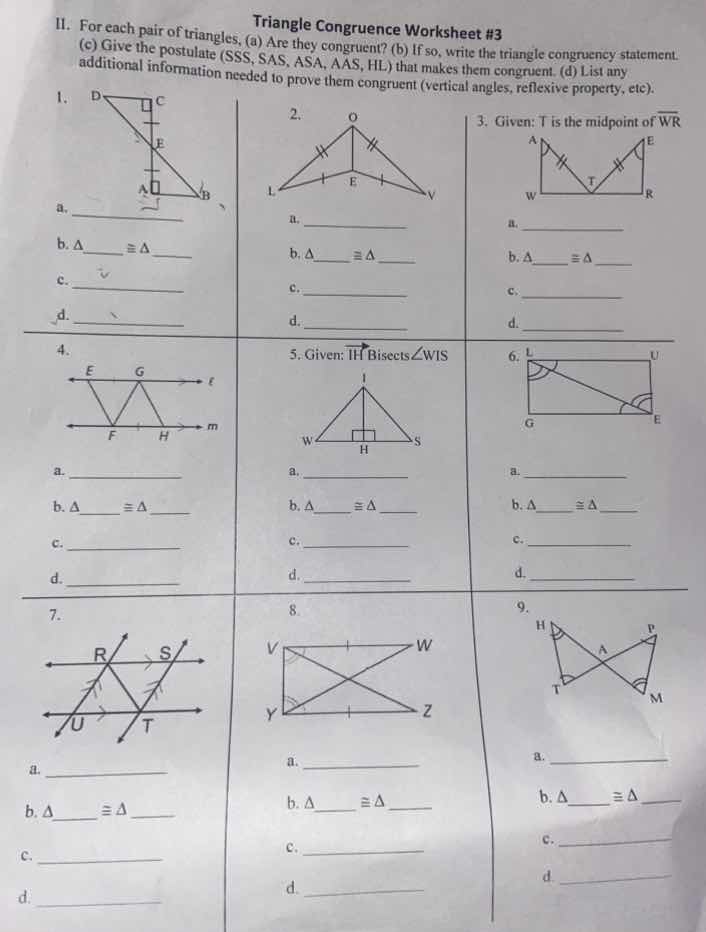
ii. for each pair of triangles, (a) are they congruent? (b) if so, write the triangle congruence statement. (c) give the postulate (sss, sas, asa, aas, hl) that makes them congruent. (d) list any additional information needed to prove them congruent (vertical angles, reflexive property, etc.).
1.
a. ______
b. \\(\delta \text{___} \cong \delta \text{___}\\)
c. ______
d. ______
2.
a. ______
b. \\(\delta \text{___} \cong \delta \text{___}\\)
c. ______
d. ______
- given: t is the midpoint of wr
a. ______
b. \\(\delta \text{___} \cong \delta \text{___}\\)
c. ______
d. ______
4.
a. ______
b. \\(\delta \text{___} \cong \delta \text{___}\\)
c. ______
d. ______
- given: \\(\overrightarrow{ih}\\) bisects \\(\angle wis\\)
a. ______
b. \\(\delta \text{___} \cong \delta \text{___}\\)
c. ______
d. ______
6.
a. ______
b. \\(\delta \text{___} \cong \delta \text{___}\\)
c. ______
d. ______
7.
a. ______
b. \\(\delta \text{___} \cong \delta \text{___}\\)
c. ______
d. ______
8.
a. ______
b. \\(\delta \text{___} \cong \delta \text{___}\\)
c. ______
d. ______
9.
a. ______
b. \\(\delta \text{___} \cong \delta \text{___}\\)
c. ______
d. ______
Analyze Question 1
In Question 1, we are given two right triangles, \(\Delta CDE\) and \(\Delta ABE\).
- Right angles are marked at \(\angle C\) and \(\angle A\), so \(\angle C \cong \angle A\).
- Segment \(DE\) is marked with a single tick mark, and segment \(BE\) is marked with a single tick mark, so \(DE \cong BE\).
- The vertical angles \(\angle DEC\) and \(\angle BEA\) are congruent by the Vertical Angles Theorem.
- Thus, we have two angles and a non-included side congruent: \(\angle C \cong \angle A\) (Angle), \(\angle DEC \cong \angle BEA\) (Angle), and \(DE \cong BE\) (Side).
- Therefore, the triangles are congruent by the Angle-Angle-Side (AAS) postulate.
- The congruence statement is \(\Delta CDE \cong \Delta ABE\).
- The additional information used is vertical angles.
Analyze Question 2
In Question 2, we have triangles \(\Delta OLE\) and \(\Delta OVE\).
- Segment \(OL\) is marked with double tick marks, and segment \(OV\) is marked with double tick marks, so \(OL \cong OV\).
- Segment \(LE\) is marked with a single tick mark, and segment \(VE\) is marked with a single tick mark, so \(LE \cong VE\).
- Segment \(OE\) is shared by both triangles, so \(OE \cong OE\) by the Reflexive Property.
- Thus, all three corresponding sides are congruent.
- Therefore, the triangles are congruent by the Side-Side-Side (SSS) postulate.
- The congruence statement is \(\Delta OLE \cong \Delta OVE\).
- The additional information used is the reflexive property.
Analyze Question 3
In Question 3, we are given that \(T\) is the midpoint of \(WR\).
- Using the Midpoint Definition, this means \(WT \cong RT\).
- Segment \(AT\) is marked with a single tick mark, and segment \(ET\) is marked with a single tick mark, so \(AT \cong ET\).
- Angle \(\angle W\) is marked with a single arc, and angle \(\angle R\) is marked with a single arc, so \(\angle W \cong \angle R\).
- We have two sides and a non-included angle (SSA), which is not a valid congruence postulate.
- Therefore, the triangles cannot be proven congruent with the given information.
Analyze Question 4
In Question 4, we have parallel lines \(l \parallel m\).
- Segment \(EG\) is marked with a single tick mark, and segment \(FH\) is marked with a single tick mark, so \(EG \cong FH\).
- Segment \(FG\) is shared by \(\Delta EGF\) and \(\Delta HGF\), but the triangles of interest are \(\Delta EGF\) and \(\Delta HFG\).
- Let's look at \(\Delta EGF\) and \(\Delta HFG\). They share the side \(GF\), so \(GF \cong FG\) by the Reflexive Property.
- Since \(l \parallel m\), the alternate interior angles \(\angle EGF\) and \(\angle HFG\) are congruent.
- We have side \(EG \cong FH\), included angle \(\angle EGF \cong \angle HFG\), and side \(GF \cong FG\).
- Therefore, the triangles are congruent by the Side-Angle-Side (SAS) postulate.
- The congruence statement is \(\Delta EGF \cong \Delta HFG\).
- The additional information used is alternate interior angles and the reflexive property.
Analyze Question 5
In Question 5, we are given that \(\vec…

Snap & solve any problem in the app
Get step-by-step solutions on Sovi AI
Photo-based solutions with guided steps
Explore more problems and detailed explanations
Question 1
a. Yes
b. \(\Delta CDE \cong \Delta ABE\)
c. AAS
d. Vertical angles
Question 2
a. Yes
b. \(\Delta OLE \cong \Delta OVE\)
c. SSS
d. Reflexive property
Question 3
a. No
b. \(\Delta\) N/A \(\cong \Delta\) N/A
c. N/A
d. Midpoint definition gives \(WT \cong RT\), but SSA is not a valid congruence postulate
Question 4
a. Yes
b. \(\Delta EGF \cong \Delta HFG\)
c. SAS
d. Alternate interior angles, Reflexive property
Question 5
a. Yes
b. \(\Delta WIH \cong \Delta SIH\)
c. ASA
d. Reflexive property, Definition of angle bisector, Perpendicular lines form congruent right angles
Question 6
a. Yes
b. \(\Delta ULE \cong \Delta GLE\)
c. ASA
d. Reflexive property
Question 7
a. Yes
b. \(\Delta RST \cong \Delta TUR\)
c. ASA
d. Alternate interior angles, Reflexive property
Question 8
a. Yes
b. \(\Delta WVY \cong \Delta ZYV\)
c. SAS
d. Reflexive property
Question 9
a. No
b. \(\Delta\) N/A \(\cong \Delta\) N/A
c. N/A
d. Vertical angles, but AAA is not a valid congruence postulate