QUESTION IMAGE
Question
transcribe it like a pro: nervous system
describes how they feel or what has happened to them and then converting it into medical terms as you enter it into a medical record. each question consists of two sentences. the first sentence uses everyday language in which a patient (or their family) explains how they feel or what is happening to them. the second sentence shows how the patients statement could be entered into their medical record.
student instructions
- read what \the patient says:\
- in the \you write:\ sentence there are boxes where medical terms are needed. some sentences have more than one box. each box represents a different medical term.
- type the correct medical term in each box provided. note that sometimes there may be more than one correct term possible. enter only one of the correct terms. abbreviations may be used.
- remember that some medical terms consist of more than one word.
- click the submit button to view your results.
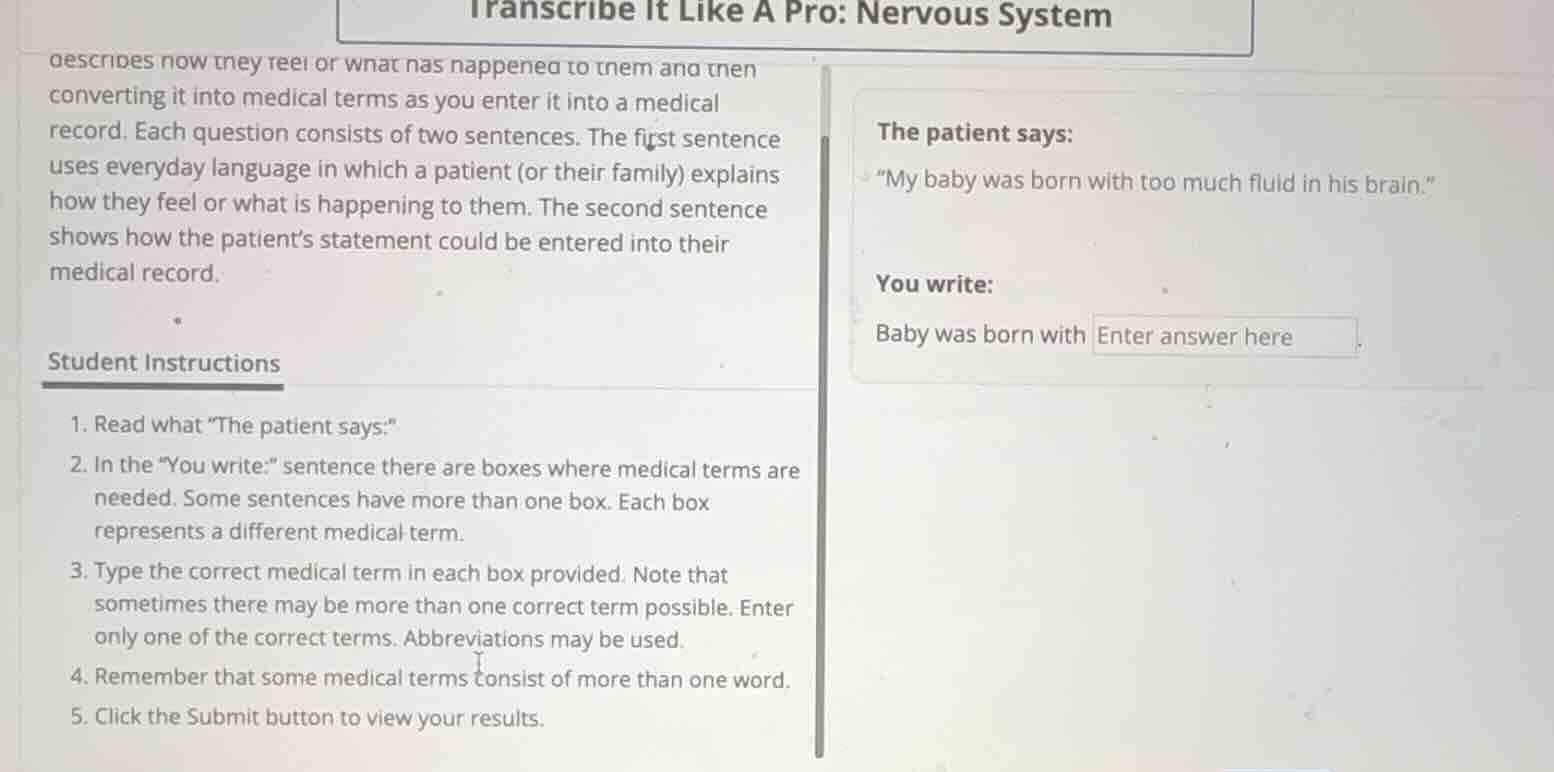
the patient says:
\my baby was born with too much fluid in his brain.\
you write:
baby was born with enter answer here
Analyze the patient's statement
The patient's statement is: "My baby was born with too much fluid in his brain." We need to translate the phrase "too much fluid in his brain" into a single professional medical term.
Identify the medical term
Using the Hydrocephalus Terminology knowledge point
- The prefix/combining form for water or fluid is hydr/o.
- The combining form for brain or head is cephal/o.
- The suffix -us indicates a condition.
- Combining these elements yields the medical term hydrocephalus, which refers to an abnormal accumulation of cerebrospinal fluid (CSF) in the brain's cavities.

Snap & solve any problem in the app
Get step-by-step solutions on Sovi AI
Photo-based solutions with guided steps
Explore more problems and detailed explanations
The patient says:
"My baby was born with too much fluid in his brain."
You write:
Baby was born with <blank>hydrocephalus</blank>.