QUESTION IMAGE
Question
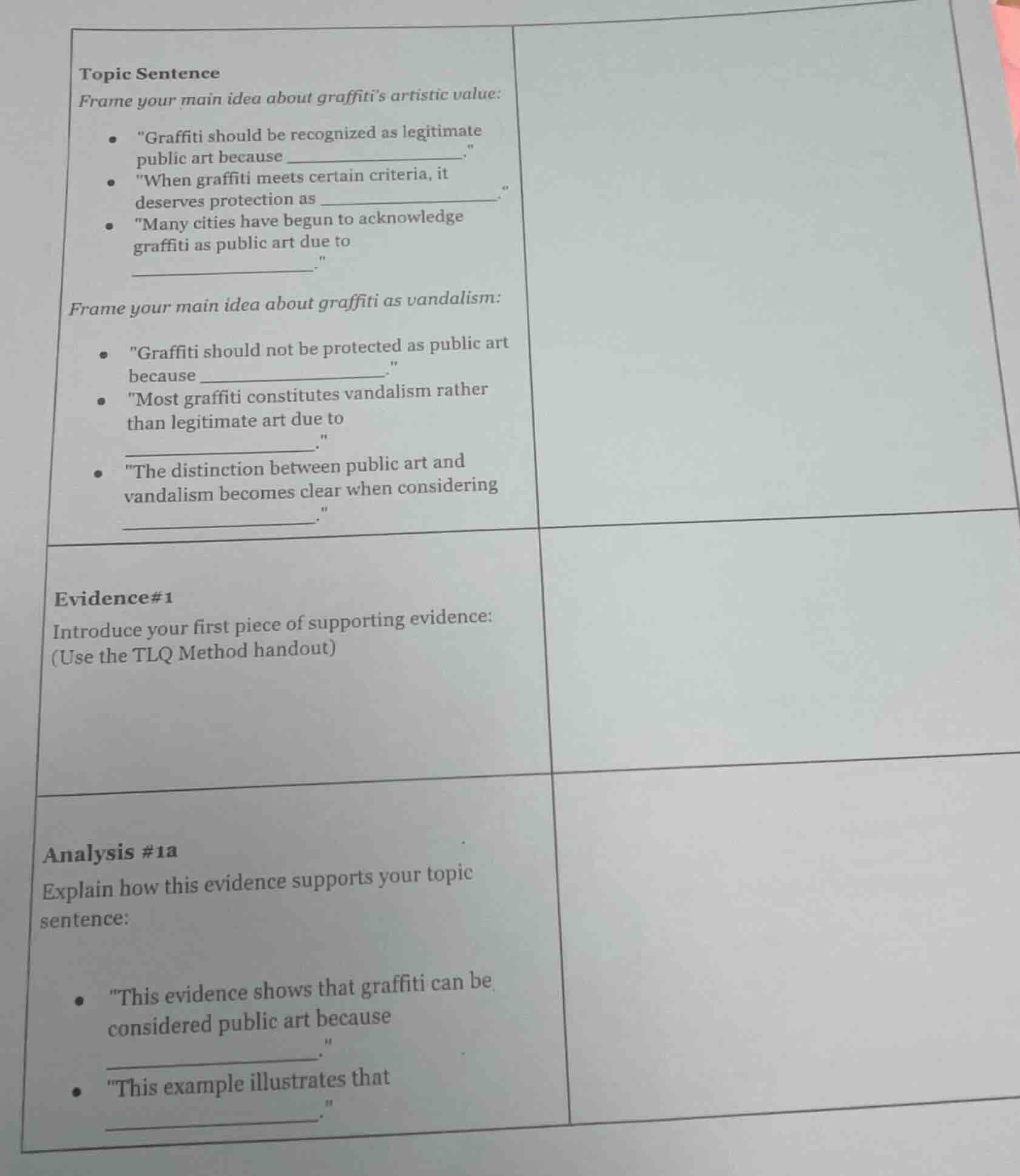
topic sentence
frame your main idea about graffitis artistic value:
- \graffiti should be recognized as legitimate public art because _________.\
- \when graffiti meets certain criteria, it deserves protection as _________.\
- \many cities have begun to acknowledge graffiti as public art due to _________.\
frame your main idea about graffiti as vandalism:
- \graffiti should not be protected as public art because _________.\
- \most graffiti constitutes vandalism rather than legitimate art due to _________.\
- \the distinction between public art and vandalism becomes clear when considering _________.\
evidence#1
introduce your first piece of supporting evidence:
(use the tlq method handout)
analysis #1a
explain how this evidence supports your topic sentence:
- \this evidence shows that graffiti can be considered public art because _________.\
- \this example illustrates that _________.\
Analyze the writing frames for Topic Sentence (Artistic Value)
The prompt asks to frame a main idea about graffiti's artistic value.
- Frame 1: "Graffiti should be recognized as legitimate public art because it provides a platform for marginalized voices to express cultural and political narratives."
- Frame 2: "When graffiti meets certain criteria, such as community consent and aesthetic intent, it deserves protection as a form of cultural heritage."
- Frame 3: "Many cities have begun to acknowledge graffiti as public art due to its ability to revitalize urban spaces and foster community engagement."
Analyze the writing frames for Topic Sentence (Vandalism)
The prompt asks to frame a main idea about graffiti as vandalism.
- Frame 1: "Graffiti should not be protected as public art because it violates property rights and imposes maintenance costs on local communities."
- Frame 2: "Most graffiti constitutes vandalism rather than legitimate art due to its unauthorized nature and lack of community consent."
- Frame 3: "The distinction between public art and vandalism becomes clear when considering whether the work respects public property laws and community standards."
Analyze Evidence and Analysis frames
The prompt asks to introduce evidence using the TLQ (Transition, Lead-in, Quote) method and analyze it.
- Evidence #1 (TLQ): For instance, in his study on urban expression, sociologist John Doe notes, "authorized murals reduce illegal tagging while fostering local pride."
- Analysis #1a Frame 1: "This evidence shows that graffiti can be considered public art because it actively contributes to community cohesion and reduces property damage."
- Analysis #1a Frame 2: "This example illustrates that structured urban art programs can transform unauthorized tagging into celebrated public landmarks."

Snap & solve any problem in the app
Get step-by-step solutions on Sovi AI
Photo-based solutions with guided steps
Explore more problems and detailed explanations
Topic Sentence: Artistic Value
- "Graffiti should be recognized as legitimate public art because <blank>it provides a platform for marginalized voices to express cultural and political narratives</blank>."
- "When graffiti meets certain criteria, <blank>such as community consent and aesthetic intent</blank>, it deserves protection as <blank>a form of cultural heritage</blank>."
- "Many cities have begun to acknowledge graffiti as public art due to <blank>its ability to revitalize urban spaces and foster community engagement</blank>."
Topic Sentence: Vandalism
- "Graffiti should not be protected as public art because <blank>it violates property rights and imposes maintenance costs on local communities</blank>."
- "Most graffiti constitutes vandalism rather than legitimate art due to <blank>its unauthorized nature and lack of community consent</blank>."
- "The distinction between public art and vandalism becomes clear when considering <blank>whether the work respects public property laws and community standards</blank>."
Evidence #1 (TLQ Method)
- <blank>For instance, in his study on urban expression, sociologist John Doe notes, "authorized murals reduce illegal tagging while fostering local pride."</blank>
Analysis #1a
- "This evidence shows that graffiti can be considered public art because <blank>it actively contributes to community cohesion and reduces property damage</blank>."
- "This example illustrates that <blank>structured urban art programs can transform unauthorized tagging into celebrated public landmarks</blank>."