Sovi.AI - AI Math Tutor

Scan to solve math questions

QUESTION IMAGE

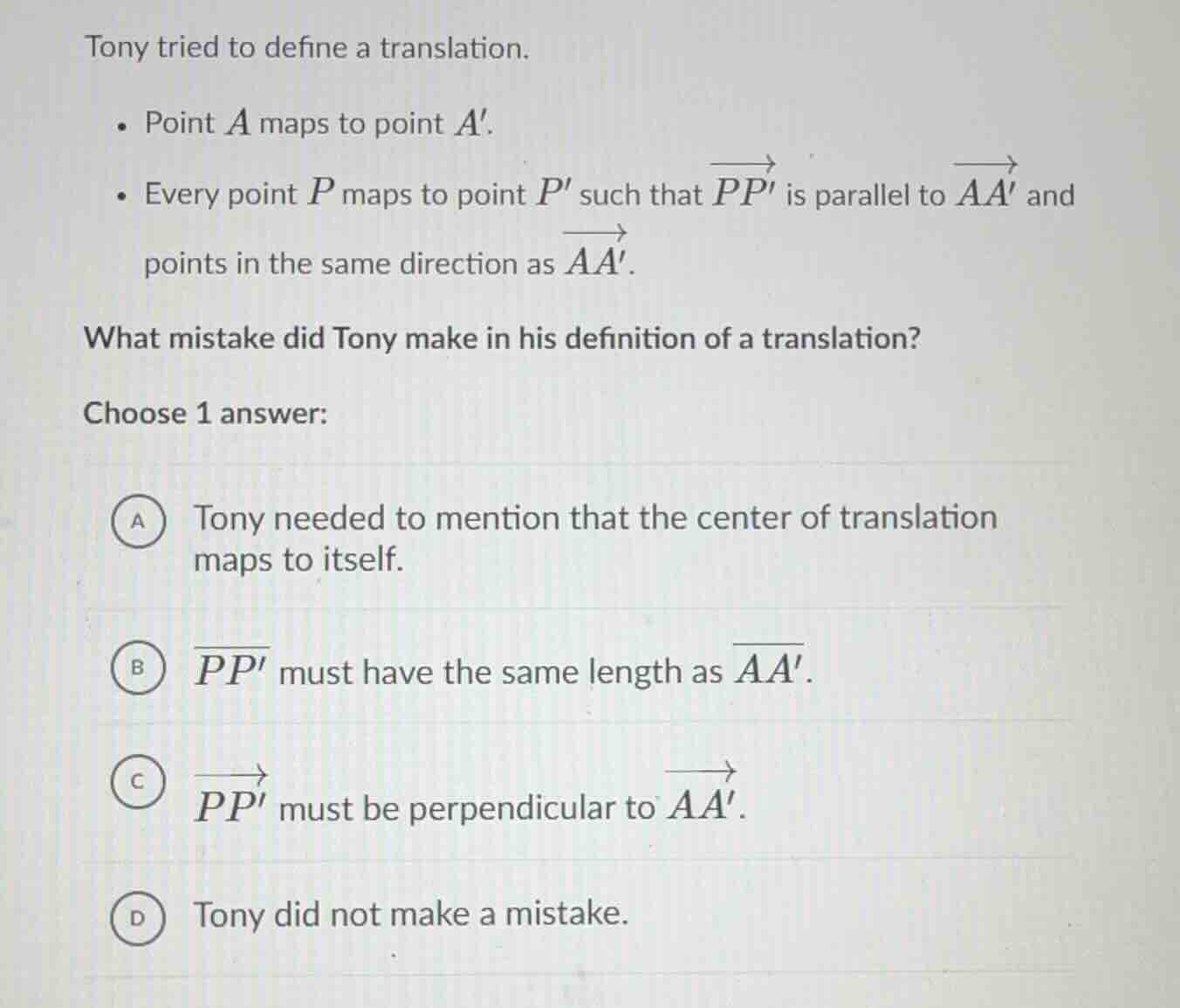
tony tried to define a translation. * point \\(a\\) maps to point \\(a\…

Question

tony tried to define a translation.

  • point \\(a\\) maps to point \\(a\\).
  • every point \\(p\\) maps to point \\(p\\) such that \\(\overrightarrow{pp}\\) is parallel to \\(\overrightarrow{aa}\\) and points in the same direction as \\(\overrightarrow{aa}\\).

what mistake did tony make in his definition of a translation?

choose 1 answer:

(a) tony needed to mention that the center of translation maps to itself.
(b) \\(\overline{pp}\\) must have the same length as \\(\overline{aa}\\).
(c) \\(\overrightarrow{pp}\\) must be perpendicular to \\(\overrightarrow{aa}\\).
(d) tony did not make a mistake.

Explanation:

Response

<pre_analysis>
{
"quality": "clear",
"question_count": 1,
"skills_matched": [
"direct_cot",
"multiple_choice_formatter",
"explain_then_answer",
"tutor",
"mastery_adaptive_brevity"
],
"needs_drawing": false,
"concepts_used": [
"Geometric Transformations",
"Translations in Geometry"
],
"new_concepts": [],
"current_concepts": [
"Geometric Transformations",
"Translations in Geometry"
]
}
</pre_analysis>

<reasoning>

Analyze the definition of translation

Using the Geometric Transformations and Translations in Geometry knowledge points

  • A translation is a rigid transformation that slides every point of a figure the same distance in the same direction.
  • Tony's definition specifies the direction (parallel to and in the same direction as ray \(\overrightarrow{AA'}\)) but completely omits the distance requirement.
  • For a translation to be fully defined, the distance each point moves must be equal to the distance from \(A\) to \(A'\), meaning the segment \(\overline{PP'}\) must have the same length as \(\overline{AA'}\).

Evaluate the given options

Using the Geometric Transformations knowledge point

  • Option (A) is incorrect because translations do not have a "center of translation" (that concept applies to dilations or rotations).
  • Option (B) is correct because the distance of the slide must be uniform, meaning the segment \(\overline{PP'}\) must have the same length as \(\overline{AA'}\).
  • Option (C) is incorrect because the direction of translation is parallel to \(\overrightarrow{AA'}\), not perpendicular.
  • Option (D) is incorrect because Tony did make a mistake by omitting the distance.

</reasoning>

<answer>
<mcq-option>(A) Tony needed to mention that the center of translation maps to itself.</mcq-option>
<mcq-correct>(B) \(\overline{PP'}\) must have the same length as \(\overline{AA'}\).</mcq-correct>
<mcq-option>(C) \(\overrightarrow{PP'}\) must be perpendicular to \(\overrightarrow{AA'}\).</mcq-option>
<mcq-option>(D) Tony did not make a mistake.</mcq-option>
</answer>

<post_analysis>
{
"subject": "Mathematics",
"question_type": "Multiple Choice",
"knowledge_point": [
"Mathematics",
"Geometry",
"Translations in Geometry"
]
}
</post_analysis>

Answer:

<pre_analysis>
{
"quality": "clear",
"question_count": 1,
"skills_matched": [
"direct_cot",
"multiple_choice_formatter",
"explain_then_answer",
"tutor",
"mastery_adaptive_brevity"
],
"needs_drawing": false,
"concepts_used": [
"Geometric Transformations",
"Translations in Geometry"
],
"new_concepts": [],
"current_concepts": [
"Geometric Transformations",
"Translations in Geometry"
]
}
</pre_analysis>

<reasoning>

Analyze the definition of translation

Using the Geometric Transformations and Translations in Geometry knowledge points

  • A translation is a rigid transformation that slides every point of a figure the same distance in the same direction.
  • Tony's definition specifies the direction (parallel to and in the same direction as ray \(\overrightarrow{AA'}\)) but completely omits the distance requirement.
  • For a translation to be fully defined, the distance each point moves must be equal to the distance from \(A\) to \(A'\), meaning the segment \(\overline{PP'}\) must have the same length as \(\overline{AA'}\).

Evaluate the given options

Using the Geometric Transformations knowledge point

  • Option (A) is incorrect because translations do not have a "center of translation" (that concept applies to dilations or rotations).
  • Option (B) is correct because the distance of the slide must be uniform, meaning the segment \(\overline{PP'}\) must have the same length as \(\overline{AA'}\).
  • Option (C) is incorrect because the direction of translation is parallel to \(\overrightarrow{AA'}\), not perpendicular.
  • Option (D) is incorrect because Tony did make a mistake by omitting the distance.

</reasoning>

<answer>
<mcq-option>(A) Tony needed to mention that the center of translation maps to itself.</mcq-option>
<mcq-correct>(B) \(\overline{PP'}\) must have the same length as \(\overline{AA'}\).</mcq-correct>
<mcq-option>(C) \(\overrightarrow{PP'}\) must be perpendicular to \(\overrightarrow{AA'}\).</mcq-option>
<mcq-option>(D) Tony did not make a mistake.</mcq-option>
</answer>

<post_analysis>
{
"subject": "Mathematics",
"question_type": "Multiple Choice",
"knowledge_point": [
"Mathematics",
"Geometry",
"Translations in Geometry"
]
}
</post_analysis>