QUESTION IMAGE
Question
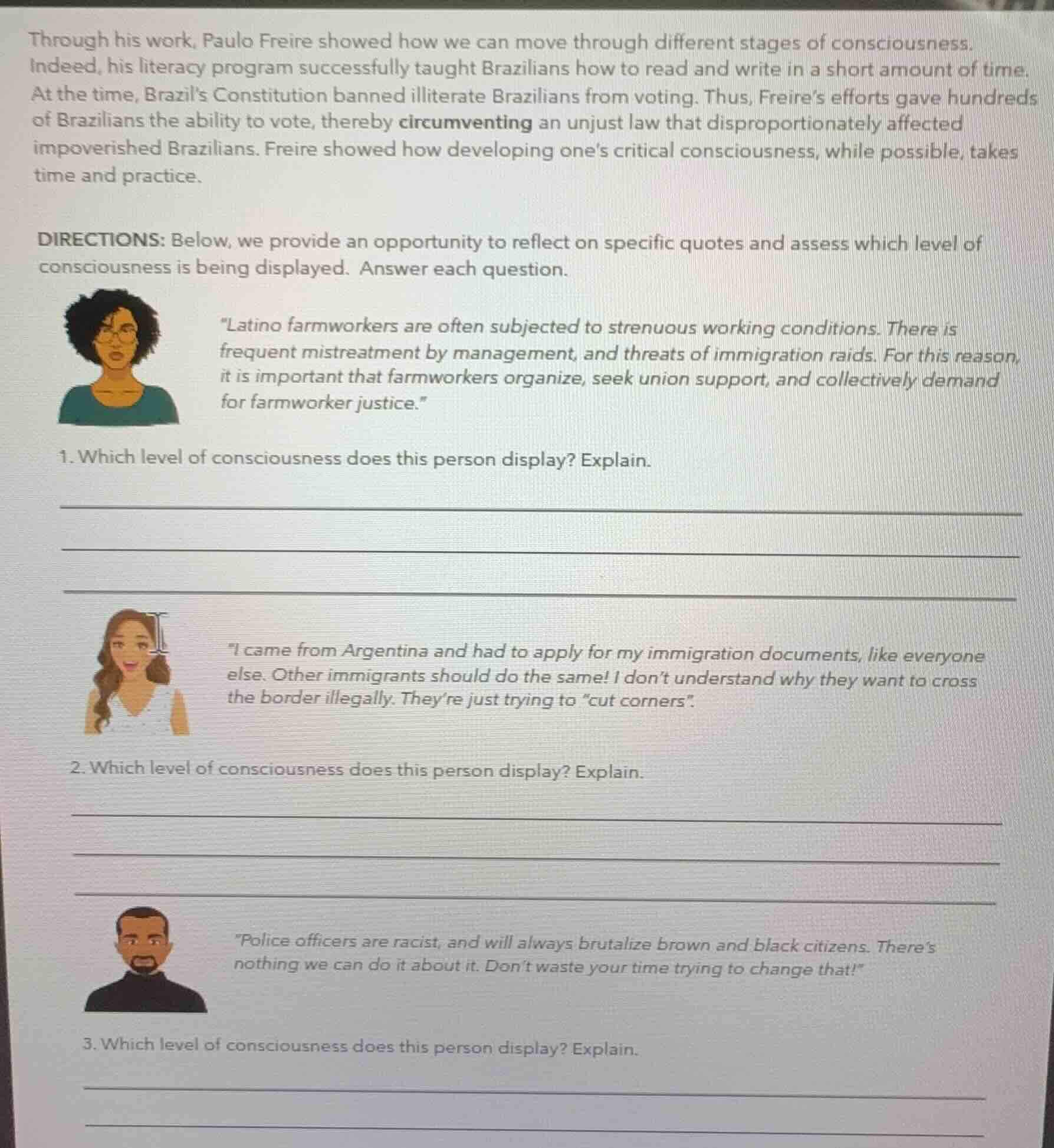
through his work, paulo freire showed how we can move through different stages of consciousness. indeed, his literacy program successfully taught brazilians how to read and write in a short amount of time. at the time, brazils constitution banned illiterate brazilians from voting. thus, freires efforts gave hundreds of brazilians the ability to vote, thereby circumventing an unjust law that disproportionately affected impoverished brazilians. freire showed how developing ones critical consciousness, while possible, takes time and practice.
directions: below, we provide an opportunity to reflect on specific quotes and assess which level of consciousness is being displayed. answer each question.
\latino farmworkers are often subjected to strenuous working conditions. there is frequent mistreatment by management, and threats of immigration raids. for this reason, it is important that farmworkers organize, seek union support, and collectively demand for farmworker justice.\
- which level of consciousness does this person display? explain.
\i came from argentina and had to apply for my immigration documents, like everyone else. other immigrants should do the same! i dont understand why they want to cross the border illegally. theyre just trying to \cut corners\.\
- which level of consciousness does this person display? explain.
\police officers are racist, and will always brutalize brown and black citizens. theres nothing we can do it about it. dont waste your time trying to change that!\
- which level of consciousness does this person display? explain.
Analyze Quote 1
The speaker identifies systemic exploitation (strenuous conditions, mistreatment, immigration raids) and actively advocates for structural change through collective action, organizing, and unionizing. This demonstrates critical consciousness (critical transitivity), where individuals understand systemic oppression and actively work to transform it.
Analyze Quote 2
The speaker views immigration strictly through an individualistic, rule-following lens ("apply... like everyone else") without recognizing systemic barriers, historical context, or unequal power dynamics. They blame individuals for "cutting corners," which aligns with semi-intransitive (or magical) consciousness, where systemic inequalities are ignored and social reality is accepted as fair and unchangeable.
Analyze Quote 3
The speaker recognizes a systemic problem ("Police officers are racist") but expresses complete hopelessness and resignation ("nothing we can do about it," "don't waste your time"). This fatalistic attitude, where oppression is recognized but viewed as an inevitable, unchangeable fact of life, represents naive consciousness (or fanatical/defensive resignation).

Snap & solve any problem in the app
Get step-by-step solutions on Sovi AI
Photo-based solutions with guided steps
Explore more problems and detailed explanations
Question 1
- Level of Consciousness: Critical Consciousness (Critical Transitivity)
- Explanation: The speaker recognizes systemic oppression (labor exploitation, unfair management, and immigration threats) and actively advocates for structural transformation through collective organizing and union support.
Question 2
- Level of Consciousness: Semi-Intransitive Consciousness (Magical Consciousness)
- Explanation: The speaker holds an individualistic view that ignores systemic barriers to legal immigration, assuming the system is fair and blaming individuals ("cutting corners") rather than questioning structural inequalities.
Question 3
- Level of Consciousness: Naive Consciousness (with fatalism/resignation)
- Explanation: The speaker acknowledges a systemic issue (police brutality and racism) but exhibits fatalism, claiming the situation is unchangeable and discouraging any action to transform it.