Sovi.AI - AI Math Tutor

Scan to solve math questions

QUESTION IMAGE

three ways you can apply the overload principle are _________ * - frequ…

Question

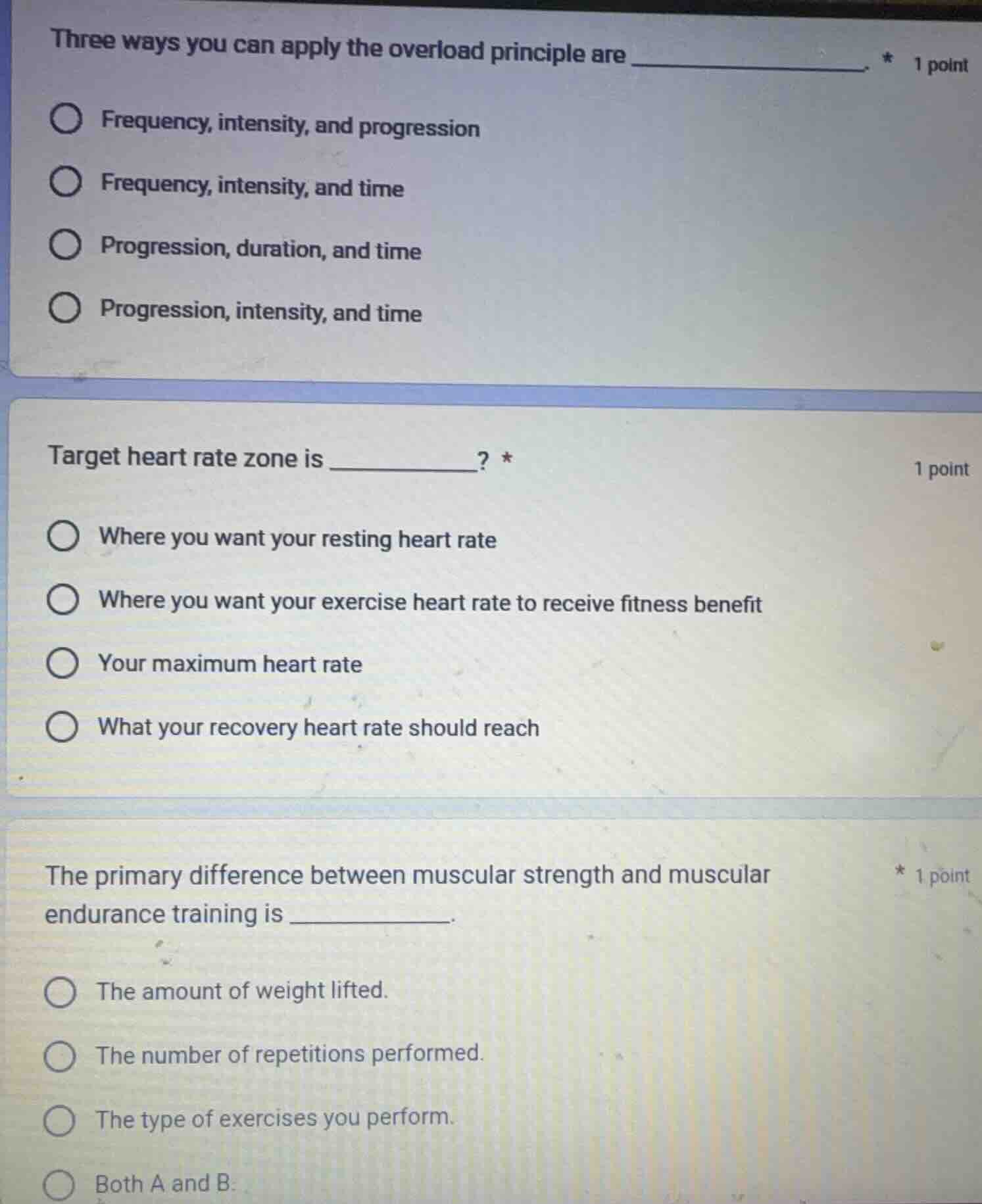
three ways you can apply the overload principle are _________ *

  • frequency, intensity, and progression
  • frequency, intensity, and time
  • progression, duration, and time
  • progression, intensity, and time

target heart rate zone is _________? *

  • where you want your resting heart rate
  • where you want your exercise heart rate to receive fitness benefit
  • your maximum heart rate
  • what your recovery heart rate should reach

the primary difference between muscular strength and muscular endurance training is _________ *

  • the amount of weight lifted.
  • the number of repetitions performed.
  • the type of exercises you perform.
  • both a and b.

Explanation:

Response

<pre_analysis>
{
"quality": "clear",
"question_count": 3,
"skills_matched": [
"direct_cot",
"multiple_choice_formatter",
"explain_then_answer",
"tutor"
],
"needs_drawing": false,
"concepts_used": [
"Exercise Physiology"
],
"new_concepts": [
"Overload Principle",
"Target Heart Rate Zone",
"Muscular Strength vs Endurance"
],
"current_concepts": [
"Exercise Physiology",
"Overload Principle",
"Target Heart Rate Zone",
"Muscular Strength vs Endurance"
]
}
</pre_analysis>

<reasoning>

Analyze overload principle application

The overload principle states that to improve fitness, you must stress the body systems beyond their normal levels. This is typically achieved by manipulating the FITT variables (Frequency, Intensity, Time, and Type). Among the choices provided, "Frequency, intensity, and time" represent the three primary ways to apply overload to a training program.
This relates directly to Exercise Physiology.

Define target heart rate zone

The target heart rate zone is a specific range of heart beats per minute that is desired during aerobic exercise. Training within this range ensures that the cardiovascular system is sufficiently challenged to improve aerobic capacity and receive optimal health and fitness benefits, without overexerting.

Compare muscular strength and endurance training

Muscular strength training focuses on the maximum force a muscle can generate, typically using heavier weights and fewer repetitions. Muscular endurance training focuses on the ability of a muscle to sustain repeated contractions over time, typically using lighter weights and more repetitions. Therefore, the primary differences lie in both the amount of weight lifted (resistance) and the number of repetitions performed.
This builds upon foundational concepts in Exercise Physiology.
</reasoning>

<answer>

Question 1

<mcq-option>Frequency, intensity, and progression</mcq-option>
<mcq-correct>Frequency, intensity, and time</mcq-correct>
<mcq-option>Progression, duration, and time</mcq-option>
<mcq-option>Progression, intensity, and time</mcq-option>

Question 2

<mcq-option>Where you want your resting heart rate</mcq-option>
<mcq-correct>Where you want your exercise heart rate to receive fitness benefit</mcq-correct>
<mcq-option>Your maximum heart rate</mcq-option>
<mcq-option>What your recovery heart rate should reach</mcq-option>

Question 3

<mcq-option>The amount of weight lifted.</mcq-option>
<mcq-option>The number of repetitions performed.</mcq-option>
<mcq-option>The type of exercises you perform.</mcq-option>
<mcq-correct>Both A and B.</mcq-correct>
</answer>

<post_analysis>
{
"subject": "Natural Science",
"question_type": "Multiple Choice",
"knowledge_point": [
"Natural Science",
"Others",
"Exercise Physiology"
]
}
</post_analysis>

Answer:

<pre_analysis>
{
"quality": "clear",
"question_count": 3,
"skills_matched": [
"direct_cot",
"multiple_choice_formatter",
"explain_then_answer",
"tutor"
],
"needs_drawing": false,
"concepts_used": [
"Exercise Physiology"
],
"new_concepts": [
"Overload Principle",
"Target Heart Rate Zone",
"Muscular Strength vs Endurance"
],
"current_concepts": [
"Exercise Physiology",
"Overload Principle",
"Target Heart Rate Zone",
"Muscular Strength vs Endurance"
]
}
</pre_analysis>

<reasoning>

Analyze overload principle application

The overload principle states that to improve fitness, you must stress the body systems beyond their normal levels. This is typically achieved by manipulating the FITT variables (Frequency, Intensity, Time, and Type). Among the choices provided, "Frequency, intensity, and time" represent the three primary ways to apply overload to a training program.
This relates directly to Exercise Physiology.

Define target heart rate zone

The target heart rate zone is a specific range of heart beats per minute that is desired during aerobic exercise. Training within this range ensures that the cardiovascular system is sufficiently challenged to improve aerobic capacity and receive optimal health and fitness benefits, without overexerting.

Compare muscular strength and endurance training

Muscular strength training focuses on the maximum force a muscle can generate, typically using heavier weights and fewer repetitions. Muscular endurance training focuses on the ability of a muscle to sustain repeated contractions over time, typically using lighter weights and more repetitions. Therefore, the primary differences lie in both the amount of weight lifted (resistance) and the number of repetitions performed.
This builds upon foundational concepts in Exercise Physiology.
</reasoning>

<answer>

Question 1

<mcq-option>Frequency, intensity, and progression</mcq-option>
<mcq-correct>Frequency, intensity, and time</mcq-correct>
<mcq-option>Progression, duration, and time</mcq-option>
<mcq-option>Progression, intensity, and time</mcq-option>

Question 2

<mcq-option>Where you want your resting heart rate</mcq-option>
<mcq-correct>Where you want your exercise heart rate to receive fitness benefit</mcq-correct>
<mcq-option>Your maximum heart rate</mcq-option>
<mcq-option>What your recovery heart rate should reach</mcq-option>

Question 3

<mcq-option>The amount of weight lifted.</mcq-option>
<mcq-option>The number of repetitions performed.</mcq-option>
<mcq-option>The type of exercises you perform.</mcq-option>
<mcq-correct>Both A and B.</mcq-correct>
</answer>

<post_analysis>
{
"subject": "Natural Science",
"question_type": "Multiple Choice",
"knowledge_point": [
"Natural Science",
"Others",
"Exercise Physiology"
]
}
</post_analysis>