QUESTION IMAGE
Question
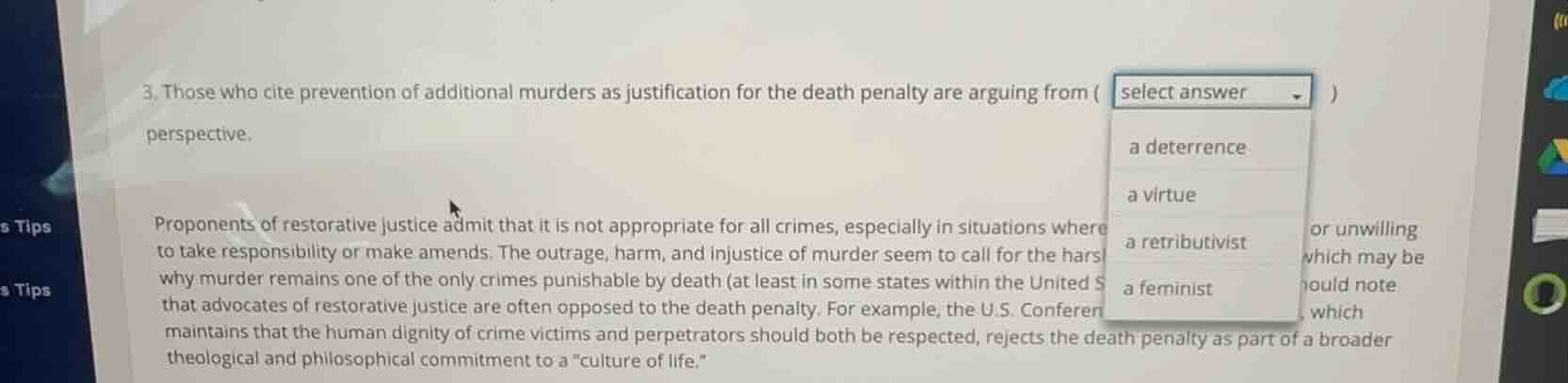
- those who cite prevention of additional murders as justification for the death penalty are arguing from ( select answer ) perspective.
options:
a deterrence
a virtue
a retributivist
a feminist
proponents of restorative justice admit that it is not appropriate for all crimes, especially in situations where offenders are unable or unwilling to take responsibility or make amends. the outrage, harm, and injustice of murder seem to call for the harshest punishment, which may be why murder remains one of the only crimes punishable by death (at least in some states within the united states). however, we should note that advocates of restorative justice are often opposed to the death penalty. for example, the u.s. conference of catholic bishops, which maintains that the human dignity of crime victims and perpetrators should both be respected, rejects the death penalty as part of a broader theological and philosophical commitment to a \culture of life.\
<pre_analysis>
{
"quality": "clear",
"question_count": 1,
"skills_matched": [
"direct_cot",
"multiple_choice_formatter",
"explain_then_answer",
"quick"
],
"needs_drawing": false,
"concepts_used": [],
"new_concepts": [
"Deterrence Theory",
"Philosophy of Law"
],
"current_concepts": [
"Deterrence Theory",
"Philosophy of Law",
"Legal Punishment"
]
}
</pre_analysis>
<reasoning>
Analyze the core argument
The statement describes individuals who justify the death penalty by citing the "prevention of additional murders."
Map to philosophical perspectives
Preventing future crimes by discouraging potential offenders or incapacitating the current offender is the core definition of deterrence. Therefore, this justification aligns with a deterrence perspective.
</reasoning>
<answer>
<mcq-correct>a deterrence</mcq-correct>
<mcq-option>a virtue</mcq-option>
<mcq-option>a retributivist</mcq-option>
<mcq-option>a feminist</mcq-option>
</answer>
<post_analysis>
{
"subject": "Social Science",
"question_type": "Multiple Choice",
"knowledge_point": [
"Social Science",
"Philosophy of Law",
"Deterrence Theory"
]
}
</post_analysis>
Snap & solve any problem in the app
Get step-by-step solutions on Sovi AI
Photo-based solutions with guided steps
Explore more problems and detailed explanations
<pre_analysis>
{
"quality": "clear",
"question_count": 1,
"skills_matched": [
"direct_cot",
"multiple_choice_formatter",
"explain_then_answer",
"quick"
],
"needs_drawing": false,
"concepts_used": [],
"new_concepts": [
"Deterrence Theory",
"Philosophy of Law"
],
"current_concepts": [
"Deterrence Theory",
"Philosophy of Law",
"Legal Punishment"
]
}
</pre_analysis>
<reasoning>
Analyze the core argument
The statement describes individuals who justify the death penalty by citing the "prevention of additional murders."
Map to philosophical perspectives
Preventing future crimes by discouraging potential offenders or incapacitating the current offender is the core definition of deterrence. Therefore, this justification aligns with a deterrence perspective.
</reasoning>
<answer>
<mcq-correct>a deterrence</mcq-correct>
<mcq-option>a virtue</mcq-option>
<mcq-option>a retributivist</mcq-option>
<mcq-option>a feminist</mcq-option>
</answer>
<post_analysis>
{
"subject": "Social Science",
"question_type": "Multiple Choice",
"knowledge_point": [
"Social Science",
"Philosophy of Law",
"Deterrence Theory"
]
}
</post_analysis>