QUESTION IMAGE
Question
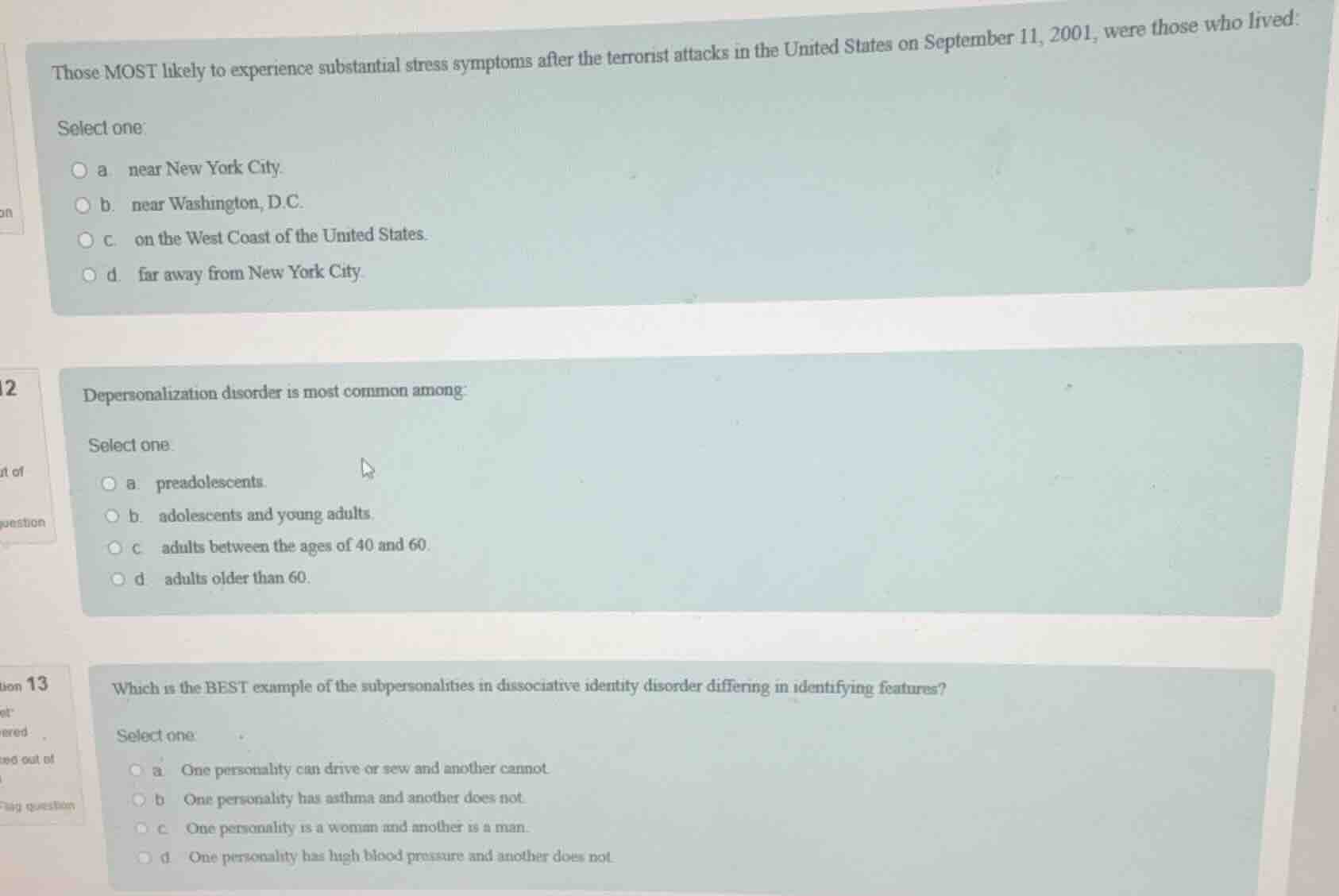
those most likely to experience substantial stress symptoms after the terrorist attacks in the united states on september 11, 2001, were those who lived:
select one:
a. near new york city.
b. near washington, d.c.
c. on the west coast of the united states.
d. far away from new york city.
depersonalization disorder is most common among:
select one:
a. preadolescents.
b. adolescents and young adults.
c. adults between the ages of 40 and 60.
d. adults older than 60.
which is the best example of the subpersonalities in dissociative identity disorder differing in identifying features?
select one:
a. one personality can drive or sew and another cannot.
b. one personality has asthma and another does not.
c. one personality is a woman and another is a man.
d. one personality has high blood pressure and another does not.
Analyze geographical proximity and stress symptoms
Research on the psychological impact of the September 11, 2001 terrorist attacks shows that geographical proximity to the disaster site was a major predictor of post-traumatic stress symptoms. Individuals living near New York City, where the World Trade Center towers fell, experienced the highest rates of substantial stress symptoms compared to those living further away.
Determine onset demographics for depersonalization disorder
Using the Depersonalization Symptoms knowledge point, we analyze the demographic patterns of depersonalization-derealization disorder. This condition typically has an early onset, most commonly appearing during adolescence or young adulthood (usually around age 16), and is highly uncommon to initiate after age 40.
Identify subpersonality differences in DID
Using the Subpersonality Relationships knowledge point, we evaluate how subpersonalities in dissociative identity disorder (DID) differ. Subpersonalities can differ in three main ways: identifying features, abilities/preferences, and physiological responses.
- Identifying features include basic demographic characteristics such as age, gender, race, and family history. Therefore, one personality being a woman and another being a man represents a difference in identifying features.
- Abilities and preferences include skills like driving or sewing.
- Physiological responses include medical conditions like asthma or high blood pressure.

Snap & solve any problem in the app
Get step-by-step solutions on Sovi AI
Photo-based solutions with guided steps
Explore more problems and detailed explanations
Question 1
- a. near New York City. (Correct answer)
- b. near Washington, D.C.
- c. on the West Coast of the United States.
- d. far away from New York City.
Question 2
- a. preadolescents.
- b. adolescents and young adults. (Correct answer)
- c. adults between the ages of 40 and 60.
- d. adults older than 60.
Question 3
- a. One personality can drive or sew and another cannot.
- b. One personality has asthma and another does not.
- c. One personality is a woman and another is a man. (Correct answer)
- d. One personality has high blood pressure and another does not.