QUESTION IMAGE
Question
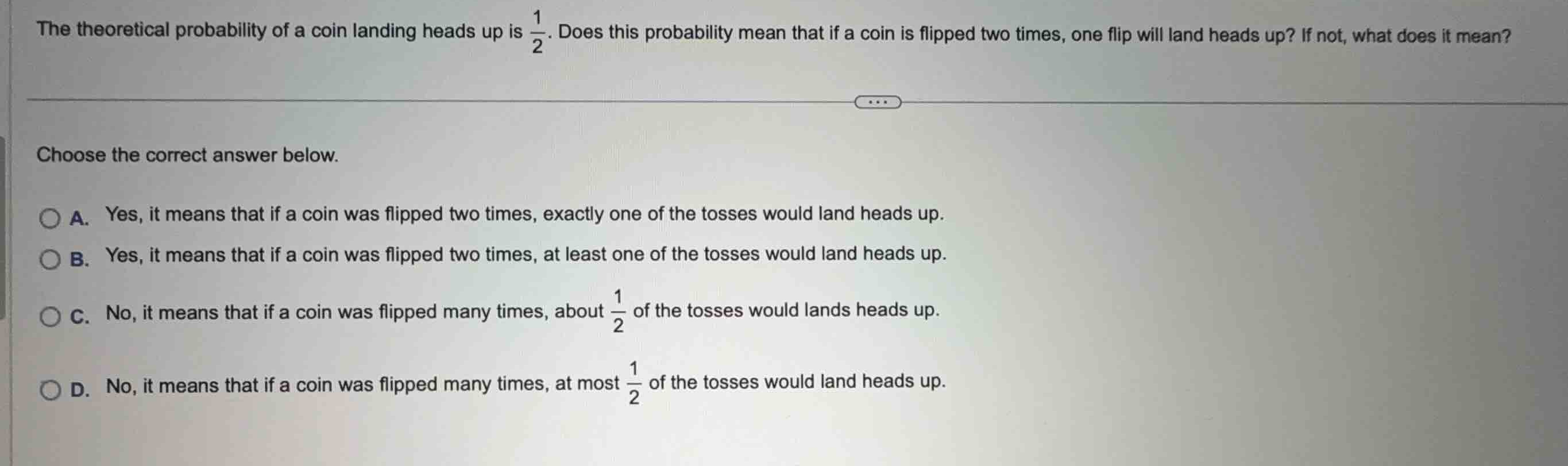
the theoretical probability of a coin landing heads up is \\(\frac{1}{2}\\). does this probability mean that if a coin is flipped two times, one flip will land heads up? if not, what does it mean?
choose the correct answer below.
a. yes, it means that if a coin was flipped two times, exactly one of the tosses would land heads up.
b. yes, it means that if a coin was flipped two times, at least one of the tosses would land heads up.
c. no, it means that if a coin was flipped many times, about \\(\frac{1}{2}\\) of the tosses would lands heads up.
d. no, it means that if a coin was flipped many times, at most \\(\frac{1}{2}\\) of the tosses would land heads up.
Analyze the definition of theoretical probability
Theoretical probability describes the long-run relative frequency of an event. A probability of \(\frac{1}{2}\) does not guarantee exact outcomes in a small number of trials (like 2 flips).
Evaluate the given options
- A and B incorrectly claim that the probability guarantees outcomes in exactly 2 flips.
- C correctly states that over many trials, the proportion of heads will approach \(\frac{1}{2}\).
- D incorrectly limits the proportion to "at most" \(\frac{1}{2}\).
Select the correct option
Option C correctly describes the long-run behavior of theoretical probability.

Snap & solve any problem in the app
Get step-by-step solutions on Sovi AI
Photo-based solutions with guided steps
Explore more problems and detailed explanations
- (A) Yes, it means that if a coin was flipped two times, exactly one of the tosses would land heads up.
- (B) Yes, it means that if a coin was flipped two times, at least one of the tosses would land heads up.
- (C) No, it means that if a coin was flipped many times, about \(\frac{1}{2}\) of the tosses would lands heads up. (Correct answer)
- (D) No, it means that if a coin was flipped many times, at most \(\frac{1}{2}\) of the tosses would land heads up.