QUESTION IMAGE
Question
texes mathematics 4-8 (115)
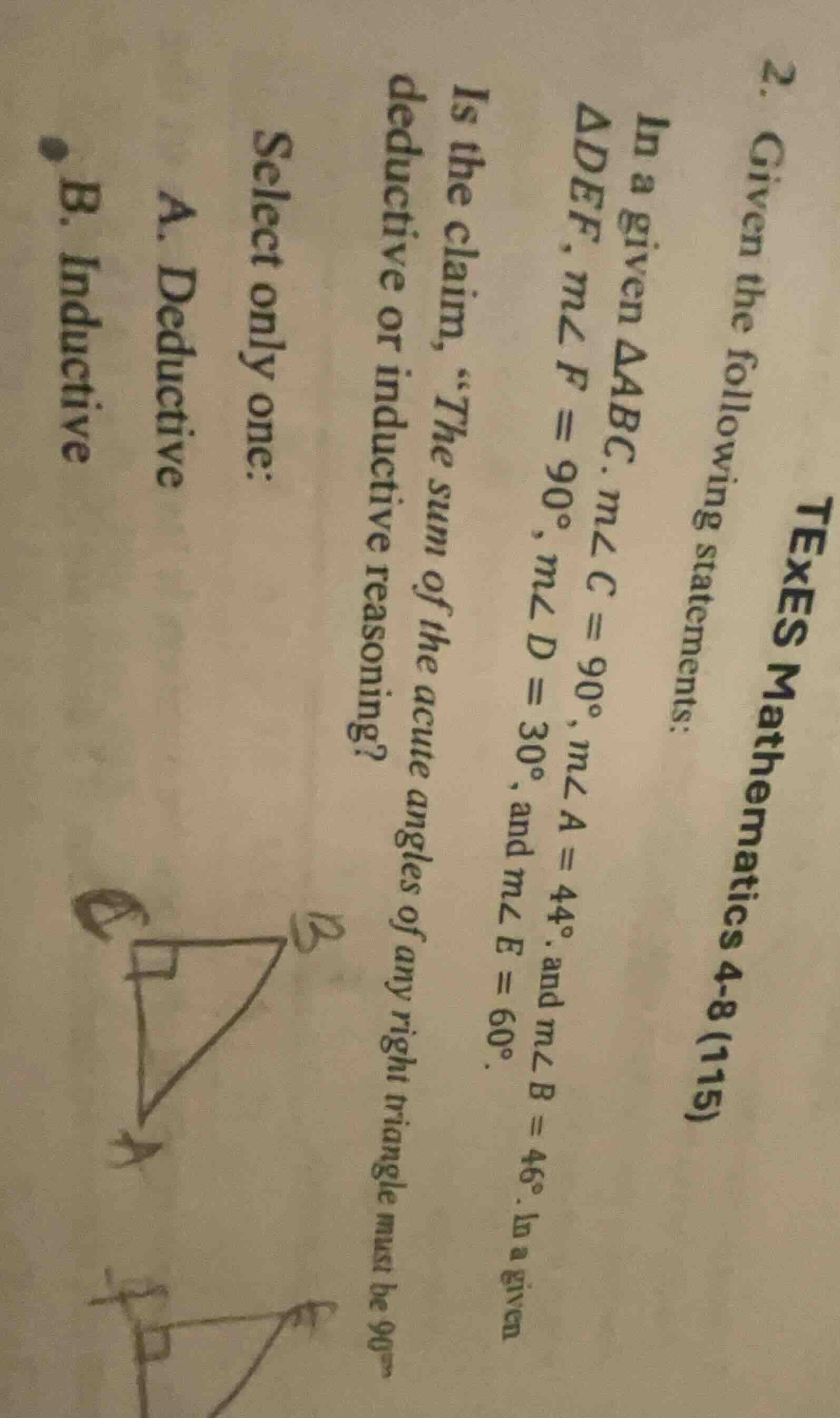
- given the following statements:
in a given \\(\delta abc\\), \\(m\angle c = 90^\circ\\), \\(m\angle a = 44^\circ\\), and \\(m\angle b = 46^\circ\\). in a given \\(\delta def\\), \\(m\angle f = 90^\circ\\), \\(m\angle d = 30^\circ\\), and \\(m\angle e = 60^\circ\\).
is the claim, \the sum of the acute angles of any right triangle must be \\(90^\circ\\)\ deductive or inductive reasoning?
select only one:
a. deductive
b. inductive
🆕 New Concept Discovered: Inductive vs. Deductive Reasoning
Using specific examples to form a general rule vs. using general rules to prove a specific case.
Step 1: Analyze the given statements
We are given specific measurements for two right triangles:
- In \(\triangle ABC\), \(m\angle C = 90^\circ\), \(m\angle A = 44^\circ\), and \(m\angle B = 46^\circ\).
- The sum of the acute angles is: \(44^\circ + 46^\circ = 90^\circ\).
- In \(\triangle DEF\), \(m\angle F = 90^\circ\), \(m\angle D = 30^\circ\), and \(m\angle E = 60^\circ\).
- The sum of the acute angles is: \(30^\circ + 60^\circ = 90^\circ\).
Step 2: Determine the type of reasoning used to make the claim
The claim is: "The sum of the acute angles of any right triangle must be \(90^\circ\)."
- Inductive reasoning starts with specific observations or examples (like \(\triangle ABC\) and \(\triangle DEF\)) and arrives at a general conclusion or rule.
- Deductive reasoning starts with general rules, facts, or definitions and applies them to a specific situation to prove it must be true.
Because the claim is a general rule formulated by observing specific examples, the reasoning used is inductive.

Snap & solve any problem in the app
Get step-by-step solutions on Sovi AI
Photo-based solutions with guided steps
Explore more problems and detailed explanations
B. Inductive