QUESTION IMAGE
Question
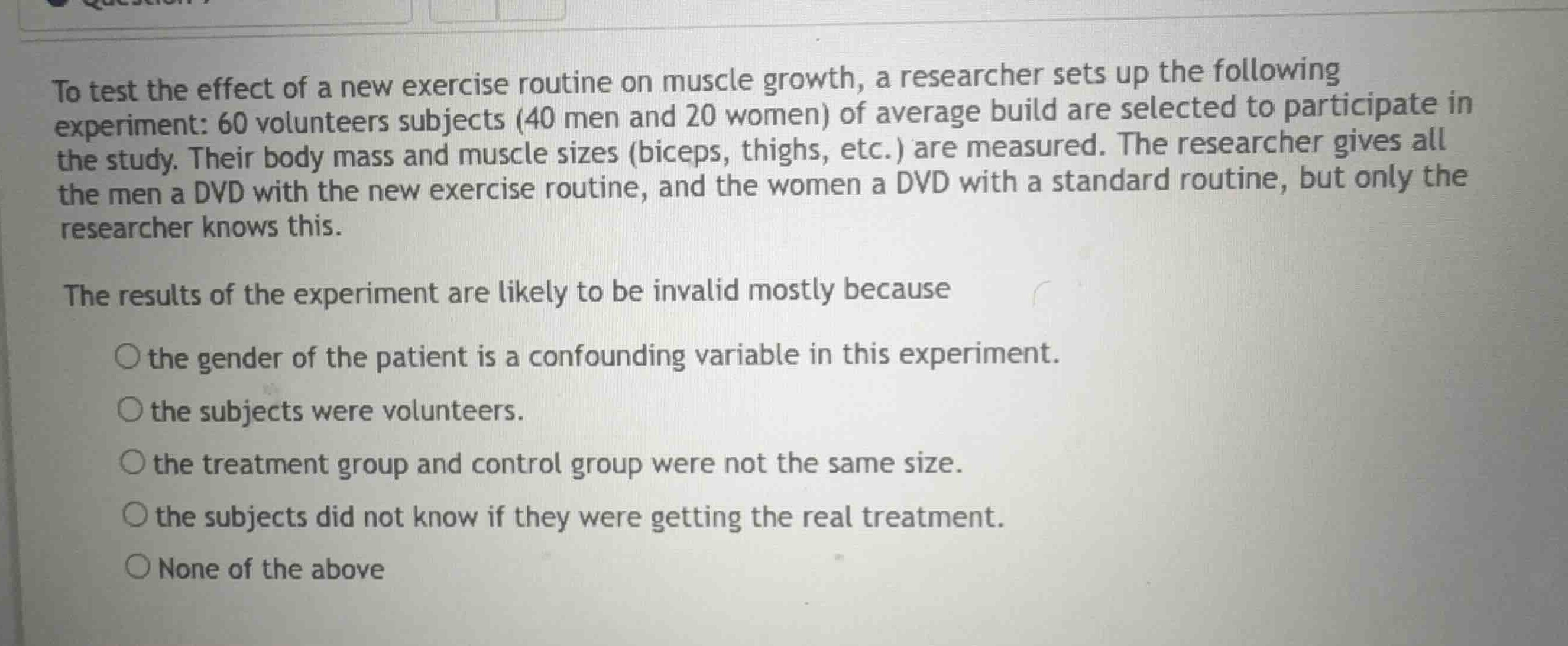
to test the effect of a new exercise routine on muscle growth, a researcher sets up the following experiment: 60 volunteers subjects (40 men and 20 women) of average build are selected to participate in the study. their body mass and muscle sizes (biceps, thighs, etc.) are measured. the researcher gives all the men a dvd with the new exercise routine, and the women a dvd with a standard routine, but only the researcher knows this.
the results of the experiment are likely to be invalid mostly because
the gender of the patient is a confounding variable in this experiment.
the subjects were volunteers.
the treatment group and control group were not the same size.
the subjects did not know if they were getting the real treatment.
none of the above
🆕 New Concept Discovered: Experimental Design and Confounding Variables
How hidden differences between groups can ruin an experiment.
Step 1: Analyze the experimental setup
The researcher wants to test the effect of a new exercise routine (the independent variable) on muscle growth (the dependent variable).
To do this, the researcher splits the 60 volunteers into two groups:
- Treatment Group (New Routine): 40 men
- Control Group (Standard Routine): 20 women
Step 2: Identify the flaw in group assignment
In a well-designed experiment, the treatment and control groups should be as similar as possible so that any observed difference in the outcome can be attributed solely to the treatment.
Here, the groups are divided entirely by gender:
- All men receive the new routine.
- All women receive the standard routine.
Because men and women naturally have different baseline physiological capacities for muscle growth (due to differences in hormones like testosterone, muscle fiber distribution, and baseline body composition), gender will influence the outcome of muscle growth independently of the exercise routine.
Step 3: Define the confounding variable
A confounding variable is an extra, uncontrolled variable that correlates with both the proposed cause and the proposed effect, making it impossible to determine which variable actually caused the outcome.
Because gender is completely entangled with the type of exercise routine:
- If the treatment group (men) shows more muscle growth, we cannot know if it was because of the new exercise routine or because of male physiology.
- Therefore, gender is a confounding variable that invalidates the experimental results.

Snap & solve any problem in the app
Get step-by-step solutions on Sovi AI
Photo-based solutions with guided steps
Explore more problems and detailed explanations
the gender of the patient is a confounding variable in this experiment.