QUESTION IMAGE
Question
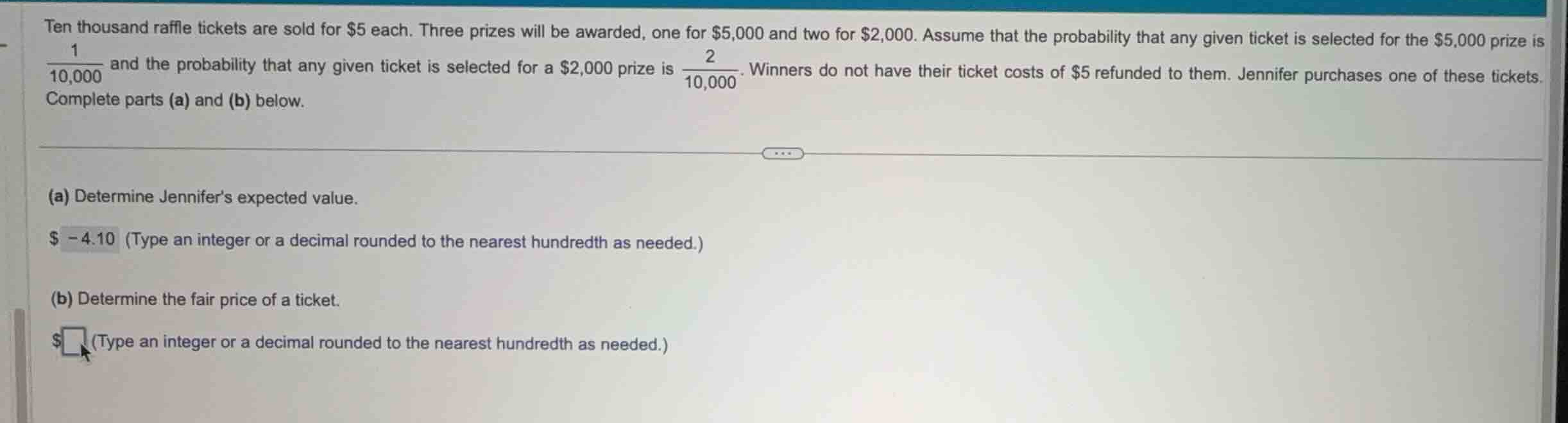
ten thousand raffle tickets are sold for \\$5 each. three prizes will be awarded, one for \\$5,000 and two for \\$2,000. assume that the probability that any given ticket is selected for the \\$5,000 prize is \\(\frac{1}{10,000}\\) and the probability that any given ticket is selected for a \\$2,000 prize is \LXI1. winners do not have their ticket costs of \\$5 refunded to them. jennifer purchases one of these tickets. complete parts (a) and (b) below.
(a) determine jennifers expected value.
\\$ -4.10 (type an integer or a decimal rounded to the nearest hundredth as needed.)
(b) determine the fair price of a ticket.
\\$ (type an integer or a decimal rounded to the nearest hundredth as needed.)
Define the random variable and outcomes
Using the Expected Value knowledge point
Let \(X\) represent the net payoff of purchasing one ticket.
- Ticket cost: \(\$5\)
- First prize outcome: net gain of \(\$5000 - \$5 = \$4995\) with probability \(P(X = 4995) = \frac{1}{10000}\)
- Second prize outcome: net gain of \(\$2000 - \$5 = \$1995\) with probability \(P(X = 1995) = \frac{2}{10000}\)
- No prize outcome: net loss of \(-\$5\) with probability \(P(X = -5) = 1 - \frac{1}{10000} - \frac{2}{10000} = \frac{9997}{10000}\)
Calculate the expected value
Using the Expected Value knowledge point
Calculate the fair price of a ticket
Using the Fair Price knowledge point

Snap & solve any problem in the app
Get step-by-step solutions on Sovi AI
Photo-based solutions with guided steps
Explore more problems and detailed explanations
Question 1
\( -4.10 \)
Question 2
\( 0.90 \)