QUESTION IMAGE
Question
systems of linear equations: mastery test
\\\
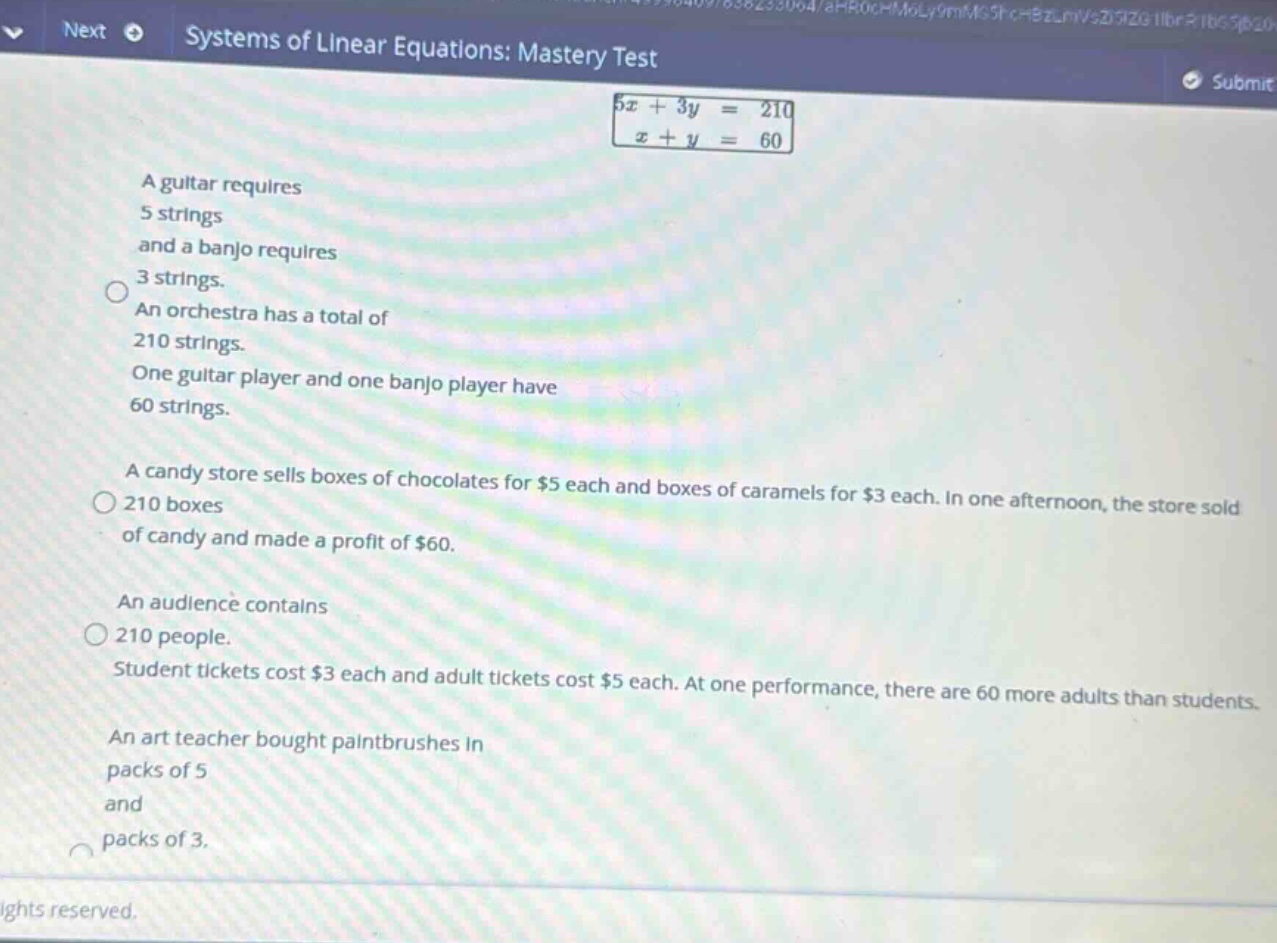
$$\begin{cases} 5x + 3y = 210 \\\\ x + y = 60 \\end{cases}$$
\\
- a guitar requires 5 strings and a banjo requires 3 strings. an orchestra has a total of 210 strings. one guitar player and one banjo player have 60 strings.
- a candy store sells boxes of chocolates for \\$5 each and boxes of caramels for \\$3 each. in one afternoon, the store sold 210 boxes of candy and made a profit of \\$60.
- an audience contains 210 people. student tickets cost \\$3 each and adult tickets cost \\$5 each. at one performance, there are 60 more adults than students.
- an art teacher bought paintbrushes in packs of 5 and packs of 3.
⚡ Using what you learned: introduction to systems of equations
Step 1: Analyze the system of equations
We are given the system:
$$
LATEXBLOCK0
$$
Here, \(x\) and \(y\) represent two unknown quantities.
- The second equation, \(x + y = 60\), means the sum of these two quantities is \(60\).
- The first equation, \(5x + 3y = 210\), means that when we multiply the first quantity by \(5\) and the second quantity by \(3\), the total is \(210\).
Step 2: Evaluate the first option
- Scenario: A guitar requires \(5\) strings and a banjo requires \(3\) strings. An orchestra has a total of \(210\) strings. One guitar player and one banjo player have \(60\) strings.
- Translation: Let \(x\) be the number of guitars and \(y\) be the number of banjos.
- Total strings: \(5x + 3y = 210\).
- The statement "One guitar player and one banjo player have \(60\) strings" does not translate to \(x + y = 60\) (which would mean the total number of instruments is \(60\)). This option is incorrect.
Step 3: Evaluate the second option
- Scenario: A candy store sells boxes of chocolates for \(\$5\) each and boxes of caramels for \(\$3\) each. In one afternoon, the store sold \(210\) boxes of candy and made a profit of \(\$60\).
- Translation: Let \(x\) be the number of chocolate boxes and \(y\) be the number of caramel boxes.
- Total boxes sold: \(x + y = 210\).
- Total profit/revenue: \(5x + 3y = 60\).
- This reverses the constants (\(210\) and \(60\)) compared to our system. This option is incorrect.
Step 4: Evaluate the third option
- Scenario: An audience contains \(210\) people. Student tickets cost \(\$3\) each and adult tickets cost \(\$5\) each. At one performance, there are \(60\) more adults than students.
- Translation: Let \(x\) be the number of adults and \(y\) be the number of students.
- Total people: \(x + y = 210\).
- "There are \(60\) more adults than students": \(x = y + 60\).
- This does not match our system. This option is incorrect.
Step 5: Evaluate the fourth option (partially cut off)
- Scenario: An art teacher bought paintbrushes in packs of \(5\) and packs of \(3\).
- Complete context: Let \(x\) be the number of packs of \(5\) paintbrushes and \(y\) be the number of packs of \(3\) paintbrushes.
- Total paintbrushes bought: \(5x + 3y = 210\).
- Total number of packs bought: \(x + y = 60\).
- This perfectly matches both equations in the system:
$$
LATEXBLOCK1
$$

Snap & solve any problem in the app
Get step-by-step solutions on Sovi AI
Photo-based solutions with guided steps
Explore more problems and detailed explanations
The correct option is the fourth one:
An art teacher bought paintbrushes in packs of 5 and packs of 3... (representing a total of 60 packs and 210 paintbrushes).