QUESTION IMAGE
Question
surveys, experiments, and data: practice
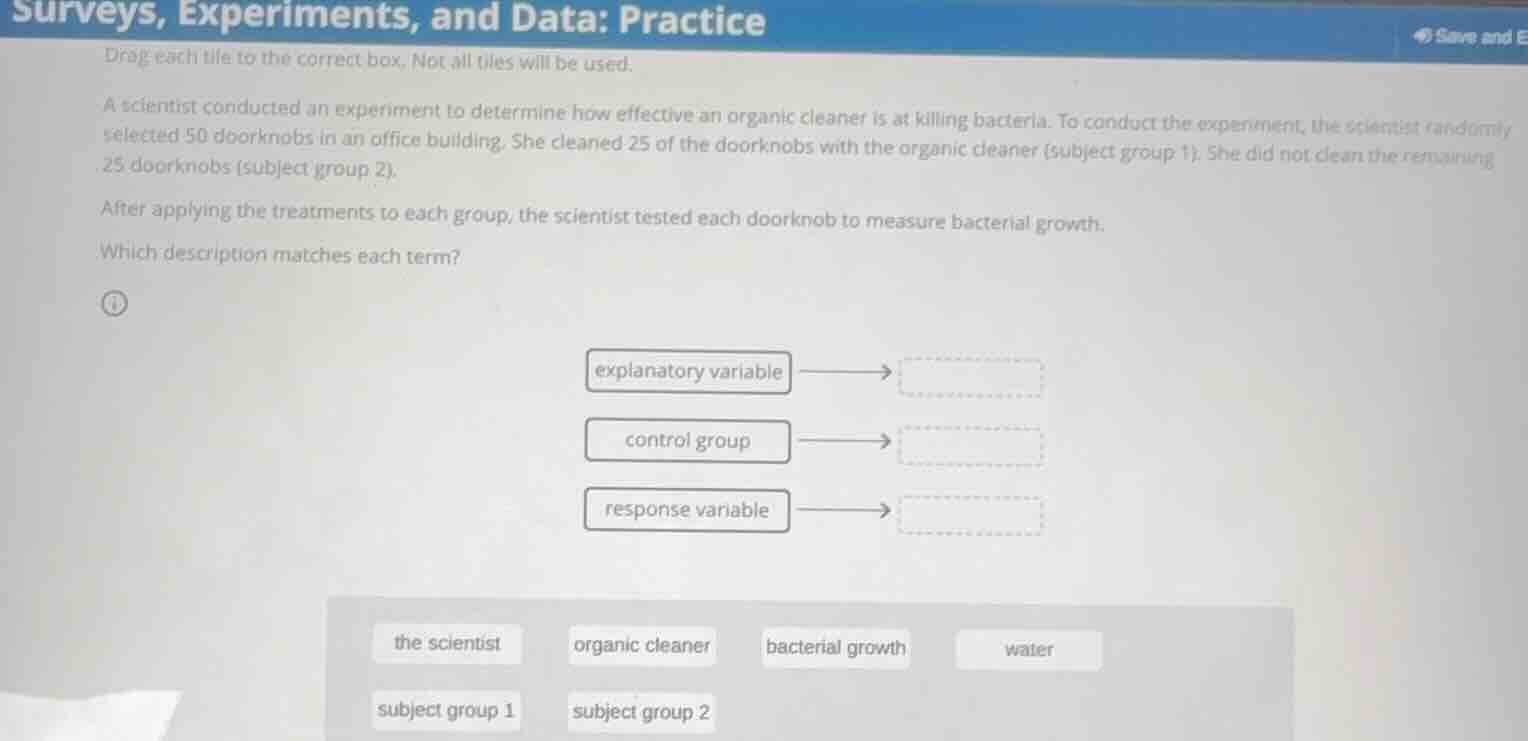
drag each tile to the correct box. not all tiles will be used.
a scientist conducted an experiment to determine how effective an organic cleaner is at killing bacteria. to conduct the experiment, the scientist randomly selected 50 doorknobs in an office building. she cleaned 25 of the doorknobs with the organic cleaner (subject group 1). she did not clean the remaining 25 doorknobs (subject group 2).
after applying the treatments to each group, the scientist tested each doorknob to measure bacterial growth.
which description matches each term?
explanatory variable ->
control group ->
response variable ->
tiles:
the scientist
organic cleaner
bacterial growth
water
subject group 1
subject group 2
Identify the explanatory variable
Using the Experimental Design knowledge point, the explanatory variable is the factor manipulated by the researcher to observe its effect. Here, the scientist applies or does not apply the organic cleaner. Thus, the explanatory variable is the organic cleaner.
Identify the control group
Using the Experimental Design knowledge point, the control group is the group of subjects that does not receive the active treatment to serve as a baseline. The problem states that the scientist did not clean the remaining 25 doorknobs, which is designated as subject group 2. Thus, the control group is subject group 2.
Identify the response variable
Using the Experimental Design knowledge point, the response variable is the outcome measured to see how it responds to the treatment. The scientist measures the bacterial growth on each doorknob. Thus, the response variable is bacterial growth.

Snap & solve any problem in the app
Get step-by-step solutions on Sovi AI
Photo-based solutions with guided steps
Explore more problems and detailed explanations
- explanatory variable $
ightarrow$ organic cleaner
- control group $
ightarrow$ subject group 2
- response variable $
ightarrow$ bacterial growth