QUESTION IMAGE
Question
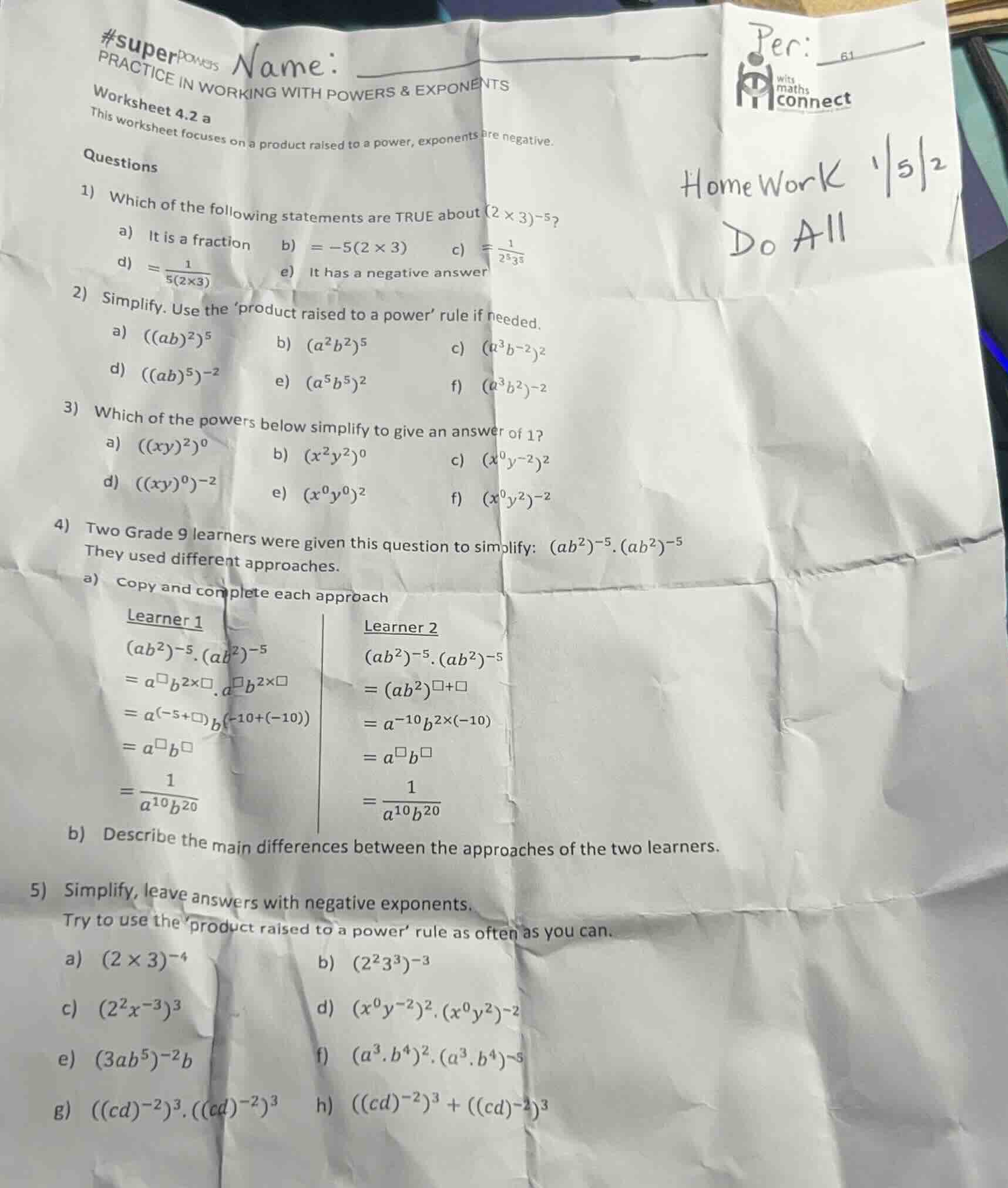
#superpowers practice in working with powers & exponents worksheet 4.2 a this worksheet focuses on a product raised to a power, exponents are negative. questions 1) which of the following statements are true about $(2 \times 3)^{-5}$? a) it is a fraction b) $ = -5(2 \times 3)$ c) $ = \frac{1}{2^5 3^5}$ d) $ = \frac{1}{5(2 \times 3)}$ e) it has a negative answer 2) simplify. use the ‘product raised to a power’ rule if needed. a) $((ab)^2)^5$ b) $(a^2 b^2)^5$ c) $(a^3 b^{-2})^2$ d) $((ab)^5)^{-2}$ e) $(a^5 b^5)^2$ f) $(a^3 b^2)^{-2}$ 3) which of the powers below simplify to give an answer of 1? a) $((xy)^2)^0$ b) $(x^2 y^2)^0$ c) $(x^0 y^{-2})^2$ d) $((xy)^0)^{-2}$ e) $(x^0 y^0)^2$ f) $(x^0 y^2)^{-2}$ 4) two grade 9 learners were given this question to simplify: $(ab^2)^{-5} \cdot (ab^2)^{-5}$ they used different approaches. a) copy and complete each approach learner 1 learner 2 $(ab^2)^{-5} \cdot (ab^2)^{-5}$ $(ab^2)^{-5} \cdot (ab^2)^{-5}$ $ = a^{\square} b^{2 \times \square} \cdot a^{\square} b^{2 \times \square}$ $ = (ab^2)^{\square + \square}$ $ = a^{(-5 + \square)} b^{(-10 + (-10))}$ $ = a^{-10} b^{2 \times (-10)}$ $ = a^{\square} b^{\square}$ $ = a^{\square} b^{\square}$ $ = \frac{1}{a^{10} b^{20}}$ $ = \frac{1}{a^{10} b^{20}}$ b) describe the main differences between the approaches of the two learners. 5) simplify, leave answers with negative exponents. try to use the ‘product raised to a power’ rule as often as you can. a) $(2 \times 3)^{-4}$ b) $(2^2 3^3)^{-3}$ c) $(2^2 x^{-3})^3$ d) $(x^0 y^{-2})^2 \cdot (x^0 y^2)^{-2}$ e) $(3ab^5)^{-2} b$ f) $(a^3 \cdot b^4)^2 \cdot (a^3 \cdot b^4)^{-5}$ g) $((cd)^{-2})^3 \cdot ((cd)^{-2})^3$ h) $((cd)^{-2})^3 + ((cd)^{-2})^3$
Question 1: Analyze \(\boldsymbol{(2 \times 3)^{-5}}\)
Step 1: Recall negative exponent rule
The rule for negative exponents is \(a^{-n}=\frac{1}{a^{n}}\) (where \(a
eq0\) and \(n\) is a positive integer). Also, \((ab)^n = a^n b^n\) (product - to - power rule). For \((2\times3)^{-5}\), first, we know that \(2\times3 = 6\), so \((2\times3)^{-5}=6^{-5}\). Using the negative exponent rule, \(6^{-5}=\frac{1}{6^{5}}\). But \(6 = 2\times3\), so \(6^{5}=(2\times3)^{5}=2^{5}\times3^{5}\) (by the product - to - power rule \((ab)^n=a^{n}b^{n}\)). So \((2\times3)^{-5}=\frac{1}{2^{5}\times3^{5}}\).
- Option a: Since \((2\times3)^{-5}=\frac{1}{2^{5}\times3^{5}}\), it is a fraction. So option a is true.
- Option b: The expression \(- 5(2\times3)\) is equal to \(-30\), while \((2\times3)^{-5}=\frac{1}{2^{5}\times3^{5}}
eq - 30\). So option b is false.
- Option c: As we derived above, \((2\times3)^{-5}=\frac{1}{2^{5}\times3^{5}}\). So option c is true.
- Option d: \(\frac{1}{5(2\times3)}=\frac{1}{30}\), and \((2\times3)^{-5}=\frac{1}{2^{5}\times3^{5}}=\frac{1}{7776}
eq\frac{1}{30}\). So option d is false.
- Option e: \((2\times3)^{-5}=\frac{1}{2^{5}\times3^{5}}\), which is a positive number (since it is a reciprocal of a positive number). So option e is false.
Step 1: Recall power - of - a - power rule
The power - of - a - power rule states that \((a^{m})^{n}=a^{m\times n}\). For \(((ab)^{2})^{5}\), let \(a = ab\), \(m = 2\) and \(n = 5\).
Using the power - of - a - power rule \((a^{m})^{n}=a^{m\times n}\), we have \(((ab)^{2})^{5}=(ab)^{2\times5}\)
Step 2: Simplify the exponent
\(2\times5 = 10\), so \((ab)^{2\times5}=(ab)^{10}\)
Step 3: Apply product - to - power rule
Using the product - to - power rule \((ab)^{n}=a^{n}b^{n}\), \((ab)^{10}=a^{10}b^{10}\)
Step 1: Apply product - to - power rule
The product - to - power rule is \((ab)^{n}=a^{n}b^{n}\). For \((a^{2}b^{2})^{5}\), we can apply this rule. Let \(a = a^{2}\), \(b = b^{2}\) and \(n = 5\).
So \((a^{2}b^{2})^{5}=(a^{2})^{5}(b^{2})^{5}\)
Step 2: Apply power - of - a - power rule
Using the power - of - a - power rule \((a^{m})^{n}=a^{m\times n}\), \((a^{2})^{5}=a^{2\times5}=a^{10}\) and \((b^{2})^{5}=b^{2\times5}=b^{10}\)
Step 3: Combine the results
\((a^{2})^{5}(b^{2})^{5}=a^{10}b^{10}\)

Snap & solve any problem in the app
Get step-by-step solutions on Sovi AI
Photo-based solutions with guided steps
Explore more problems and detailed explanations
The true statements are a) It is a fraction and c) \(=\frac{1}{2^{5}3^{5}}\)