QUESTION IMAGE
Question
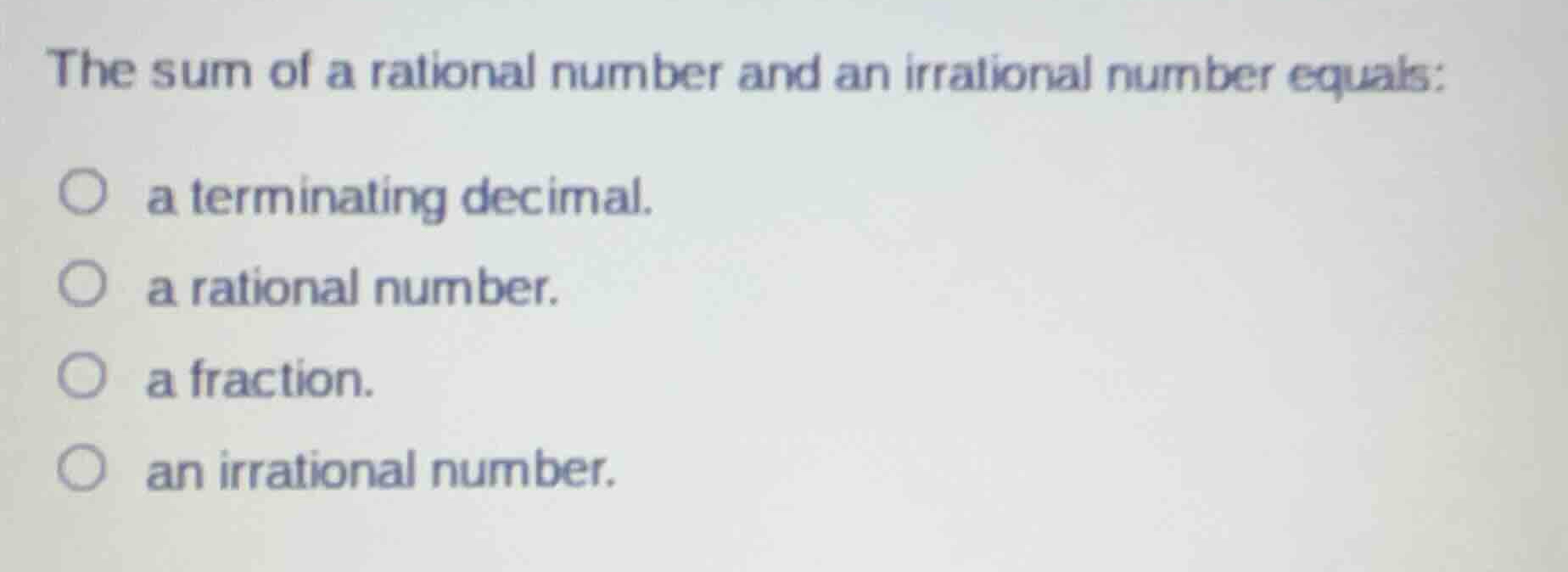
the sum of a rational number and an irrational number equals:
a terminating decimal.
a rational number.
a fraction.
an irrational number.
Define the algebraic representation of the sum
Let \(r\) be a rational number and \(i\) be an irrational number. Assume their sum is a rational number \(q\):
$$r + i = q$$
Analyze the assumption using algebraic properties
Subtract \(r\) from both sides to isolate \(i\):
$$i = q - r$$
Since the difference of two rational numbers (\(q\) and \(r\)) must be rational, this implies \(i\) is rational, which contradicts the given fact that \(i\) is irrational.
Determine the correct classification
The assumption that the sum is rational leads to a contradiction. Therefore, the sum must be an irrational number.

Snap & solve any problem in the app
Get step-by-step solutions on Sovi AI
Photo-based solutions with guided steps
Explore more problems and detailed explanations
- a terminating decimal.
- a rational number.
- a fraction.
- an irrational number. (Correct answer)