QUESTION IMAGE
Question
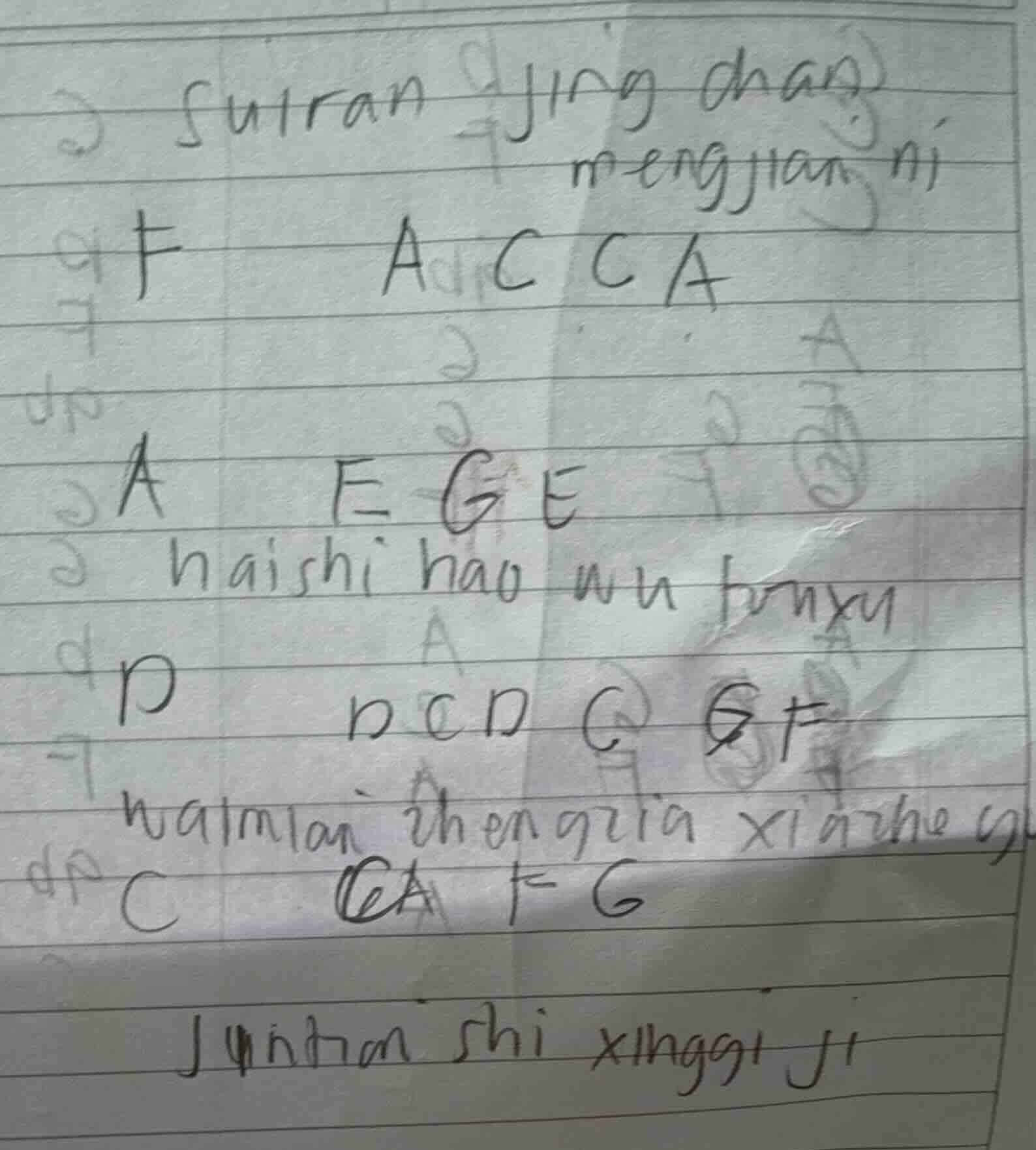
suiran jing chang mengjian ni
a c c a
a e g e
haishi hao wu touxu
d d c d c g f
waimian zhengzai xiazhe yu
c c a f g
jintian shi xingqi ji
🆕 New Concept Discovered: Cipher Decryption with Musical Notes
Mapping letters to musical pitches or scale degrees to decode hidden text.
Step 1: Transcribe the Pinyin text and letters
Let's write down the handwritten text line by line to understand the structure. The text consists of Chinese Pinyin sentences with capital letters written underneath or around them, along with some musical symbols (like clefs or accidentals) on the left margin.
- Line 1 (Pinyin):
suiran jingchang mengjian ni(虽然经常梦见你 - Although I often dream of you) - Line 2 (Letters):
F A C C A(with a treble clef symbol on the left) - Line 3 (Letters):
A E G E(with a treble clef symbol on the left) - Line 4 (Pinyin):
haishi hao wu touxu(还是毫无头绪 - Still have no clue) - Line 5 (Letters):
D D C D C G F(with a bass clef symbol on the left) - Line 6 (Pinyin):
waimian zhengzai xiazhe yu(外面正在下着雨 - It is raining outside) - Line 7 (Letters):
C C A F G(with a bass clef symbol on the left) - Line 8 (Pinyin):
jintian shi xingqi ji(今天是星期几 - What day of the week is it today?)
Step 2: Analyze the musical notes
The letters written are: A, C, D, E, F, G. These correspond to musical notes.
The symbols on the left margin represent musical clefs:
- The symbol next to
FandAlooks like a Treble Clef (\(\oint\)). - The symbol next to
DandClooks like a Bass Clef (\(9:\) or \(\mathcal{F}\) clef).
Let's treat these letters as musical notes and find their corresponding scale degrees or solfège syllables in the key of C Major (where C = 1, D = 2, E = 3, F = 4, G = 5, A = 6, B = 7):
- Line 2:
F A C C A\(
ightarrow\) 4, 6, 1, 1, 6
- Line 3:
A E G E\(
ightarrow\) 6, 3, 5, 3
- Line 5:
D D C D C G F\(
ightarrow\) 2, 2, 1, 2, 1, 5, 4
- Line 7:
C C A F G\(
ightarrow\) 1, 1, 6, 4, 5
Step 3: Match the notes to the Pinyin syllables
Let's look at the number of syllables in each Pinyin line and compare them to the number of musical notes:
- Pinyin:
sui-ran jing-chang meng-jian ni(7 syllables)
- Notes:
F A C C A(5 notes) +A E G E(4 notes) = 9 notes total. - Let's look closer at the alignment:
suiranhasFunder it.jingchanghasA C C Aunder it.mengjian nihasA E G Eunder it.- Total syllables: 7. Total notes: 9. This suggests a direct mapping of notes to a numerical code rather than a 1-to-1 syllable match, or it represents a specific melody.
Let's hum or play the melody represented by these notes:
- Melody:
F - A - C - C - AA - E - G - ED - D - C - D - C - G - FC - C - A - F - G
This melody is the famous opening theme of the Mandopop song "Love Confession" (告白气球 - Gàobái Qìqiú) by Jay Chou (周杰伦)!
Let's verify the lyrics of "Love Confession":
- "塞纳河畔 左岸的咖啡" (Sāinà hépàn zuǒ'àn de kāfēi) \(
ightarrow\) The Pinyin in the image is a parody/alternative lyrics written to the exact same rhythm and melody:
- Original:
Sai-na he-pan zuo-an de ka-fei(9 syllables) - Image:
Sui-ran jing-chang meng-jian ni(7 syllables, sung to the same melody notes:F A C C A A E G E) - Original:
wo shou-zhi yi-bei wen-nuan de ma-qi-duo(11 syllables) - Image:
hai-shi hao wu tou-xu(6 syllables, sung to the melody notes:D D C D C G F) - Original:
wen tou-xiang de de-shuang-shuang... - Image:
wai-mian zheng-zai xia-zhe yu(7 syllables, sung to the melody notes:C C A F G)
Step 4: Solve the final question
The final line asks:jintian shi xingqi ji (今天是星期几 - What day…

Snap & solve any problem in the app
Get step-by-step solutions on Sovi AI
Photo-based solutions with guided steps
Explore more problems and detailed explanations
星期五 (Friday)