QUESTION IMAGE
Question
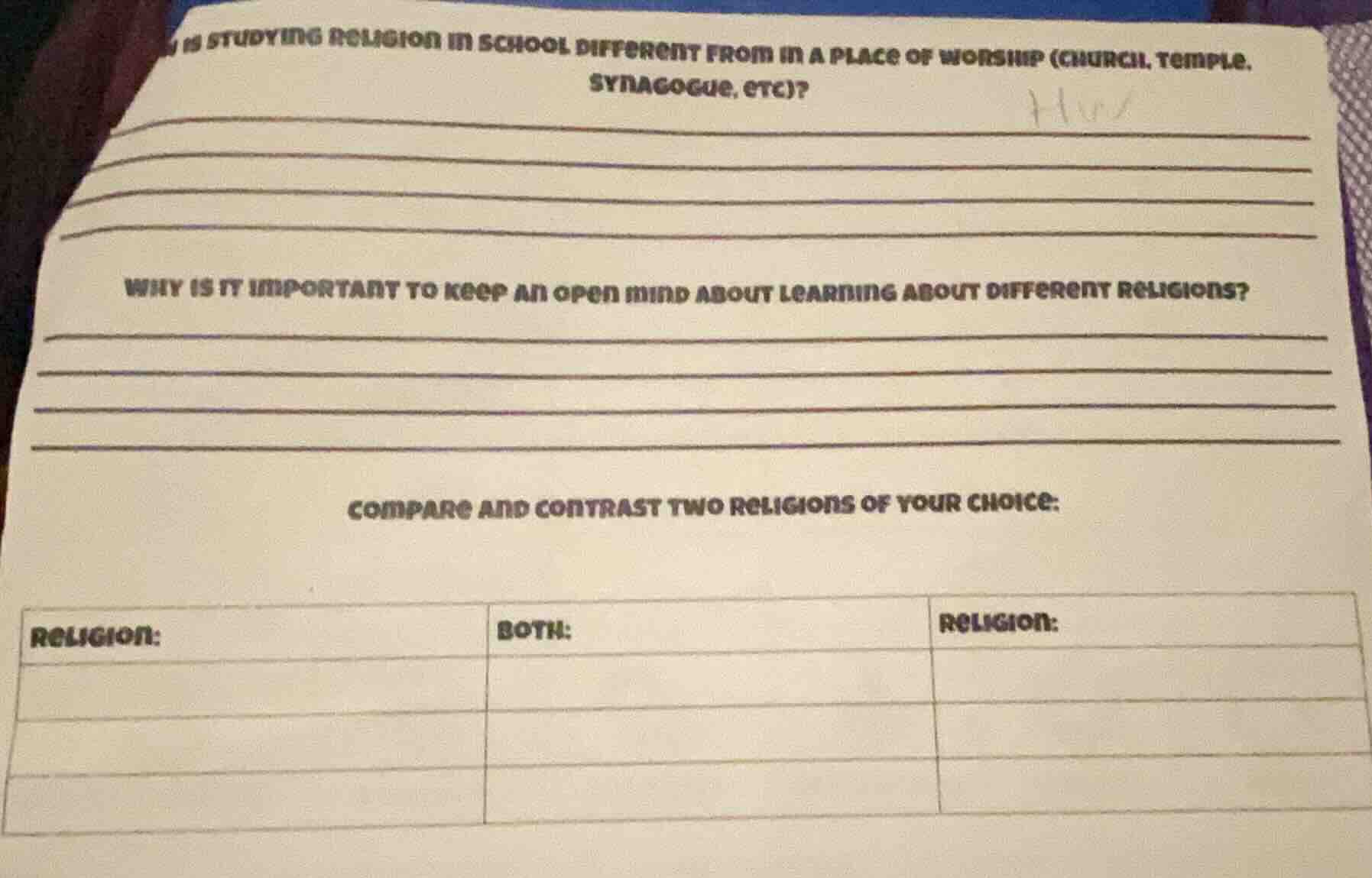
is studying religion in school different from in a place of worship (church, temple, synagogue, etc)?
why is it important to keep an open mind about learning about different religions?
compare and contrast two religions of your choice:
religion: \t both: \t religion:
- For the first question: School religious study is objective, academic, and covers multiple faiths, while worship spaces focus on practicing and deepening one specific tradition's beliefs and rituals.
- For the second question: An open mind fosters cultural understanding, reduces prejudice, builds empathy, and helps navigate diverse global communities respectfully.
- For the comparison table: Christianity and Islam are chosen as they have shared Abrahamic roots but distinct key tenets.

Snap & solve any problem in the app
Get step-by-step solutions on Sovi AI
Photo-based solutions with guided steps
Explore more problems and detailed explanations
- Is studying religion in school different from in a place of worship?
Yes. School study is neutral, academic, and examines multiple religions to teach context and diversity. Places of worship center on practicing, celebrating, and deepening commitment to a single faith's doctrines and communal rituals.
- Why is it important to keep an open mind about learning about different religions?
It reduces bias and discrimination, builds empathy for diverse communities, enhances cross-cultural communication skills, and provides context for global history, politics, and culture.
- Compare and contrast two religions of your choice:
| Religion: Christianity | Both: | Religion: Islam |
|---|---|---|
| Sacred text is the Bible (Old + New Testaments) | Have core moral codes (e.g., compassion, charity) | Sacred text is the Quran (and Hadith) |
| Central figure is Jesus Christ, seen as divine | Grew in the Middle East, global followings | Central figure is the Prophet Muhammad, seen as a final messenger |