QUESTION IMAGE
Question
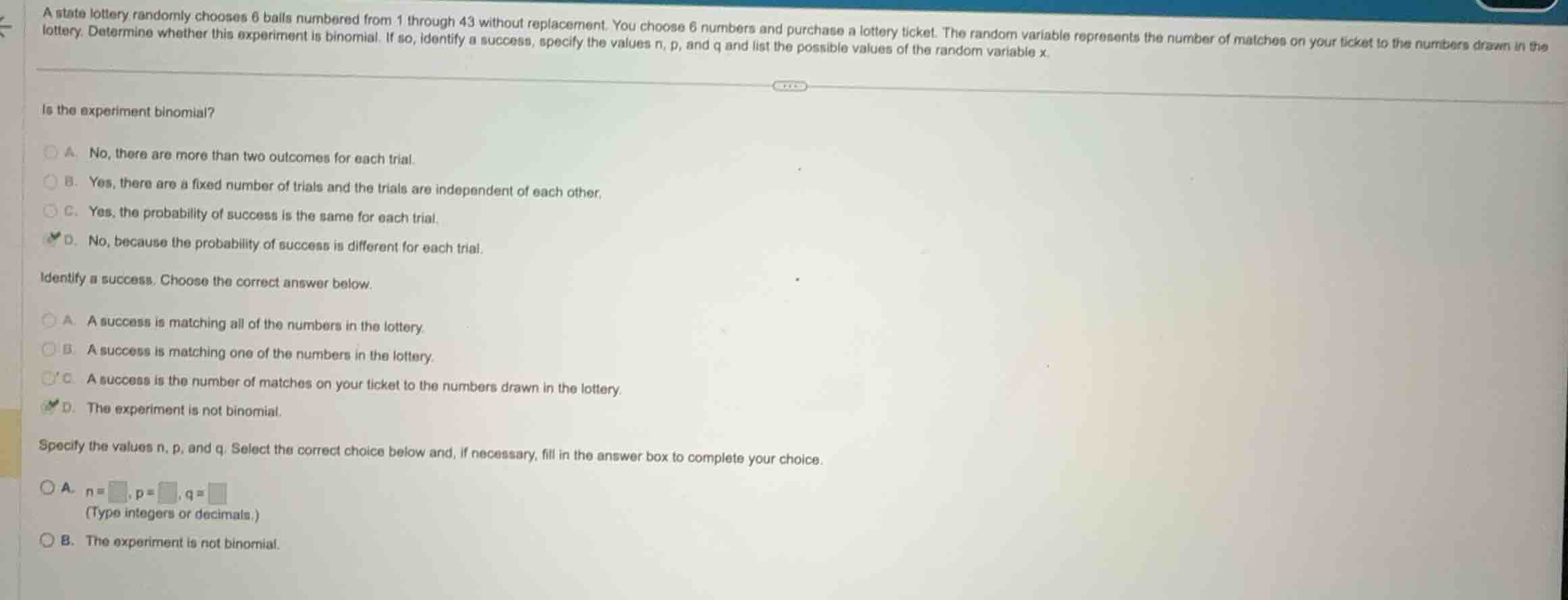
a state lottery randomly chooses 6 balls numbered from 1 through 43 without replacement. you choose 6 numbers and purchase a lottery ticket. the random variable represents the number of matches on your ticket to the numbers drawn in the lottery. determine whether this experiment is binomial. if so, identify a success, specify the values n, p, and q and list the possible values of the random variable x.
is the experiment binomial?
a. no, there are more than two outcomes for each trial.
b. yes, there are a fixed number of trials and the trials are independent of each other.
c. yes, the probability of success is the same for each trial.
d. no, because the probability of success is different for each trial.
identify a success. choose the correct answer below.
a. a success is matching all of the numbers in the lottery.
b. a success is matching one of the numbers in the lottery.
c. a success is the number of matches on your ticket to the numbers drawn in the lottery.
d. the experiment is not binomial.
specify the values n, p, and q. select the correct choice below and, if necessary, fill in the answer box to complete your choice.
a. \\(n = \square\\), \\(p = \square\\), \\(q = \square\\)
(type integers or decimals.)
b. the experiment is not binomial.
Analyze the experiment conditions
The lottery selects 6 balls from 43 without replacement. Because the selection is done without replacement, the trials (selections of individual numbers) are dependent, meaning the probability of matching a number changes with each draw. Thus, the experiment is hypergeometric rather than binomial.
Evaluate the first question
Since the trials are dependent (without replacement), the probability of success is different for each trial. This matches option D: "No, because the probability of success is different for each trial."
Evaluate the second and third questions
Since the experiment is determined to be not binomial in the first part, the subsequent questions regarding identifying a success and specifying binomial parameters \(n\), \(p\), and \(q\) must reflect this. For both parts, the correct choice is that the experiment is not binomial (Option D for the second part, and Option B for the third part).

Snap & solve any problem in the app
Get step-by-step solutions on Sovi AI
Photo-based solutions with guided steps
Explore more problems and detailed explanations
Question 1
- (A) No, there are more than two outcomes for each trial.
- (B) Yes, there are a fixed number of trials and the trials are independent of each other.
- (C) Yes, the probability of success is the same for each trial.
- (D) No, because the probability of success is different for each trial. (Correct answer)
Question 2
- (A) A success is matching all of the numbers in the lottery.
- (B) A success is matching one of the numbers in the lottery.
- (C) A success is the number of matches on your ticket to the numbers drawn in the lottery.
- (D) The experiment is not binomial. (Correct answer)
Question 3
- (A) \(n =\) [ ], \(p =\) [ ], \(q =\) [ ]
- (B) The experiment is not binomial. (Correct answer)