QUESTION IMAGE
Question
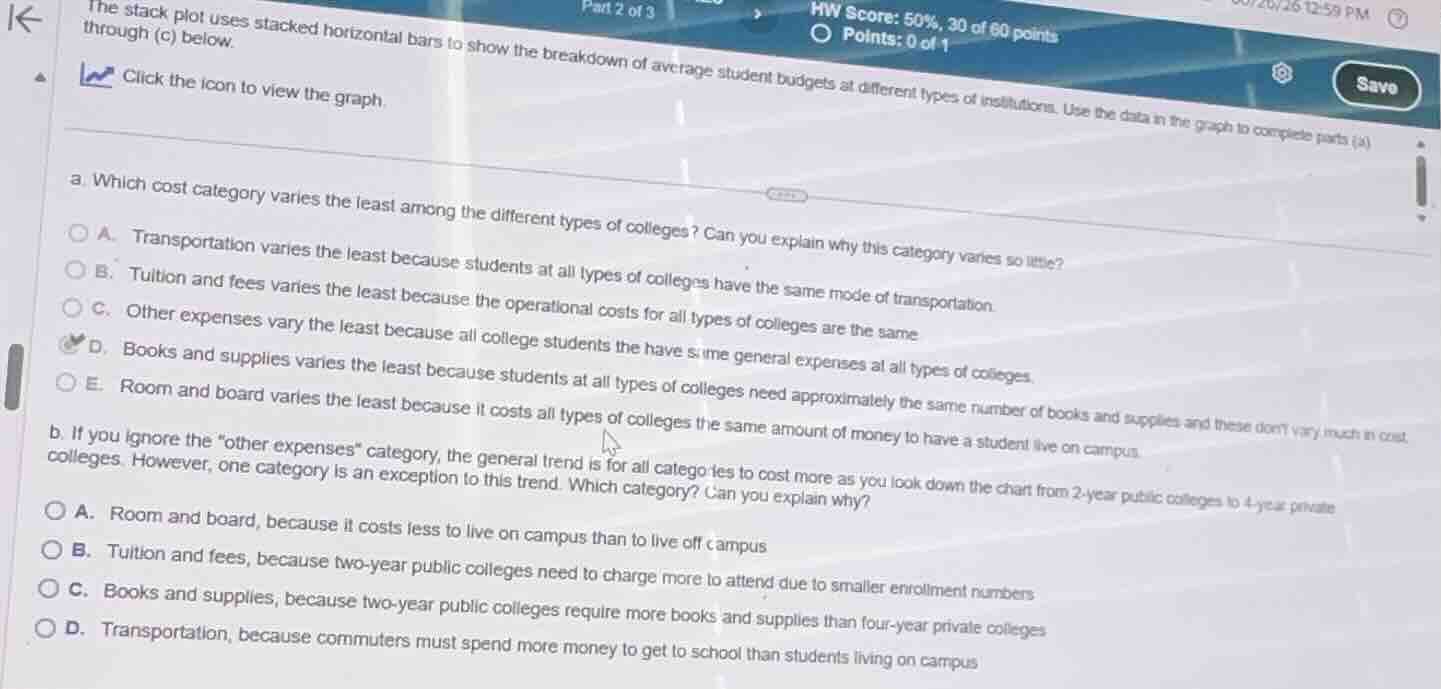
the stack plot uses stacked horizontal bars to show the breakdown of average student budgets at different types of institutions. use the data in the graph to complete parts (a) through (c) below.
click the icon to view the graph.
a. which cost category varies the least among the different types of colleges? can you explain why this category varies so little?
a. transportation varies the least because students at all types of colleges have the same mode of transportation.
b. tuition and fees varies the least because the operational costs for all types of colleges are the same.
c. other expenses vary the least because all college students have some general expenses at all types of colleges.
d. books and supplies varies the least because students at all types of colleges need approximately the same number of books and supplies and these dont vary much in cost.
e. room and board varies the least because it costs all types of colleges the same amount of money to have a student live on campus.
b. if you ignore the \other expenses\ category, the general trend is for all categories to cost more as you look down the chart from 2-year public colleges to 4-year private colleges. however, one category is an exception to this trend. which category? can you explain why?
a. room and board, because it costs less to live on campus than to live off campus
b. tuition and fees, because two-year public colleges need to charge more to attend due to smaller enrollment numbers
c. books and supplies, because two-year public colleges require more books and supplies than four-year private colleges
d. transportation, because commuters must spend more money to get to school than students living on campus
Analyze cost variation among categories
Using the Cost Variation Analysis knowledge point
- Books and supplies vary the least because students at all types of colleges need approximately the same number of books and supplies, and these don't vary much in cost.
- Other categories like tuition, room and board, and transportation depend heavily on the specific institution type (e.g., public vs. private, commuter vs. residential).
Identify the exception to the general cost trend
Using the Cost Variation Analysis knowledge point
- The general trend shows costs increasing from 2-year public to 4-year private colleges.
- Transportation is the exception because commuters at 2-year public colleges often spend more on travel than students living on campus at 4-year private colleges.

Snap & solve any problem in the app
Get step-by-step solutions on Sovi AI
Photo-based solutions with guided steps
Explore more problems and detailed explanations
Question 1
- (A) Transportation varies the least because students at all types of colleges have the same mode of transportation.
- (B) Tuition and fees varies the least because the operational costs for all types of colleges are the same.
- (C) Other expenses vary the least because all college students have the same general expenses at all types of colleges.</mcq-correct>
- (D) Books and supplies varies the least because students at all types of colleges need approximately the same number of books and supplies and these don't vary much in cost. (Correct answer)
<mcq-option>(E) Room and board varies the least because it costs all types of colleges the same amount of money to have a student live on campus.
Question 2
- (A) Room and board, because it costs less to live on campus than to live off campus
- (B) Tuition and fees, because two-year public colleges need to charge more to attend due to smaller enrollment numbers
- (C) Books and supplies, because two-year public colleges require more books and supplies than four-year private colleges
- (D) Transportation, because commuters must spend more money to get to school than students living on campus (Correct answer)