QUESTION IMAGE
Question
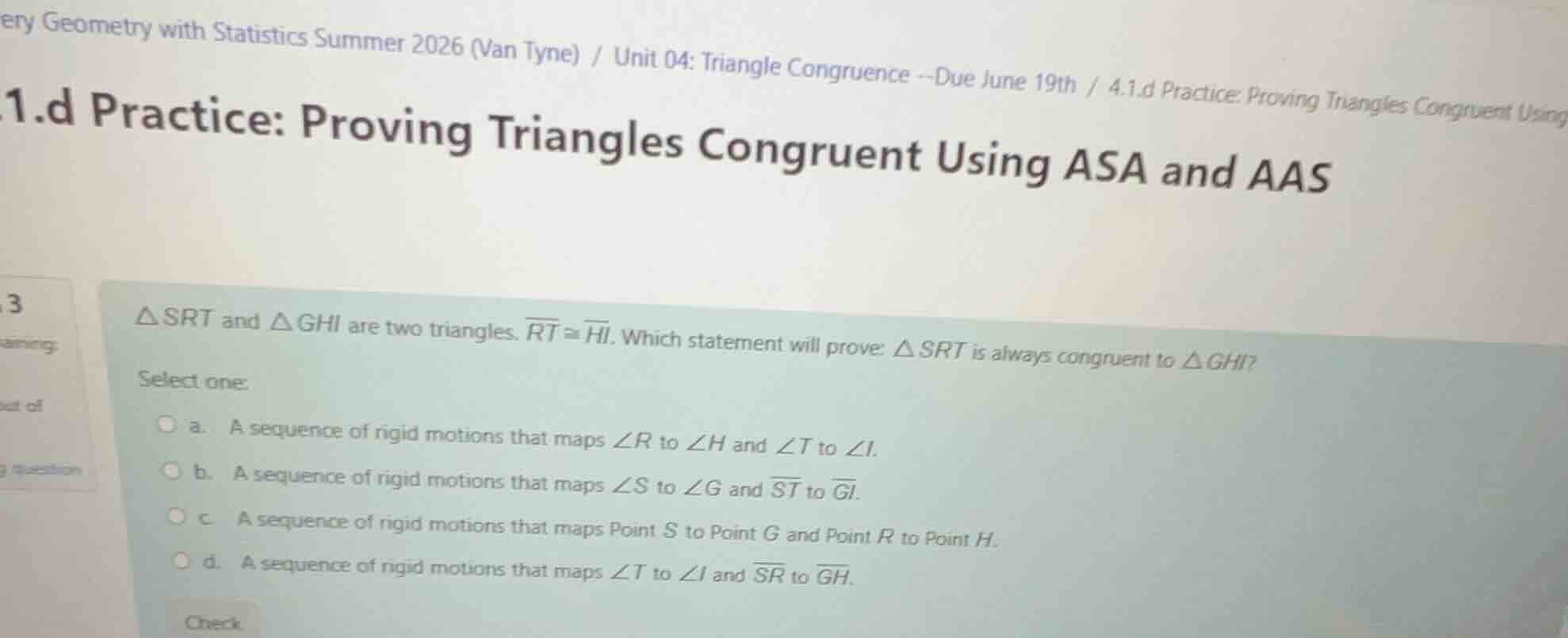
\delta srt and \delta ghi are two triangles. \overline{rt} \cong \overline{hi}. which statement will prove \delta srt is always congruent to \delta ghi?
select one:
a. a sequence of rigid motions that maps \angle r to \angle h and \angle t to \angle i.
b. a sequence of rigid motions that maps \angle s to \angle g and \overline{st} to \overline{gi}.
c. a sequence of rigid motions that maps point s to point g and point r to point h.
d. a sequence of rigid motions that maps \angle t to \angle i and \overline{sr} to \overline{gh}.
⚡ Using what you learned: congruence criteria for triangles (sss, sas, asa, aas, hl)
Step 1: Analyze the Given Information
We are given two triangles, \(\Delta SRT\) and \(\Delta GHI\), with one pair of congruent corresponding sides:
We need to find which additional condition, mapped via rigid motions (which preserve angle measures and segment lengths), guarantees that \(\Delta SRT \cong \Delta GHI\).
Step 2: Evaluate the Options
- Option a: Maps \(\angle R\) to \(\angle H\) and \(\angle T\) to \(\angle I\).
- This gives \(\angle R \cong \angle H\) and \(\angle T \cong \angle I\).
- Together with the given side \(\overline{RT} \cong \overline{HI}\), the congruent side is included between the two pairs of congruent angles.
- This satisfies the Angle-Side-Angle (ASA) congruence criterion:
- Therefore, this statement proves \(\Delta SRT \cong \Delta GHI\).
- Option b: Maps \(\angle S\) to \(\angle G\) and \(\overline{ST}\) to \(\overline{GI}\).
- This gives \(\angle S \cong \angle G\) and \(\overline{ST} \cong \overline{GI}\).
- Along with \(\overline{RT} \cong \overline{HI}\), this corresponds to Side-Side-Angle (SSA), which is not a valid congruence criterion.
- Option c: Maps Point \(S\) to Point \(G\) and Point \(R\) to Point \(H\).
- This only establishes correspondence of vertices and does not provide enough congruent parts to satisfy any congruence criteria.
- Option d: Maps \(\angle T\) to \(\angle I\) and \(\overline{SR}\) to \(\overline{GH}\).
- This gives \(\angle T \cong \angle I\) and \(\overline{SR} \cong \overline{GH}\).
- Along with \(\overline{RT} \cong \overline{HI}\), this corresponds to Side-Angle-Side (SAS) but with the angle not properly included between the sides for both triangles in the correct correspondence order.

Snap & solve any problem in the app
Get step-by-step solutions on Sovi AI
Photo-based solutions with guided steps
Explore more problems and detailed explanations
a. A sequence of rigid motions that maps \(\angle R\) to \(\angle H\) and \(\angle T\) to \(\angle I\).