QUESTION IMAGE
Question
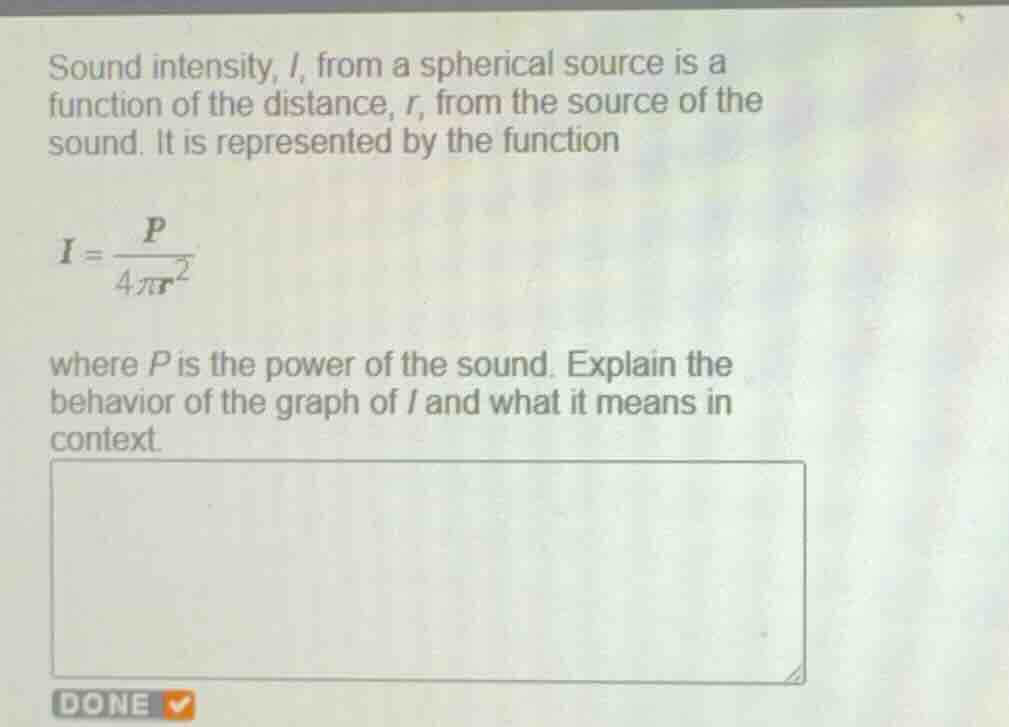
sound intensity, \\(i\\), from a spherical source is a function of the distance, \\(r\\), from the source of the sound. it is represented by the function
\\i = \frac{p}{4\pi r^2}\\
where \\(p\\) is the power of the sound. explain the behavior of the graph of \\(i\\) and what it means in context.
Analyze the function type
Using the Rational Functions knowledge point
Determine graphical behavior
Using the Rational Function Graphing knowledge point
Interpret in physical context
As distance \(r\) from the source increases, sound intensity \(I\) decreases rapidly following an inverse-square relationship. Very close to the source (\(r \to 0\)), the intensity becomes extremely high, while at very large distances (\(r \to \infty\)), the sound fades away toward zero intensity.

Snap & solve any problem in the app
Get step-by-step solutions on Sovi AI
Photo-based solutions with guided steps
Explore more problems and detailed explanations
The graph of \(I = \frac{P}{4\pi r^2}\) (for \(r > 0\)) is strictly decreasing, with a vertical asymptote at \(r = 0\) and a horizontal asymptote at \(I = 0\).
In context, this means that as you move further away from the sound source, the sound intensity decreases rapidly according to the inverse-square law. Extremely close to the source, the sound is intensely loud, while at very great distances, the sound intensity approaches zero and becomes nearly silent.