QUESTION IMAGE
Question
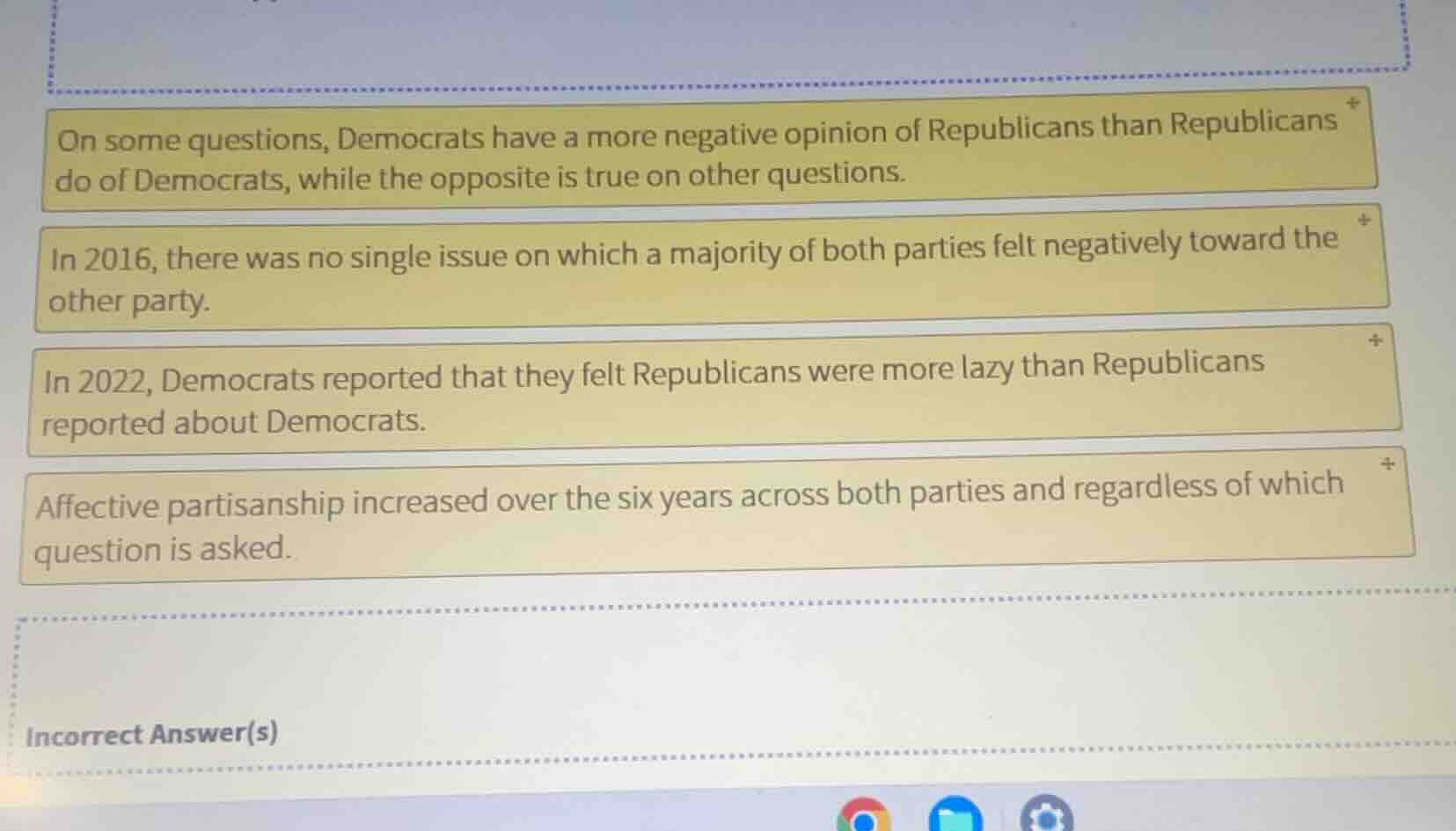
on some questions, democrats have a more negative opinion of republicans than republicans do of democrats, while the opposite is true on other questions.
in 2016, there was no single issue on which a majority of both parties felt negatively toward the other party.
in 2022, democrats reported that they felt republicans were more lazy than republicans reported about democrats.
affective partisanship increased over the six years across both parties and regardless of which question is asked.
incorrect answer(s)
Analyze the context of affective polarization
The question asks to identify the "Incorrect Answer(s)" from a set of statements describing partisan attitudes (affective polarization/partisanship) between Democrats and Republicans, likely based on a Pew Research Center infographic or dataset comparing 2016 and 2022.
Evaluate the statements against empirical trends
- "On some questions, Democrats have a more negative opinion of Republicans than Republicans do of Democrats, while the opposite is true on other questions." (True: Specific traits like being "closed-minded" or "immoral" show varying gaps between parties).
- "In 2016, there was no single issue on which a majority of both parties felt negatively toward the other party." (False: In 2016, majorities in both parties already viewed the other party as closed-minded, dishonest, etc.).
- "In 2022, Democrats reported that they felt Republicans were more lazy than Republicans reported about Democrats." (False: Republicans generally rate Democrats as more lazy than vice versa).
- "Affective partisanship increased over the six years across both parties and regardless of which question is asked." (False: While polarization generally increased, it did not increase on every single trait/question uniformly).
Identify the incorrect statements
In this interactive drag-and-drop format, the user must select which of the statements are "Incorrect Answer(s)" (i.e., false statements about the data).
- "In 2016, there was no single issue on which a majority of both parties felt negatively toward the other party."
- "In 2022, Democrats reported that they felt Republicans were more lazy than Republicans reported about Democrats."
- "Affective partisanship increased over the six years across both parties and regardless of which question is asked."

Snap & solve any problem in the app
Get step-by-step solutions on Sovi AI
Photo-based solutions with guided steps
Explore more problems and detailed explanations
- On some questions, Democrats have a more negative opinion of Republicans than Republicans do of Democrats, while the opposite is true on other questions.
- In 2016, there was no single issue on which a majority of both parties felt negatively toward the other party. (Correct answer)
- In 2022, Democrats reported that they felt Republicans were more lazy than Republicans reported about Democrats. (Correct answer)
- Affective partisanship increased over the six years across both parties and regardless of which question is asked. (Correct answer)