QUESTION IMAGE
Question
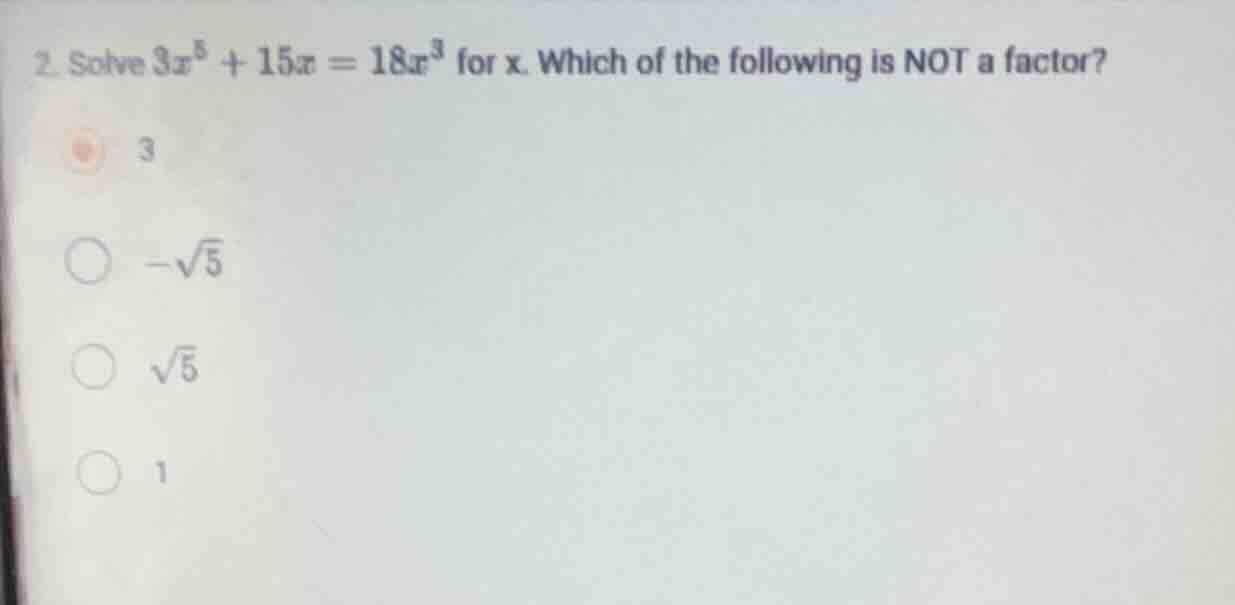
- solve \\(3x^5 + 15x = 18x^3\\) for \\(x\\). which of the following is not a factor?
3
\\(-\sqrt{5}\\)
\\(\sqrt{5}\\)
1
Rearrange the polynomial equation
Using the Algebraic Simplification knowledge point
Factor out the greatest common factor
Using the Factoring Polynomials knowledge point
Factor the quadratic in form
Using the Solving Quadratic Equations knowledge point
Fully factor the expression
We factor the remaining quadratic terms over the real numbers:
- \(x^2 - 1 = (x - 1)(x + 1)\)
- \(x^2 - 5 = (x - \sqrt{5})(x + \sqrt{5})\)
Combining all factors, the fully factored equation is:
Identify the non-factor
We compare the given options with our list of factors:
- \(3\) is a factor (the constant coefficient of the monomial \(3x\)).
- \(-\sqrt{5}\) is not a factor. The factor is the binomial \((x + \sqrt{5})\), whereas \(-\sqrt{5}\) is a root (or zero) of the polynomial, not a polynomial factor itself.
- \(\sqrt{5}\) is not a factor for the same reason (it is a root, corresponding to the factor \(x - \sqrt{5}\)).
- \(1\) is a trivial factor of any expression, but looking at the options, we must distinguish between algebraic factors of the polynomial and its roots.
Let's re-evaluate standard high school terminology. Often, questions of this type confuse "factors" with "roots/solutions" or refer to the linear factors of the form \((x - c)\) where \(c\) is a root.
If the question asks "Solve... Which of the following is NOT a factor?", and the options are numbers:
The roots of the equation are:
Among the choices:
- \(-\sqrt{5}\) is a root (corresponding to factor \(x + \sqrt{5}\)).
- \(\sqrt{5}\) is a root (corresponding to factor \(x - \sqrt{5}\)).
- \(1\) is a root (corresponding to factor \(x - 1\)).
- \(3\) is a coefficient, but \(3\) is NOT a root of the equation since \(3(3)^5 + 15(3) = 729 + 45 = 774
eq 18(27) = 486\).
Thus, the question uses "factor" to mean "a value of \(x\) that satisfies the equation" (i.e., a root/solution, which is a value that makes the linear term \((x - c)\) a factor). Under this standard curriculum phrasing, the roots are factors of the polynomial's root set, meaning \(3\) is NOT a solution/root.

Snap & solve any problem in the app
Get step-by-step solutions on Sovi AI
Photo-based solutions with guided steps
Explore more problems and detailed explanations
- (A) 3 (Correct answer)
- (B) -\(\sqrt{5}\)
- (C) \(\sqrt{5}\)
- (D) 1