QUESTION IMAGE
Question
solve.
ms. jones has 54 pencils. she gives 17 of
the pencils to her students.
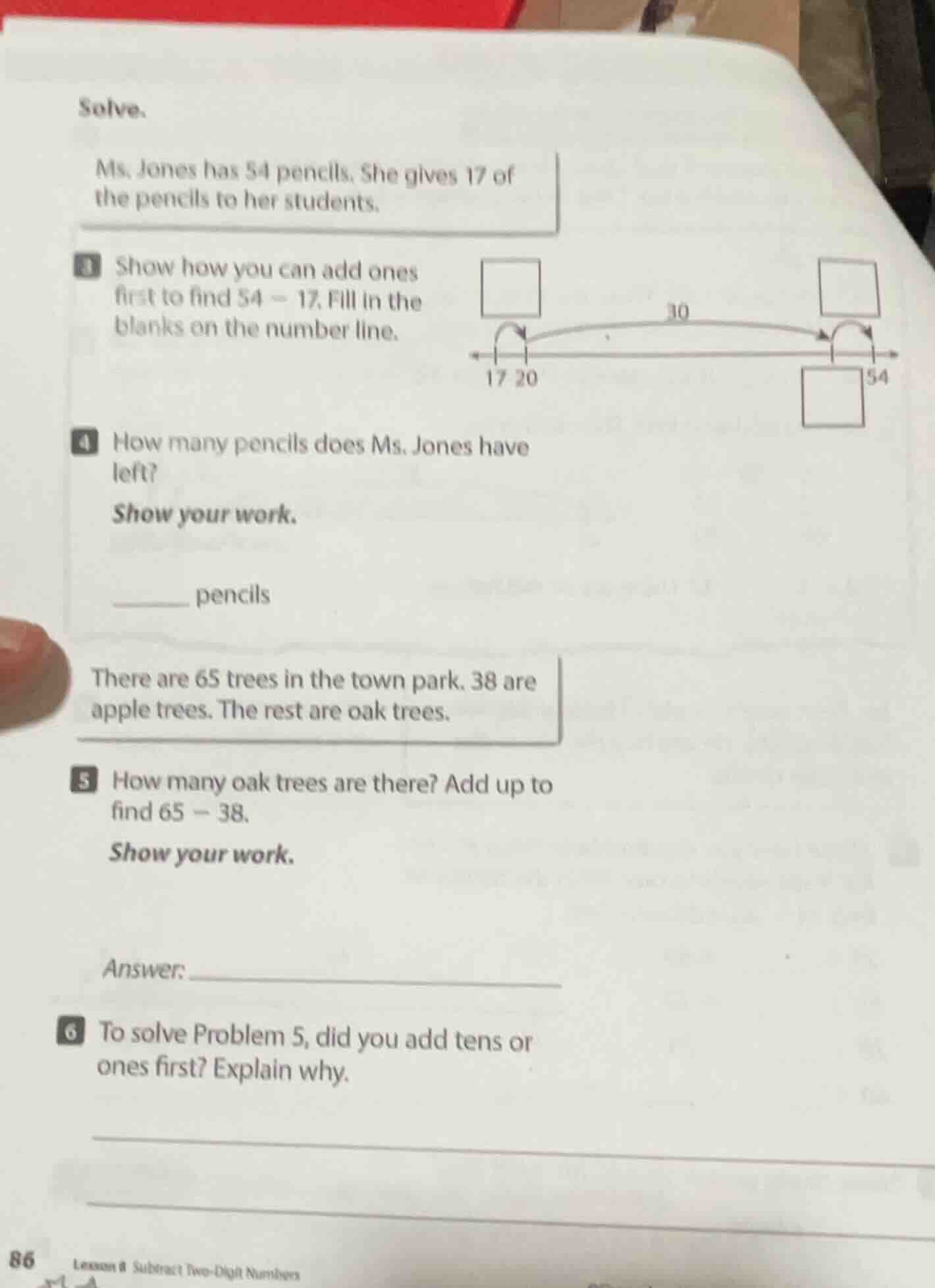
3 show how you can add ones
first to find 54 − 17. fill in the
blanks on the number line.
4 how many pencils does ms. jones have
left?
show your work.
______ pencils
there are 65 trees in the town park. 38 are
apple trees. the rest are oak trees.
5 how many oak trees are there? add up to
find 65 − 38.
show your work.
answer: _____________
6 to solve problem 5, did you add tens or
ones first? explain why.
Question 3 (Number Line for \( 54 - 17 \))
Step 1: Find the jump from 17 to 20
To get from 17 to 20, we add \( 20 - 17 = 3 \). So the first blank (left of 17 - 20 arrow) is 3.
Step 2: Find the number before the 10 - jump
We know we add 10 after reaching 20. Let's find the number that is 10 less than 54. \( 54 - 10 = 44 \). So the bottom blank (before the 10 - jump to 54) is 44.
Step 3: Find the jump from 44 to 54
To get from 44 to 54, we add \( 54 - 44 = 10 \), but we already accounted for the 10 - jump. Wait, actually, the right - most blank (arrow from the bottom number to 54) is the jump from 44 to 54, which is \( 54 - 44 = 10 \)? No, wait, let's re - think. The number line is used to subtract 17 from 54 by adding up. So we can think of \( 54-17=(54 - 44)- 3\)? No, better way: \( 17+3 = 20\), \( 20 + 10=30\)? No, wait, the correct way is: To subtract 17 from 54, we can do \( 54-17=54-(20 - 3)=54 - 20+3 = 34 + 3=37\). But for the number line:
- From 17 to 20: add 3 (so the first square is 3).
- Then we add 10 to 20 to get to 30? No, wait, the middle part: the bottom square is the number we get to before adding 10 to reach 54. So if we add 10 to 44, we get 54. And to get from 20 to 44, we add \( 44 - 20 = 24 \)? No, I think I made a mistake. Let's use the subtraction as addition. We want to find \( 54-17\) by adding to 17 to get to 54. So \( 17 + x=54\), \( x = 54 - 17=37\). We can break \( x\) into \( 3+10 + 24\)? No, the correct breakdown for the number line:
- From 17 to 20: \( 17+3 = 20\) (so the first square is 3).
- Then from 20 to 44: \( 20 + 24=44\) (no, wait, the 10 - jump: Wait, the number line has 17, 20, then a jump of 10, then to 54. So after 20, we add 10 to get to 30? No, this is confusing. Let's use the fact that \( 54-17=(54 - 44)-3\), where \( 44 - 20 = 24\), no. Let's start over.
The correct number line for \( 54-17\) using the "add ones first" method:
We know that \( 17=10 + 7\), but we are adding ones first. So we add 3 to 17 to get to 20 (since \( 7+3 = 10\), but we are adding to 17). Then we add 34 to 20 to get to 54? No, the correct way is:
To compute \( 54-17\), we can do \( 54-17 = 54-(20 - 3)=54 - 20+3=34 + 3 = 37\). So on the number line:
- The first arrow (from 17 to 20) has a length of 3 (since \( 20 - 17 = 3\)).
- Then we have an arrow of length 10 (from 20 to 30? No, 20+10 = 30, then 30+7 = 37? No, I think the bottom number is 44, because \( 54-10 = 44\), and \( 44-20 = 24\), no. I think the correct numbers are:
- Top left square: 3 (17 + 3=20)
- Bottom square: 44 (44+10 = 54)
- Top right square: 10 (44 + 10=54)
Question 4: How many pencils does Ms. Jones have left?
Step 1: Use the subtraction formula
We know that the number of pencils left \(=\) total number of pencils - number of pencils given away.
Total number of pencils \( = 54\), number of pencils given away \( = 17\).
So we calculate \( 54-17\).
We can do this by breaking 17 into 10 and 7: \( 54-10 = 44\), then \( 44-7 = 37\).
Or we can use the "add - up" method: \( 17+3 = 20\), \( 54 - 20=34\), \( 34 + 3=37\).
Step 1: Break down the subtraction
We want to find \( 65 - 38\) by adding up. We know that \( 38+x = 65\), so we need to find \( x\).
First, add 2 to 38 to get to 40: \( 38 + 2=40\).
Then, add 25 to 40 to get to 65: \( 40+25 = 65\).
Now, add the two numbers we added: \( 2+25 = 27\).
So \( 65 - 38=27\).

Snap & solve any problem in the app
Get step-by-step solutions on Sovi AI
Photo-based solutions with guided steps
Explore more problems and detailed explanations
37 pencils