QUESTION IMAGE
Question
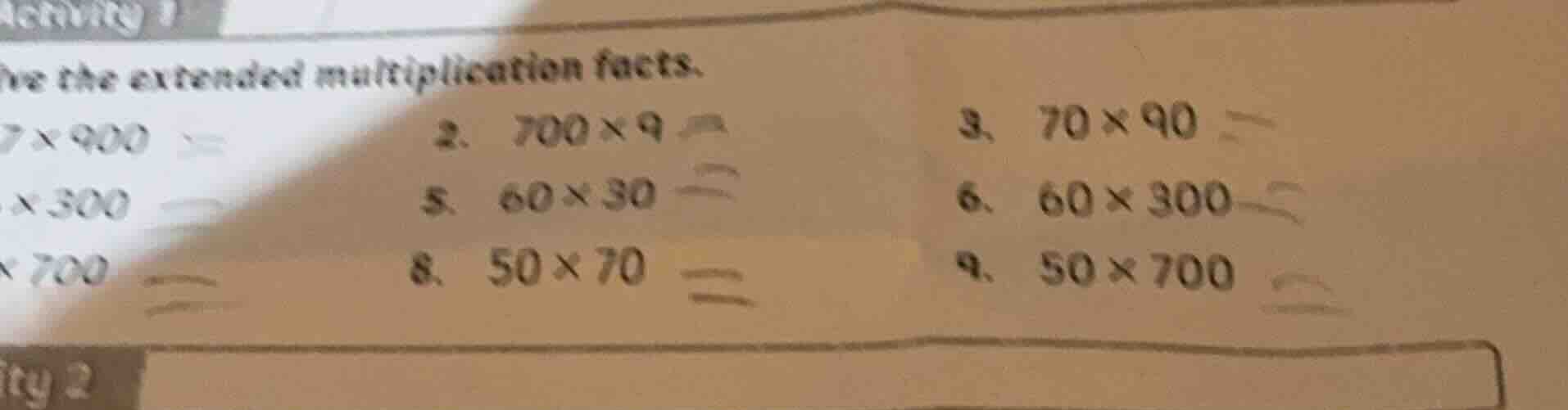
solve the extended multiplication facts.
- 7×900 =
- 700×9 =
- 70×90 =
- 6×300 =
- 60×30 =
- 60×300 =
- 5×700 =
- 50×70 =
- 50×700 =
Let's solve these multiplication problems one by one. We'll use the rule that when multiplying numbers with trailing zeros, we can first multiply the non - zero parts and then add the total number of trailing zeros at the end.
Problem 2: \(700\times9\)
Step 1: Multiply non - zero parts
First, we consider the non - zero parts of the numbers. For \(700\) and \(9\), the non - zero part of \(700\) is \(7\) and the other number is \(9\). We calculate \(7\times9 = 63\).
Step 2: Add trailing zeros
The number \(700\) has \(2\) trailing zeros. So we add these \(2\) trailing zeros to the result of \(7\times9\). So \(700\times9=6300\).
Problem 3: \(70\times90\)
Step 1: Multiply non - zero parts
The non - zero part of \(70\) is \(7\) and the non - zero part of \(90\) is \(9\). We calculate \(7\times9 = 63\).
Step 2: Add trailing zeros
The number \(70\) has \(1\) trailing zero and \(90\) has \(1\) trailing zero. So in total, there are \(1 + 1=2\) trailing zeros. We add these \(2\) trailing zeros to \(63\), so \(70\times90 = 6300\).
Problem 5: \(60\times30\)
Step 1: Multiply non - zero parts
The non - zero part of \(60\) is \(6\) and the non - zero part of \(30\) is \(3\). We calculate \(6\times3=18\).
Step 2: Add trailing zeros
The number \(60\) has \(1\) trailing zero and \(30\) has \(1\) trailing zero. So there are \(1 + 1 = 2\) trailing zeros. We add these \(2\) trailing zeros to \(18\), so \(60\times30=1800\).
Problem 6: \(60\times300\)
Step 1: Multiply non - zero parts
The non - zero part of \(60\) is \(6\) and the non - zero part of \(300\) is \(3\). We calculate \(6\times3 = 18\).
Step 2: Add trailing zeros
The number \(60\) has \(1\) trailing zero and \(300\) has \(2\) trailing zeros. So in total, there are \(1+2 = 3\) trailing zeros. We add these \(3\) trailing zeros to \(18\), so \(60\times300 = 18000\).
Problem 8: \(50\times70\)
Step 1: Multiply non - zero parts
The non - zero part of \(50\) is \(5\) and the non - zero part of \(70\) is \(7\). We calculate \(5\times7=35\).
Step 2: Add trailing zeros
The number \(50\) has \(1\) trailing zero and \(70\) has \(1\) trailing zero. So there are \(1 + 1=2\) trailing zeros. We add these \(2\) trailing zeros to \(35\), so \(50\times70 = 3500\).
Problem 9: \(50\times700\)
Step 1: Multiply non - zero parts
The non - zero part of \(50\) is \(5\) and the non - zero part of \(700\) is \(7\). We calculate \(5\times7 = 35\).
Step 2: Add trailing zeros
The number \(50\) has \(1\) trailing zero and \(700\) has \(2\) trailing zeros. So in total, there are \(1+2 = 3\) trailing zeros. We add these \(3\) trailing zeros to \(35\), so \(50\times700=35000\).
(Note: For the problem \(7\times900\) and the one with \(×300\) and \(×700\) in the original image, since the first number is not fully visible, we can't solve them. But we have solved the other visible problems as above.)

Snap & solve any problem in the app
Get step-by-step solutions on Sovi AI
Photo-based solutions with guided steps
Explore more problems and detailed explanations
s:
- \(700\times9=\boldsymbol{6300}\)
- \(70\times90=\boldsymbol{6300}\)
- \(60\times30=\boldsymbol{1800}\)
- \(60\times300=\boldsymbol{18000}\)
- \(50\times70=\boldsymbol{3500}\)
- \(50\times700=\boldsymbol{35000}\)