QUESTION IMAGE
Question
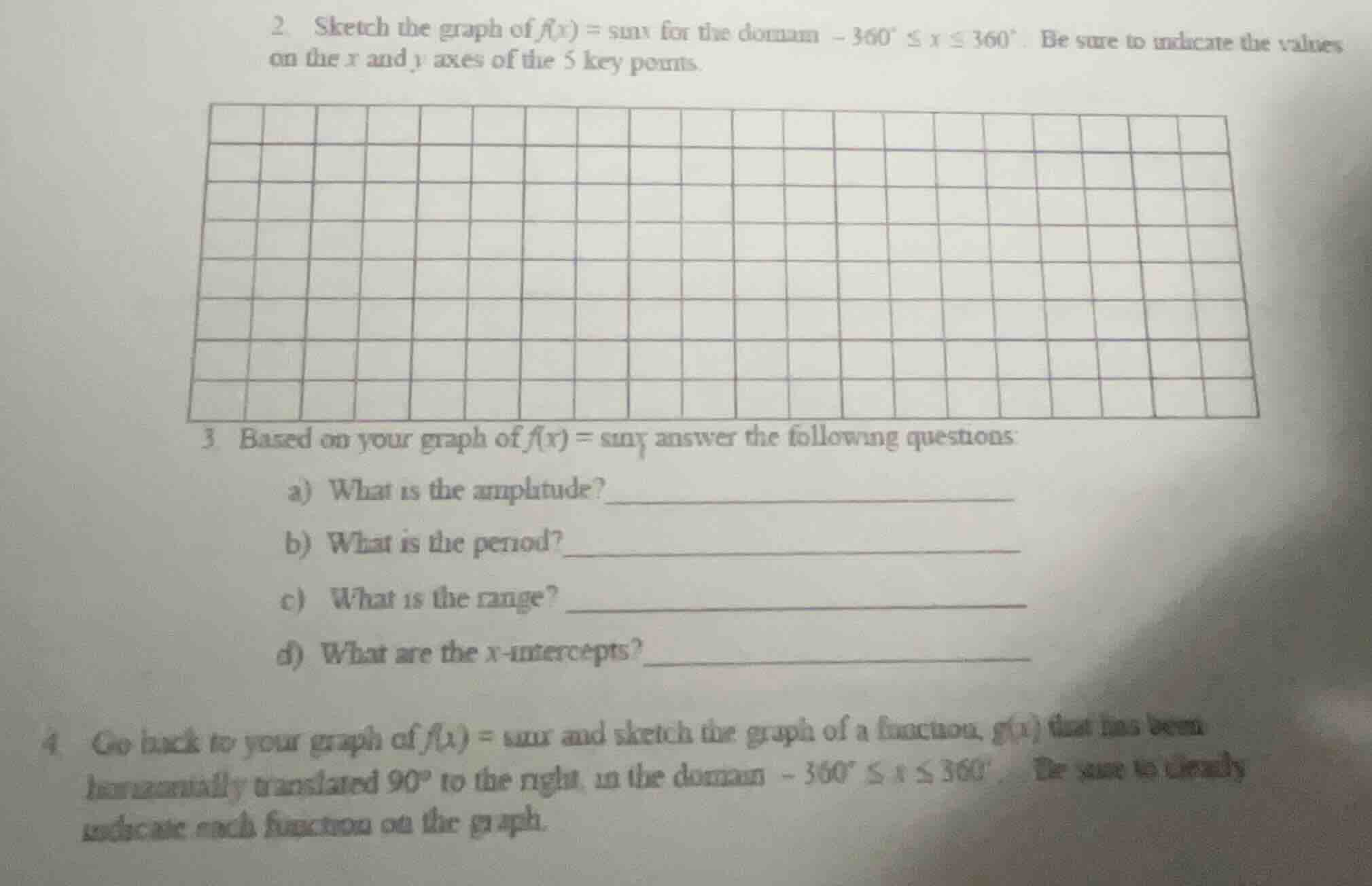
- sketch the graph of (f(x) = \sin x) for the domain (-360^\circ \le x \le 360^\circ). be sure to indicate the values on the (x) and (y) axes of the 5 key points.
- based on your graph of (f(x) = \sin x) answer the following questions:
a) what is the amplitude?
b) what is the period?
c) what is the range?
d) what are the (x)-intercepts?
- go back to your graph of (f(x) = \sin x) and sketch the graph of a function, (g(x)) that has been horizontally translated (90^\circ) to the right, in the domain (-360^\circ \le x \le 360^\circ). be sure to clearly indicate each function on the graph.
Identify key points of \(f(x) = \sin x\)
Using the Domain and Range knowledge point, we analyze \(f(x) = \sin x\) on \([-360^\circ, 360^\circ]\).
The 5 key points in \([0^\circ, 360^\circ]\) are:
- \((0^\circ, 0)\)
- \((90^\circ, 1)\)
- \((180^\circ, 0)\)
- \((270^\circ, -1)\)
- \((360^\circ, 0)\)
Extending to \([-360^\circ, 0^\circ]\):
- \((-90^\circ, -1)\)
- \((-180^\circ, 0)\)
- \((-270^\circ, 1)\)
- \((-360^\circ, 0)\)
Determine properties of \(f(x) = \sin x\)
From the graph of \(f(x) = \sin x\):
- Amplitude: The maximum displacement from the midline is \(1\).
- Period: The length of one complete cycle is \(360^\circ\).
- Range: The output values lie between \(-1\) and \(1\), written as \([-1, 1]\).
- x-intercepts: The points where \(f(x) = 0\) are \(-360^\circ, -180^\circ, 0^\circ, 180^\circ, 360^\circ\).
Apply horizontal translation for \(g(x)\)
The function \(g(x)\) is \(f(x)\) translated \(90^\circ\) to the right:
We shift each key point of \(f(x)\) by adding \(90^\circ\) to the x-coordinate:
- \((-360^\circ, 0) \to (-270^\circ, 0)\)
- \((-270^\circ, 1) \to (-180^\circ, 1)\)
- \((-180^\circ, 0) \to (-90^\circ, 0)\)
- \((-90^\circ, -1) \to (0^\circ, -1)\)
- \((0^\circ, 0) \to (90^\circ, 0)\)
- \((90^\circ, 1) \to (180^\circ, 1)\)
- \((180^\circ, 0) \to (270^\circ, 0)\)
- \((270^\circ, -1) \to (360^\circ, -1)\)
- \((-360^\circ, -1)\) is obtained by extending the pattern leftward.

Snap & solve any problem in the app
Get step-by-step solutions on Sovi AI
Photo-based solutions with guided steps
Explore more problems and detailed explanations
Question 2
The graph of \(f(x) = \sin x\) is plotted on the domain \([-360^\circ, 360^\circ]\) with key points at:
Question 3
a) What is the amplitude?
<blank>1</blank>
b) What is the period?
<blank>\(360^\circ\)</blank>
c) What is the range?
<blank>\([-1, 1]\)</blank>
d) What are the x-intercepts?
<blank>\(-360^\circ, -180^\circ, 0^\circ, 180^\circ, 360^\circ\)</blank>
Question 4
The graph of \(g(x) = \sin(x - 90^\circ)\) is plotted on the domain \([-360^\circ, 360^\circ]\) with key points at: