QUESTION IMAGE
Question
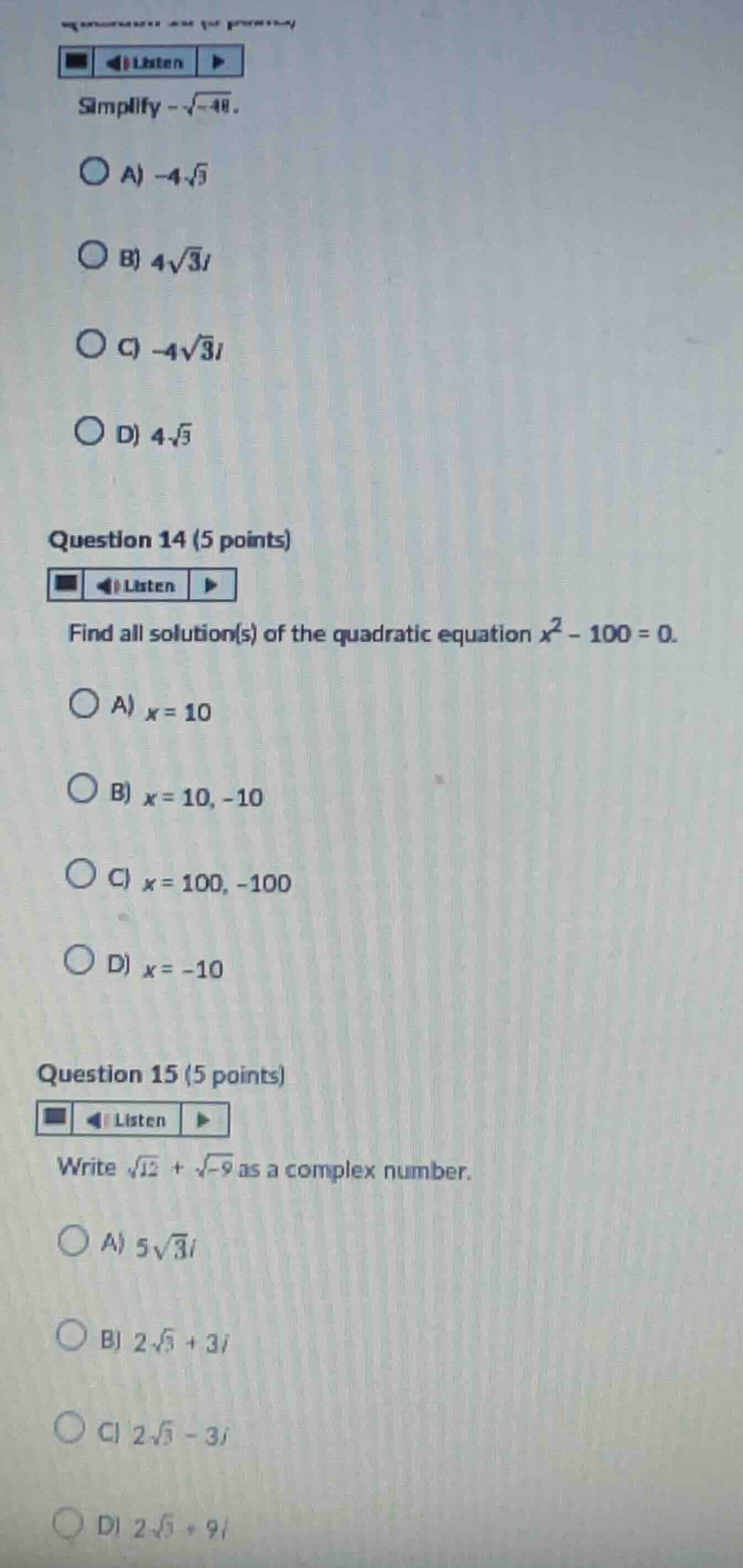
simplify \\(-\sqrt{-48}\\).
a) \\(-4\sqrt{3}i\\)
b) \\(4\sqrt{3}i\\)
c) \\(-4\sqrt{3}i\\)
d) \\(4\sqrt{3}\\)
question 14 (5 points)
find all solution(s) of the quadratic equation \\(x^2 - 100 = 0\\).
a) \\(x = 10\\)
b) \\(x = 10, -10\\)
c) \\(x = 100, -100\\)
d) \\(x = -10\\)
question 15 (5 points)
write \\(\sqrt{12} + \sqrt{-9}\\) as a complex number.
a) \\(5\sqrt{3}i\\)
b) \\(2\sqrt{3} + 3i\\)
c) \\(2\sqrt{3} - 3i\\)
d) \\(2\sqrt{3} + 9i\\)
Simplify the radical expression
Using the Simplifying Radicals with Negative Radicands knowledge point, we simplify \(-\sqrt{-48}\).
First, express the negative radicand using the imaginary unit \(i = \sqrt{-1}\):
Next, factor out the largest perfect square from \(48\), which is \(16\):
Solve the quadratic equation
Using the Square Root Principle knowledge point
Write the sum as a complex number
Using the Complex Number Representation knowledge point, we simplify \(\sqrt{12} + \sqrt{-9}\).
First, simplify the real radical term \(\sqrt{12}\):
Next, simplify the imaginary radical term \(\sqrt{-9}\):
Combine the real and imaginary parts to write the final complex number:

Snap & solve any problem in the app
Get step-by-step solutions on Sovi AI
Photo-based solutions with guided steps
Explore more problems and detailed explanations
Question 13
- (A) \(-4\sqrt{5}\)
- (B) \(4\sqrt{3}i\)
- (C) \(-4\sqrt{3}i\) (Correct answer)
- (D) \(4\sqrt{5}\)
Question 14
- (A) \(x = 10\)
- (B) \(x = 10, -10\) (Correct answer)
- (C) \(x = 100, -100\)
- (D) \(x = -10\)
Question 15
- (A) \(5\sqrt{3}i\)
- (B) \(2\sqrt{3} + 3i\) (Correct answer)
- (C) \(2\sqrt{3} - 3i\)
- (D) \(2\sqrt{3} + 9i\)