QUESTION IMAGE
Question
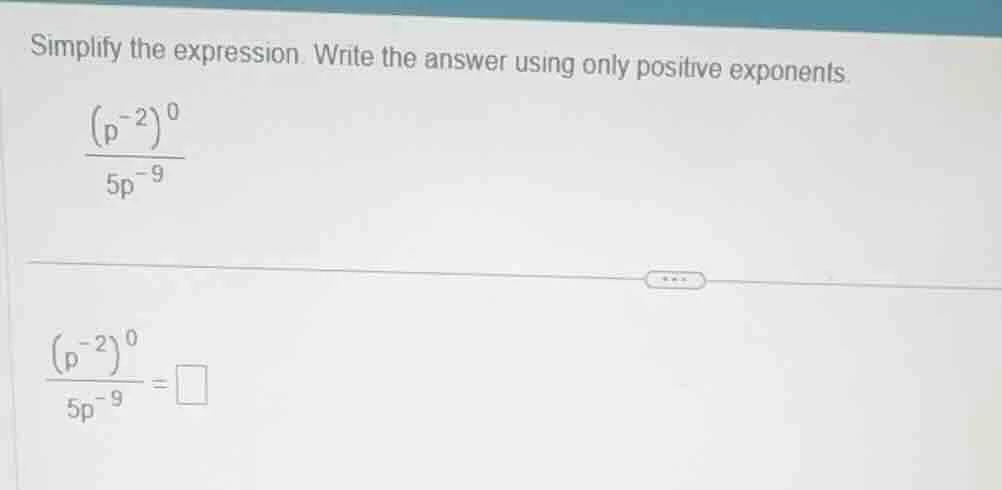
simplify the expression. write the answer using only positive exponents.\\(\frac{(p^{-2})^{0}}{5p^{-9}}\\)\\(\frac{(p^{-2})^{0}}{5p^{-9}} = \square\\)
Step1: Simplify the numerator using exponent rule \( (a^m)^n = a^{mn} \) and \( a^0 = 1 \) (for \( a
eq 0 \))
For \( (p^{-2})^0 \), applying \( (a^m)^n = a^{mn} \), we get \( p^{-2 \times 0}=p^0 \). Then, by the rule \( a^0 = 1 \) (where \( a = p \) and \( p
eq 0 \)), \( p^0 = 1 \). So the numerator simplifies to 1.
Step2: Simplify the denominator using the negative exponent rule \( a^{-n}=\frac{1}{a^n} \) (or \( \frac{1}{a^{-n}} = a^n \))
The denominator is \( 5p^{-9} \). Using the rule \( \frac{1}{a^{-n}} = a^n \), we can rewrite \( p^{-9} \) in the denominator as \( p^{9} \) in the numerator when we take the reciprocal. Wait, actually, let's handle the fraction. The original expression is \( \frac{1}{5p^{-9}} \). Using \( \frac{1}{a^{-n}} = a^n \), this becomes \( \frac{p^{9}}{5} \). Wait, no, let's do it step by step. The numerator is 1, denominator is \( 5p^{-9} \). So \( \frac{1}{5p^{-9}}=\frac{1}{5}\times\frac{1}{p^{-9}} \). Then, \( \frac{1}{p^{-9}} = p^{9} \) (by \( \frac{1}{a^{-n}} = a^n \)). So multiplying by \( \frac{1}{5} \), we get \( \frac{p^{9}}{5} \)? Wait, no, that's not right. Wait, the original expression is \( \frac{(p^{-2})^0}{5p^{-9}} \). We found the numerator is 1, so it's \( \frac{1}{5p^{-9}} \). Now, using the rule \( a^{-n}=\frac{1}{a^n} \), so \( p^{-9}=\frac{1}{p^9} \), so \( 5p^{-9}=5\times\frac{1}{p^9}=\frac{5}{p^9} \). Then, \( \frac{1}{\frac{5}{p^9}} = \frac{p^9}{5} \)? Wait, no, that's dividing by a fraction. Wait, \( \frac{1}{\frac{5}{p^9}} = 1\times\frac{p^9}{5}=\frac{p^9}{5} \). Wait, but let's check the exponent rules again. The negative exponent rule: \( a^{-n}=\frac{1}{a^n} \), so \( \frac{1}{a^{-n}} = a^n \). So \( \frac{1}{p^{-9}} = p^9 \), so \( \frac{1}{5p^{-9}}=\frac{p^9}{5} \). Wait, but let's verify with the exponent rules for division. Alternatively, using the rule \( \frac{a^m}{a^n}=a^{m - n} \), but here we have a fraction with numerator 1 (which is \( p^0 \)) and denominator \( 5p^{-9} \). So \( \frac{p^0}{5p^{-9}}=\frac{1}{5}p^{0 - (-9)}=\frac{1}{5}p^{9}=\frac{p^9}{5} \). Ah, that's a better way. Using \( \frac{a^m}{a^n}=a^{m - n} \), where \( a = p \), \( m = 0 \), \( n = -9 \), and the coefficient is \( \frac{1}{5} \). So \( \frac{p^0}{5p^{-9}}=\frac{1}{5}p^{0 - (-9)}=\frac{1}{5}p^{9}=\frac{p^9}{5} \). Wait, but let's check the first step again. \( (p^{-2})^0 = p^{(-2)\times0}=p^0 = 1 \), that's correct (as long as \( p
eq0 \)). Then, the expression is \( \frac{1}{5p^{-9}} \). Now, using \( \frac{1}{a^{-n}} = a^n \), so \( \frac{1}{p^{-9}} = p^9 \), so \( \frac{1}{5p^{-9}}=\frac{p^9}{5} \). Yes, that's correct.
Wait, but let's do it using the quotient of powers rule. The quotient of powers rule is \( \frac{a^m}{a^n}=a^{m - n} \). So in the expression \( \frac{(p^{-2})^0}{5p^{-9}} \), the numerator is \( p^0 \) (which is 1), so we can write the entire expression as \( \frac{p^0}{5p^{-9}} \). Using the quotient of powers rule for the variable part: \( \frac{p^0}{p^{-9}} = p^{0 - (-9)} = p^{9} \). Then, the coefficient is \( \frac{1}{5} \), so the entire expression is \( \frac{p^9}{5} \).

Snap & solve any problem in the app
Get step-by-step solutions on Sovi AI
Photo-based solutions with guided steps
Explore more problems and detailed explanations
\(\frac{p^{9}}{5}\)