QUESTION IMAGE
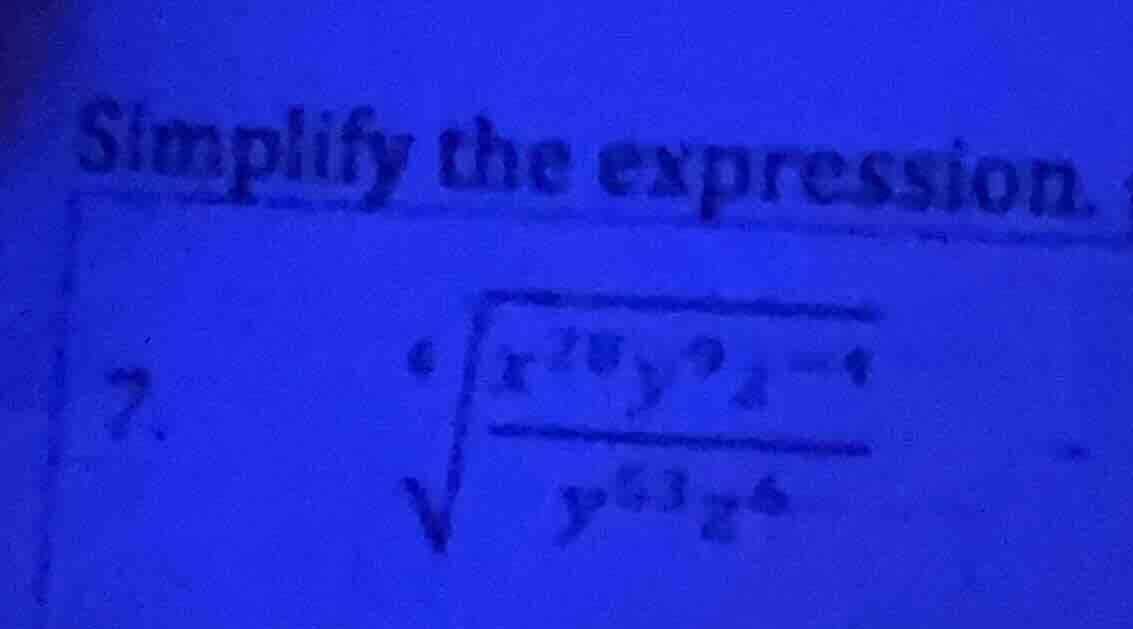
Question
simplify the expression.
- (sqrt6{\frac{x^{28} y^{9} z^{-4}}{y^{63} z^{6}}})
Step1: Simplify the fraction inside the radical
First, we simplify the exponents of \(y\) and \(z\) in the fraction \(\frac{x^{28}y^{9}z^{-4}}{y^{63}z^{6}}\). For the \(y\)-terms, we use the rule \(a^m\div a^n = a^{m - n}\), so \(y^{9}\div y^{63}=y^{9 - 63}=y^{-54}\). For the \(z\)-terms, \(z^{-4}\div z^{6}=z^{-4 - 6}=z^{-10}\). The \(x\)-term remains \(x^{28}\) since there is only one \(x\)-term. So the fraction simplifies to \(x^{28}y^{-54}z^{-10}\).
Step2: Apply the sixth root (which is the same as raising to the power of \(\frac{1}{6}\))
We now take the sixth root of \(x^{28}y^{-54}z^{-10}\), which is equivalent to raising each term to the power of \(\frac{1}{6}\). Using the rule \((a^m)^n=a^{mn}\):
- For the \(x\)-term: \((x^{28})^{\frac{1}{6}} = x^{\frac{28}{6}}=x^{\frac{14}{3}}\) (we can also write this as \(x^{4+\frac{2}{3}} = x^{4}x^{\frac{2}{3}}\), but let's keep it as an improper fraction for now).
- For the \(y\)-term: \((y^{-54})^{\frac{1}{6}}=y^{\frac{-54}{6}} = y^{-9}\)
- For the \(z\)-term: \((z^{-10})^{\frac{1}{6}}=z^{\frac{-10}{6}}=z^{-\frac{5}{3}}\)
Step3: Rewrite negative exponents as positive exponents in the denominator (optional, but to simplify)
Recall that \(a^{-n}=\frac{1}{a^n}\). So we can rewrite \(y^{-9}=\frac{1}{y^{9}}\) and \(z^{-\frac{5}{3}}=\frac{1}{z^{\frac{5}{3}}}\). Also, \(x^{\frac{14}{3}}\) can be written as \(x^{4}x^{\frac{2}{3}}\) (since \(\frac{14}{3}=4+\frac{2}{3}\)). But let's also express the fractional exponents as radicals if needed, but maybe we can simplify further. Wait, let's check the exponents again. Wait, maybe I made a mistake in the exponent of \(y\). Wait, original \(y\) exponent: numerator is \(y^9\), denominator is \(y^{63}\), so \(9 - 63=-54\), that's correct. Then taking the sixth root: \(-54\times\frac{1}{6}=-9\), correct. For \(z\): numerator \(z^{-4}\), denominator \(z^{6}\), so \(-4 - 6=-10\), times \(\frac{1}{6}\) is \(-\frac{10}{6}=-\frac{5}{3}\), correct. For \(x\): \(28\times\frac{1}{6}=\frac{14}{3}\), correct.
But maybe we can write \(x^{\frac{14}{3}}\) as \(x^{4}x^{\frac{2}{3}}\), and \(x^{\frac{2}{3}}=\sqrt[3]{x^{2}}\), \(z^{-\frac{5}{3}}=\frac{1}{z^{\frac{5}{3}}}=\frac{1}{z\sqrt[3]{z^{2}}}\), and \(y^{-9}=\frac{1}{y^{9}}\). But let's see if we can simplify the exponents more. Wait, maybe there was a typo in the original problem? Wait, the original problem has \(y^9\) in the numerator and \(y^{63}\) in the denominator? That seems like a big exponent. Alternatively, maybe it's \(y^{9}\) and \(y^{6}\)? Wait, the user's image shows \(y^{63}\)? Maybe that's a typo, but assuming it's correct.
Wait, let's re - express the original expression:
\(\sqrt[6]{\frac{x^{28}y^{9}z^{-4}}{y^{63}z^{6}}}=\sqrt[6]{x^{28}y^{9 - 63}z^{-4-6}}=\sqrt[6]{x^{28}y^{-54}z^{-10}}\)
\(=(x^{28})^{\frac{1}{6}}(y^{-54})^{\frac{1}{6}}(z^{-10})^{\frac{1}{6}}\)
\(=x^{\frac{28}{6}}y^{-9}z^{-\frac{10}{6}}\)
Simplify the fractions:
\(\frac{28}{6}=\frac{14}{3}\), \(\frac{10}{6}=\frac{5}{3}\)
So we have \(x^{\frac{14}{3}}y^{-9}z^{-\frac{5}{3}}\)
We can also write this with positive exponents in the denominator for \(y\) and \(z\):
\(\frac{x^{\frac{14}{3}}}{y^{9}z^{\frac{5}{3}}}\)
Or we can separate the integer and fractional parts of the exponent for \(x\):
\(x^{\frac{14}{3}}=x^{4+\frac{2}{3}}=x^{4}x^{\frac{2}{3}}\)
And \(z^{\frac{5}{3}}=z^{1+\frac{2}{3}}=z\sqrt[3]{z^{2}}\), \(x^{\frac{2}{3}}=\sqrt[3]{x^{2}}\)
So \(\frac{x^{4}\sqrt[3]{x^{2}}}{y^{9}z\sqrt[3]{z^{2}}}\)
But maybe the problem had a typo, and the denominator for \(y\) is \(y^{6}\) instead of \(y^{63}\). Let's assume…

Snap & solve any problem in the app
Get step-by-step solutions on Sovi AI
Photo-based solutions with guided steps
Explore more problems and detailed explanations
\(\frac{x^{\frac{14}{3}}}{y^{9}z^{\frac{5}{3}}}\) (or equivalent forms like \(\frac{x^{4}\sqrt[3]{x^{2}}}{y^{9}z\sqrt[3]{z^{2}}}\) or \(x^{\frac{14}{3}}y^{-9}z^{-\frac{5}{3}}\))