QUESTION IMAGE
Question
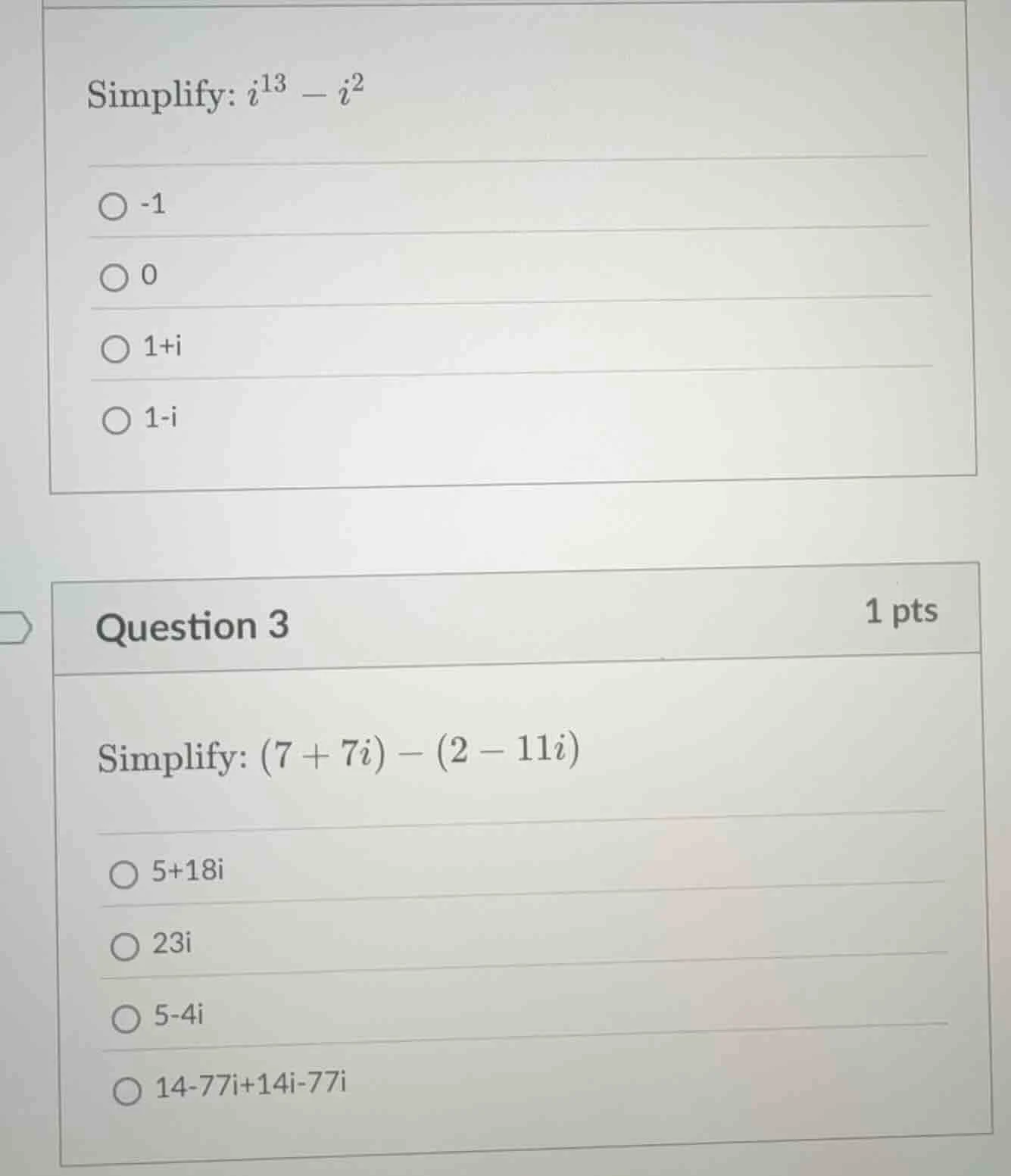
simplify: $i^{13} - i^{2}$
-1
0
1+i
1-i
question 3
1 pts
simplify: $(7 + 7i) - (2 - 11i)$
5+18i
23i
5-4i
14-77i+14i-77i
First Problem: Simplify \( i^{13} - i^2 \)
Step1: Simplify \( i^{13} \)
Recall that \( i^1 = i \), \( i^2 = -1 \), \( i^3 = -i \), \( i^4 = 1 \), and the powers of \( i \) repeat every 4. So we can divide the exponent by 4 and use the remainder. For \( i^{13} \), \( 13 \div 4 = 3 \) with a remainder of 1. Thus, \( i^{13} = i^{4 \times 3 + 1} = (i^4)^3 \times i^1 = 1^3 \times i = i \).
Step2: Simplify \( i^2 \)
We know that \( i^2 = -1 \) by definition.
Step3: Substitute and Simplify
Substitute the simplified forms into the expression: \( i^{13} - i^2 = i - (-1) = i + 1 = 1 + i \). Wait, no, wait. Wait, \( i^{13} \): \( 13 = 4*3 + 1 \), so \( i^{13} = (i^4)^3 i = 1^3 i = i \). Then \( i^2 = -1 \). So \( i - (-1) = i + 1 \)? Wait, but let's check again. Wait, the original expression is \( i^{13} - i^2 \). So \( i^{13} = i \), \( i^2 = -1 \), so \( i - (-1) = i + 1 \)? But let's check the options. Wait, maybe I made a mistake. Wait, \( i^1 = i \), \( i^2 = -1 \), \( i^3 = -i \), \( i^4 = 1 \), \( i^5 = i \), so the cycle is 4. So 13 divided by 4 is 3 with remainder 1, so \( i^{13} = i^1 = i \). Then \( i^2 = -1 \). So \( i - (-1) = i + 1 \)? But the options include 1 + i. Wait, but let's check again. Wait, maybe I messed up the sign. Wait, \( i^{13} - i^2 = i - (-1) = i + 1 \), which is \( 1 + i \). But let's check the options. The options are -1, 0, 1 + i, 1 - i. So 1 + i is an option. Wait, but maybe I made a mistake. Wait, \( i^2 = -1 \), so \( -i^2 = -(-1) = 1 \). Then \( i^{13} = i \), so \( i + 1 \), which is 1 + i. So that's correct.
Wait, but let's re-express:
\( i^{13} = i^{4 \times 3 + 1} = (i^4)^3 \cdot i = 1^3 \cdot i = i \)
\( i^2 = -1 \)
So \( i^{13} - i^2 = i - (-1) = i + 1 = 1 + i \)
So the answer is 1 + i.
Second Problem: Simplify \( (7 + 7i) - (2 - 11i) \)
Step1: Distribute the Negative Sign
Distribute the negative sign to the terms inside the second parentheses: \( (7 + 7i) - 2 + 11i \)
Step2: Combine Like Terms (Real Parts and Imaginary Parts)
Combine the real parts: \( 7 - 2 = 5 \)
Combine the imaginary parts: \( 7i + 11i = 18i \)
Step3: Write the Result
Put the real and imaginary parts together: \( 5 + 18i \)

Snap & solve any problem in the app
Get step-by-step solutions on Sovi AI
Photo-based solutions with guided steps
Explore more problems and detailed explanations
s:
- For \( i^{13} - i^2 \): \( \boldsymbol{1 + i} \) (Option: 1+i)
- For \( (7 + 7i) - (2 - 11i) \): \( \boldsymbol{5 + 18i} \) (Option: 5+18i)