QUESTION IMAGE
Question
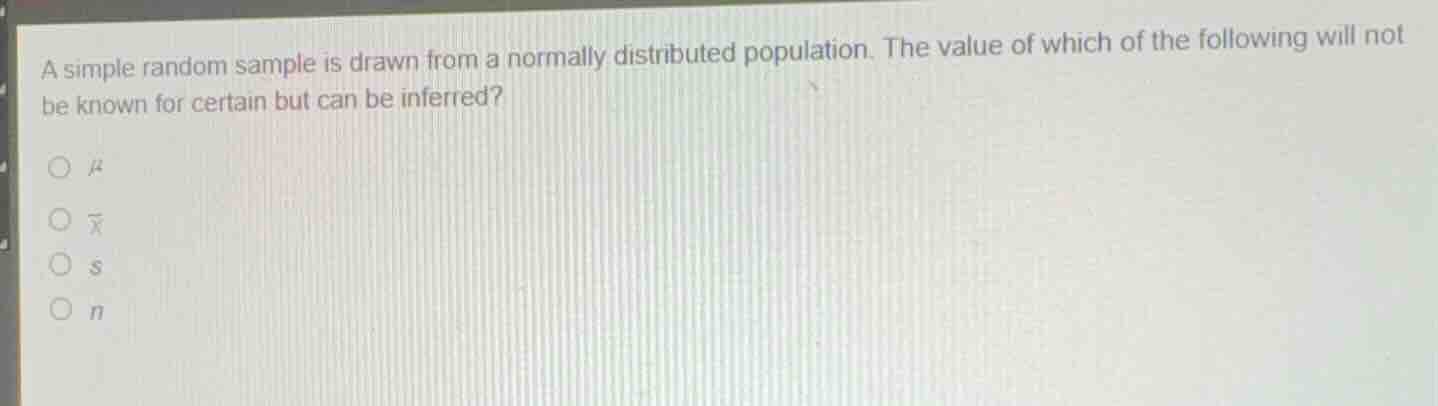
a simple random sample is drawn from a normally distributed population. the value of which of the following will not be known for certain but can be inferred?
\\(\mu\\)
\\(\bar{x}\\)
\\(s\\)
\\(n\\)
Define sample statistics and population parameters
Using the Sample vs Population knowledge point, we distinguish between values calculated directly from a sample and values describing the entire population. When we draw a simple random sample of size \(n\), we collect individual data points. From these data points, we can directly calculate the sample mean \(\bar{x}\) and the sample standard deviation \(s\). The sample size \(n\) is also known exactly because it is the number of observations we chose to collect. Therefore, \(\bar{x}\), \(s\), and \(n\) are known for certain once the sample is collected.
Identify the inferred value
Using the Statistical Inference Assumptions knowledge point, we use sample statistics to make generalizations about the population. The population mean \(\mu\) is a population parameter. Because we only have access to a subset of the population (the sample), we cannot know the exact value of \(\mu\) for certain. Instead, we use statistical inference (such as calculating a confidence interval or performing a hypothesis test) to estimate or infer the value of \(\mu\) based on our sample mean \(\bar{x}\). Thus, \(\mu\) is the value that will not be known for certain but can be inferred.

Snap & solve any problem in the app
Get step-by-step solutions on Sovi AI
Photo-based solutions with guided steps
Explore more problems and detailed explanations
- (A) \(\mu\) (Correct answer)
- (B) \(\bar{x}\)
- (C) \(s\)
- (D) \(n\)