QUESTION IMAGE
Question
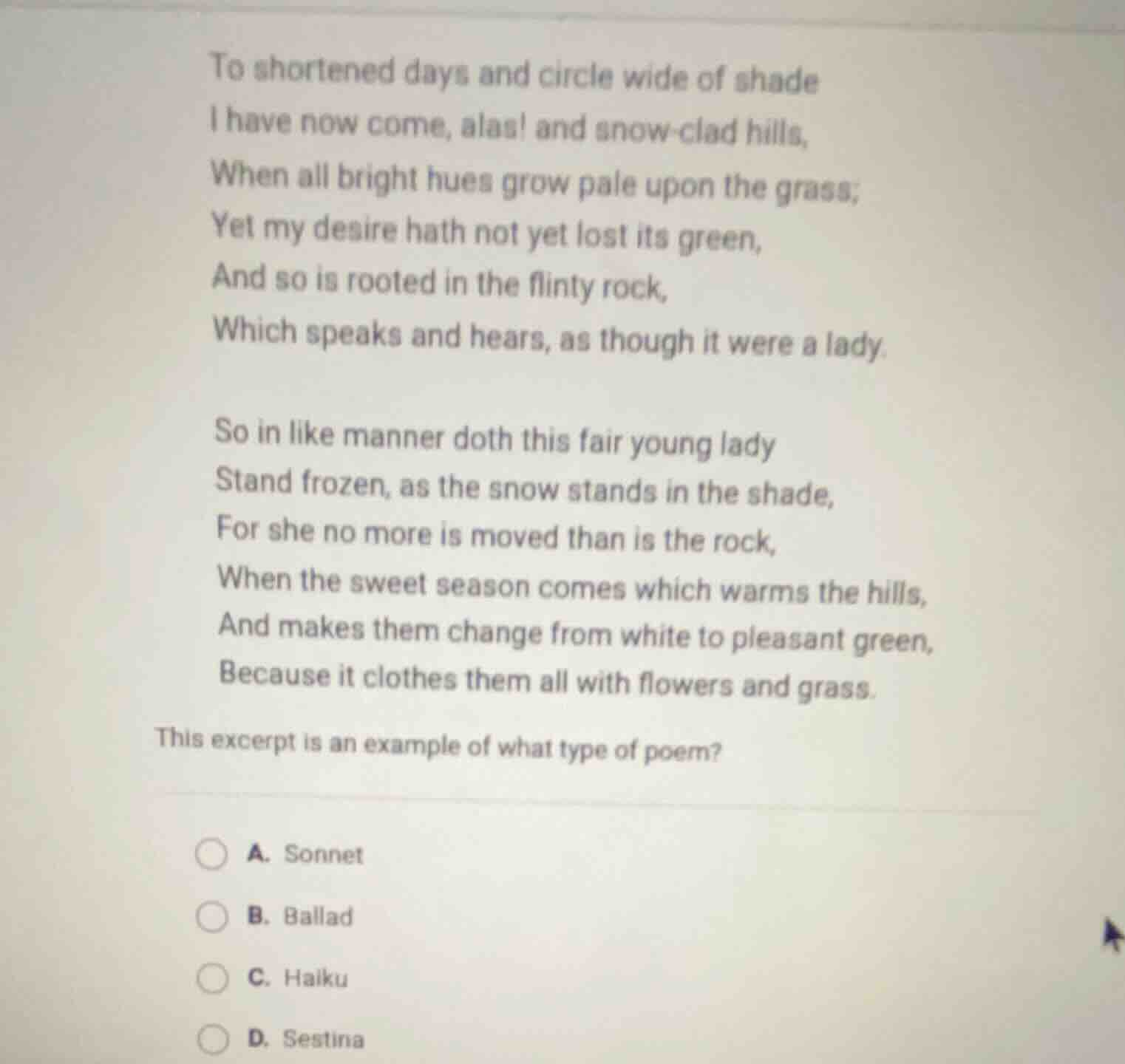
to shortened days and circle wide of shade
i have now come, alas! and snow-clad hills,
when all bright hues grow pale upon the grass;
yet my desire hath not yet lost its green,
and so is rooted in the flinty rock,
which speaks and hears, as though it were a lady.
so in like manner doth this fair young lady
stand frozen, as the snow stands in the shade,
for she no more is moved than is the rock,
when the sweet season comes which warms the hills,
and makes them change from white to pleasant green,
because it clothes them all with flowers and grass.
this excerpt is an example of what type of poem?
a. sonnet
b. ballad
c. haiku
d. sestina
Analyze the end-words of each line
The first stanza ends with: shade, hills, grass, green, rock, lady.
The second stanza ends with: lady, shade, rock, hills, green, grass.
Identify the poetic form
The repetition of the exact same six end-words in a rotating pattern across six-line stanzas (sestets) is the defining characteristic of a sestina.
Match with the options
The pattern of end-words matches a Sestina, which corresponds to option D.

Snap & solve any problem in the app
Get step-by-step solutions on Sovi AI
Photo-based solutions with guided steps
Explore more problems and detailed explanations
- (A) Sonnet
- (B) Ballad
- (C) Haiku
- (D) Sestina (Correct answer)