QUESTION IMAGE
Question
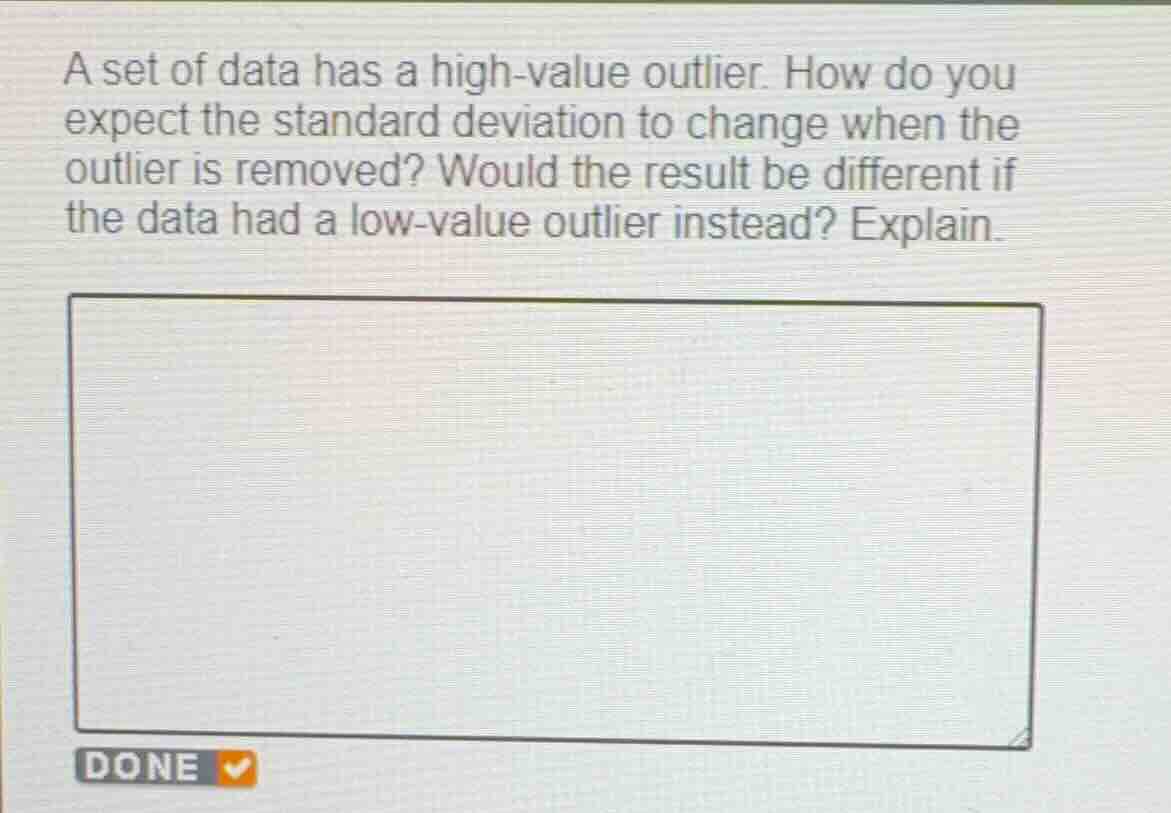
a set of data has a high-value outlier. how do you expect the standard deviation to change when the outlier is removed? would the result be different if the data had a low-value outlier instead? explain.
Analyze the effect of a high-value outlier
An outlier is a data point that lies far away from the rest of the values in a dataset. Standard deviation measures the average spread or distance of data points from the mean. Because a high-value outlier is far from the mean, it significantly increases the sum of squared deviations. Removing this outlier reduces the overall spread, which causes the standard deviation to decrease.
Analyze the effect of a low-value outlier
A low-value outlier is also located far away from the mean, just in the opposite direction. Like a high-value outlier, its extreme distance from the center increases the overall variability of the dataset. Removing a low-value outlier reduces the spread of the data, which also causes the standard deviation to decrease.
Compare the two scenarios
The standard deviation is a measure of spread and is not directional; it only measures how far data points are from the mean, regardless of whether they are above or below it. Therefore, removing either a high-value outlier or a low-value outlier will have the same qualitative effect: the standard deviation will decrease. The result would not be different.

Snap & solve any problem in the app
Get step-by-step solutions on Sovi AI
Photo-based solutions with guided steps
Explore more problems and detailed explanations
When a high-value outlier is removed, the standard deviation is expected to decrease because the overall spread of the data relative to the mean is reduced.
The result would not be different if the data had a low-value outlier instead. Removing a low-value outlier also reduces the overall variability and spread of the dataset, which similarly causes the standard deviation to decrease.