QUESTION IMAGE
Question
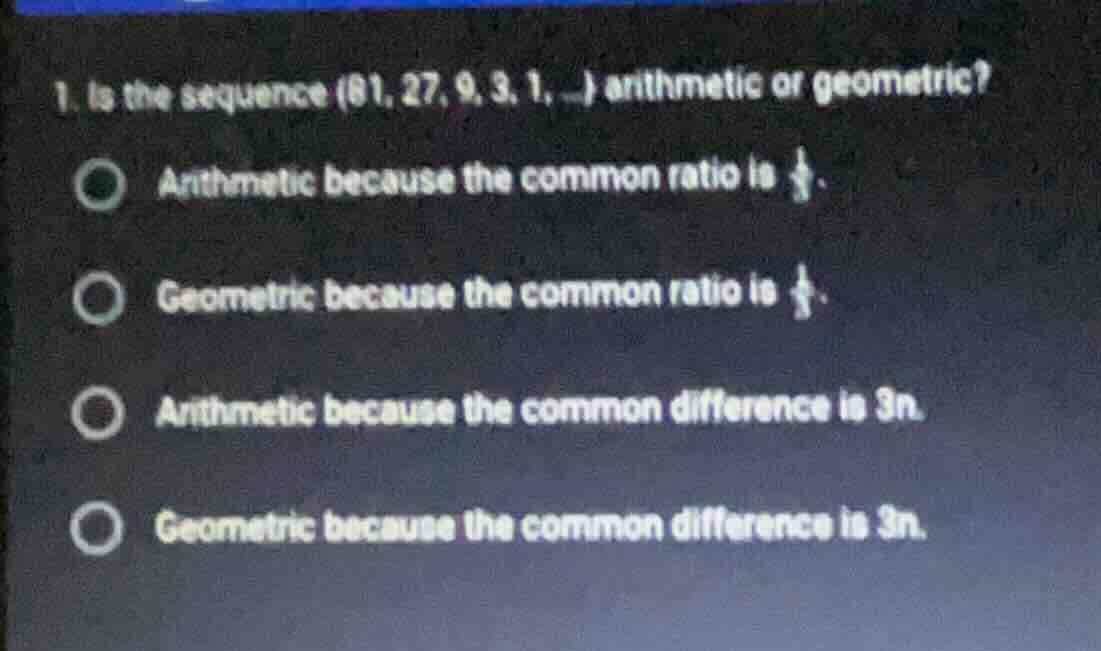
- is the sequence \\( (81, 27, 9, 3, 1, \dots) \\) arithmetic or geometric?
- arithmetic because the common ratio is \\( \frac{1}{3} \\).
- geometric because the common ratio is \\( \frac{1}{3} \\).
- arithmetic because the common difference is \\( 3n \\).
- geometric because the common difference is \\( 3n \\).
🆕 New Concept Discovered: Arithmetic vs. Geometric Sequences
Multiplying vs. adding to find the next term
Step 1: Analyze the sequence behavior
Let's look at the given sequence:
$$ (81, 27, 9, 3, 1, \dots) $$
To find how we get from one term to the next, we check the relationship between consecutive terms.
- Arithmetic sequences change by adding or subtracting a constant value (a common difference).
- Geometric sequences change by multiplying or dividing by a constant value (a common ratio).
Step 2: Test for a common ratio
Let's divide each term by the term before it to see if there is a constant multiplier (common ratio, \( r \)):
$$ \frac{27}{81} = \frac{1}{3} $$
$$ \frac{9}{27} = \frac{1}{3} $$
$$ \frac{3}{9} = \frac{1}{3} $$
$$ \frac{1}{3} = \frac{1}{3} $$
Since we multiply each term by \(\frac{1}{3}\) to get the next term, the sequence is geometric with a common ratio of \(\frac{1}{3}\).

Snap & solve any problem in the app
Get step-by-step solutions on Sovi AI
Photo-based solutions with guided steps
Explore more problems and detailed explanations
Geometric because the common ratio is \(\frac{1}{3}\).