Sovi.AI - AI Math Tutor

Scan to solve math questions

QUESTION IMAGE

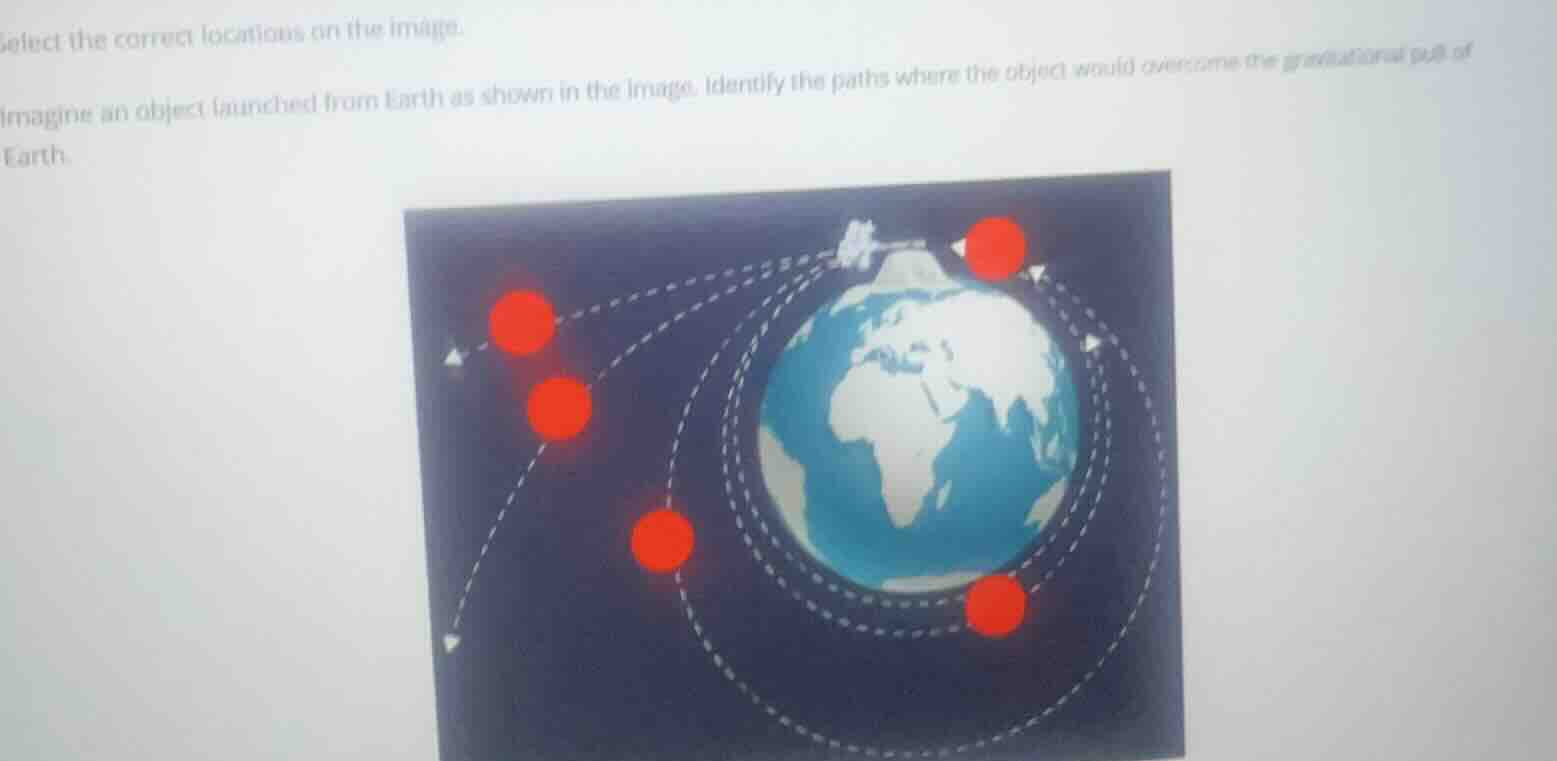
select the correct locations on the image. imagine an object launched f…

Question

select the correct locations on the image.

imagine an object launched from earth as shown in the image. identify the paths where the object would overcome the gravitational pull of earth.

Explanation:

Response

<pre_analysis>
{
"quality": "clear",
"question_count": 1,
"skills_matched": [
"direct_cot",
"explain_then_answer",
"tutor"
],
"needs_drawing": false,
"concepts_used": [],
"new_concepts": [
"Escape Velocity",
"Orbital Motion",
"Gravitational Bound State"
],
"current_concepts": [
"Escape Velocity",
"Orbital Motion",
"Gravitational Bound State"
]
}
</pre_analysis>

<reasoning>

Analyze the launch trajectories

The diagram illustrates Newton's cannonball thought experiment, showing different trajectories of an object launched from a high altitude above Earth. We need to identify which paths overcome the gravitational pull of Earth.

Evaluate closed orbital paths

The paths that loop completely around the Earth (forming closed circular or elliptical orbits) are bound by Earth's gravity. The red selection markers on these closed loops represent trajectories where the object remains in orbit, meaning it has not overcome Earth's gravitational pull.

Evaluate open escape paths

The paths that curve away from the Earth and extend out into space (hyperbolic or parabolic trajectories) represent cases where the launch velocity exceeds the escape velocity. The two red selection markers on the far left lie on trajectories that do not loop back around the Earth but instead head out into deep space, overcoming Earth's gravity.

Identify the correct target locations

The correct locations to select on the image are the two red circular markers on the far left, which lie on the open, escaping trajectories.
</reasoning>

<answer>
The correct locations to select on the image are the two red circular markers on the far left, which lie on the open paths heading away from Earth into space.
</answer>

<post_analysis>
{
"subject": "Natural Science",
"question_type": "Free Response",
"knowledge_point": [
"Natural Science",
"Physics",
"Escape Velocity"
]
}
</post_analysis>

Answer:

<pre_analysis>
{
"quality": "clear",
"question_count": 1,
"skills_matched": [
"direct_cot",
"explain_then_answer",
"tutor"
],
"needs_drawing": false,
"concepts_used": [],
"new_concepts": [
"Escape Velocity",
"Orbital Motion",
"Gravitational Bound State"
],
"current_concepts": [
"Escape Velocity",
"Orbital Motion",
"Gravitational Bound State"
]
}
</pre_analysis>

<reasoning>

Analyze the launch trajectories

The diagram illustrates Newton's cannonball thought experiment, showing different trajectories of an object launched from a high altitude above Earth. We need to identify which paths overcome the gravitational pull of Earth.

Evaluate closed orbital paths

The paths that loop completely around the Earth (forming closed circular or elliptical orbits) are bound by Earth's gravity. The red selection markers on these closed loops represent trajectories where the object remains in orbit, meaning it has not overcome Earth's gravitational pull.

Evaluate open escape paths

The paths that curve away from the Earth and extend out into space (hyperbolic or parabolic trajectories) represent cases where the launch velocity exceeds the escape velocity. The two red selection markers on the far left lie on trajectories that do not loop back around the Earth but instead head out into deep space, overcoming Earth's gravity.

Identify the correct target locations

The correct locations to select on the image are the two red circular markers on the far left, which lie on the open, escaping trajectories.
</reasoning>

<answer>
The correct locations to select on the image are the two red circular markers on the far left, which lie on the open paths heading away from Earth into space.
</answer>

<post_analysis>
{
"subject": "Natural Science",
"question_type": "Free Response",
"knowledge_point": [
"Natural Science",
"Physics",
"Escape Velocity"
]
}
</post_analysis>