QUESTION IMAGE
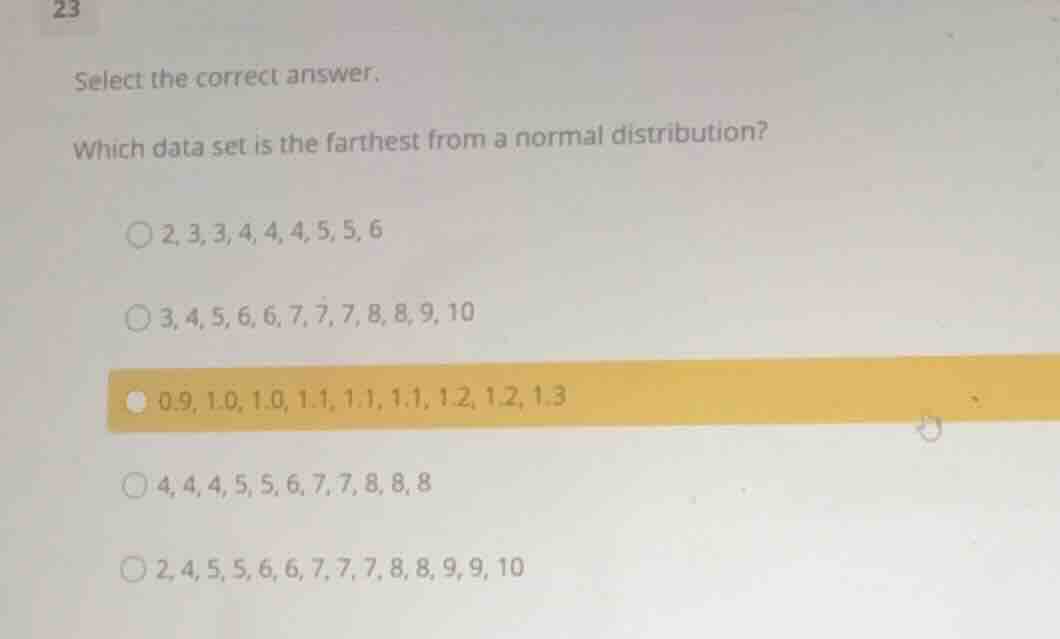
Question
select the correct answer.
which data set is the farthest from a normal distribution?
2, 3, 3, 4, 4, 4, 5, 5, 6
3, 4, 5, 6, 6, 7, 7, 7, 8, 8, 9, 10
0.9, 1.0, 1.0, 1.1, 1.1, 1.1, 1.2, 1.2, 1.3
4, 4, 4, 5, 5, 6, 7, 7, 8, 8, 8
2, 4, 5, 5, 6, 6, 7, 7, 7, 8, 8, 9, 9, 10
Analyze the symmetry of each data set
A normal distribution is symmetric, bell-shaped, and peaks in the middle. We analyze the frequency distribution of each option:
- Option 1: \(2, 3, 3, 4, 4, 4, 5, 5, 6\)
Frequencies: \(2: 1\), \(3: 2\), \(4: 3\), \(5: 2\), \(6: 1\). This is perfectly symmetric and bell-shaped.
- Option 2: \(3, 4, 5, 6, 6, 7, 7, 7, 8, 8, 9, 10\)
Frequencies: \(3: 1\), \(4: 1\), \(5: 1\), \(6: 2\), \(7: 3\), \(8: 2\), \(9: 1\), \(10: 1\). This is perfectly symmetric and bell-shaped.
- Option 3: \(0.9, 1.0, 1.0, 1.1, 1.1, 1.1, 1.2, 1.2, 1.3\)
Frequencies: \(0.9: 1\), \(1.0: 2\), \(1.1: 3\), \(1.2: 2\), \(1.3: 1\). This is perfectly symmetric and bell-shaped.
- Option 4: \(4, 4, 4, 5, 5, 6, 7, 7, 8, 8, 8\)
Frequencies: \(4: 3\), \(5: 2\), \(6: 1\), \(7: 2\), \(8: 3\). This is symmetric but U-shaped (bimodal at the extremes), which is the opposite of a bell-shaped normal distribution.
- Option 5: \(2, 4, 5, 5, 6, 6, 7, 7, 7, 8, 8, 9, 9, 10\)
Frequencies: \(2: 1\), \(4: 1\), \(5: 2\), \(6: 2\), \(7: 3\), \(8: 2\), \(9: 2\), \(10: 1\). This is symmetric and bell-shaped.
Determine the furthest distribution
The fourth data set \(4, 4, 4, 5, 5, 6, 7, 7, 8, 8, 8\) has its highest frequencies at the extreme values (\(4\) and \(8\)) and its lowest frequency at the center (\(6\)). This U-shaped distribution is the furthest from a bell-shaped normal distribution.

Snap & solve any problem in the app
Get step-by-step solutions on Sovi AI
Photo-based solutions with guided steps
Explore more problems and detailed explanations
- (A) 2, 3, 3, 4, 4, 4, 5, 5, 6
- (B) 3, 4, 5, 6, 6, 7, 7, 7, 8, 8, 9, 10
- (C) 0.9, 1.0, 1.0, 1.1, 1.1, 1.1, 1.2, 1.2, 1.3
- (D) 4, 4, 4, 5, 5, 6, 7, 7, 8, 8, 8 (Correct answer)
- (E) 2, 4, 5, 5, 6, 6, 7, 7, 7, 8, 8, 9, 9, 10