QUESTION IMAGE
Question
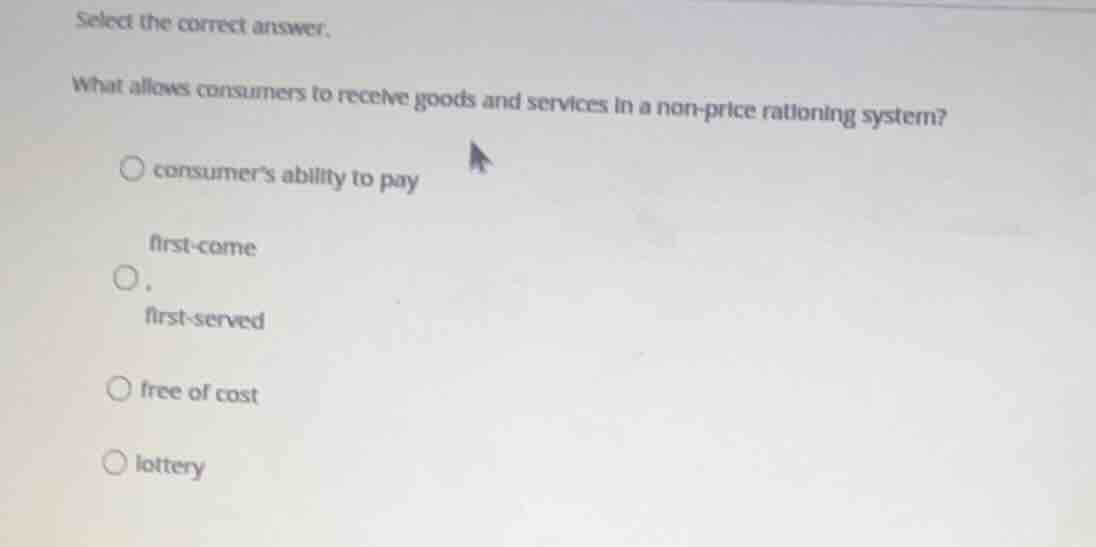
select the correct answer.
what allows consumers to receive goods and services in a non-price rationing system?
- consumers ability to pay
- first-come first-served
- free of cost
- lottery
Analyze the question context
The question asks what allows consumers to receive goods and services in a non-price rationing system. This relates to Economic Systems and how resources are allocated when the Price Mechanism is not used.
Evaluate the options
- consumer's ability to pay: This is the primary mechanism in a market-based Price Mechanism system, not a non-price system.
- first-come, first-served: In a non-price rationing system (often seen in a Command Economy or during shortages), goods are allocated based on waiting in line or queuing. This is a classic non-price rationing method.
- free of cost: While goods might be distributed without a direct monetary price, "free of cost" itself is not the mechanism that determines who receives the limited goods.
- lottery: While a lottery is a form of non-price allocation, the most common everyday mechanism for distributing standard consumer goods in non-price systems (like historical command economies) is queuing, represented by "first-come, first-served".
Determine the correct choice
"first-come, first-served" is the standard mechanism that determines allocation when prices are not allowed to clear the market.

Snap & solve any problem in the app
Get step-by-step solutions on Sovi AI
Photo-based solutions with guided steps
Explore more problems and detailed explanations
- consumer's ability to pay
- first-come, first-served (Correct answer)
- free of cost
- lottery