QUESTION IMAGE
Question
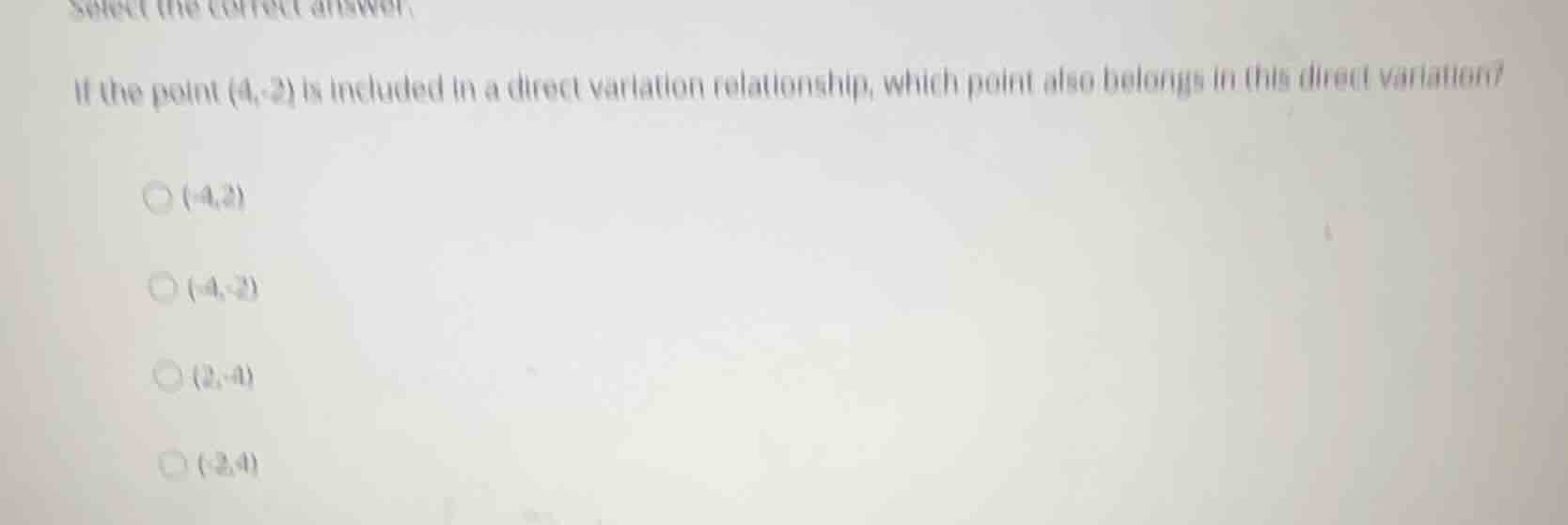
select the correct answer.
if the point \\((4, -2)\\) is included in a direct variation relationship, which point also belongs in this direct variation?
\\((-4, 2)\\)
\\((-4, -2)\\)
\\((2, -4)\\)
\\((-2, 4)\\)
Define direct variation
A direct variation is a linear relationship represented by the equation:
where \(k\) is a non-zero constant called the constant of variation.
Find the constant of variation
Using the given point \((4, -2)\), we substitute \(x = 4\) and \(y = -2\) into the direct variation equation:
Solving for \(k\):
Thus, the equation for this relationship is:
Test the given options
We substitute the \(x\)-coordinates of the given options into our equation to see which \(y\)-coordinate matches:
- For \((4, 2)\): \(y = -\frac{1}{2}(4) = -2
eq 2\)
- For \((-4, -2)\): \(y = -\frac{1}{2}(-4) = 2
eq -2\)
- For \((2, -4)\): \(y = -\frac{1}{2}(2) = -1
eq -4\)
- For \((-2, 1)\): \(y = -\frac{1}{2}(-2) = 1\) (This point matches)

Snap & solve any problem in the app
Get step-by-step solutions on Sovi AI
Photo-based solutions with guided steps
Explore more problems and detailed explanations
- (A) \((4, 2)\)
- (B) \((-4, -2)\)
- (C) \((2, -4)\)
- (D) \((-2, 1)\) (Correct answer)