QUESTION IMAGE
Question
select the correct answer.
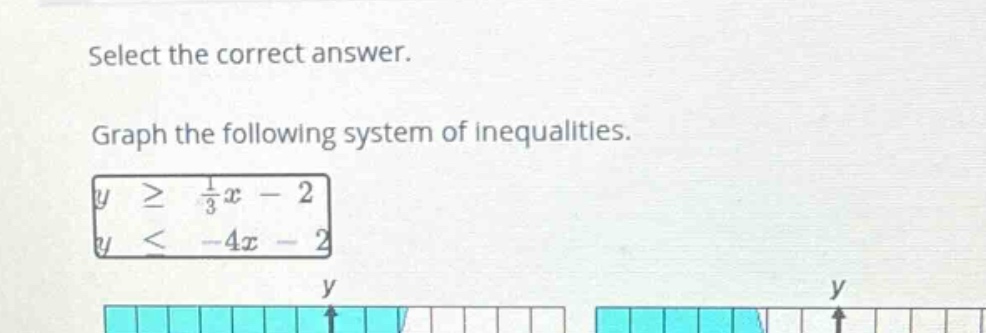
graph the following system of inequalities.
\\
\
\\
🆕 New Concept Discovered: Graphing Systems of Inequalities
Finding where shaded regions overlap on a coordinate plane.
Step 1: Analyze the boundary lines
To graph the system, we first look at the boundary lines of each inequality:
- For \( y \ge \frac{1}{3}x - 2 \):
- The boundary line is \( y = \frac{1}{3}x - 2 \).
- It has a \( y \)-intercept at \( (0, -2) \) and a slope of \( \frac{1}{3} \) (rise 1, run 3).
- Because the inequality symbol is \( \ge \) (greater than or equal to), the line is solid, and we shade above the line.
- For \( y < -4x - 2 \):
- The boundary line is \( y = -4x - 2 \).
- It has a \( y \)-intercept at \( (0, -2) \) and a slope of \( -4 \) (down 4, run 1).
- Because the inequality symbol is \( < \) (less than), the line is dashed, and we shade below the line.
Step 2: Identify the intersection point
Both boundary lines share the same \( y \)-intercept:
This is the point where the solid line and the dashed line intersect.
Step 3: Determine the correct shaded region
To find the solution set of the system, we look for the region where the individual shaded areas overlap:
- Above the solid line \( y = \frac{1}{3}x - 2 \)
- Below the dashed line \( y = -4x - 2 \)
We can test a point in this region, such as \( (-2, -2) \):
- First inequality: \( -2 \ge \frac{1}{3}(-2) - 2 \implies -2 \ge -\frac{8}{3} \approx -2.67 \) (True)
- Second inequality: \( -2 < -4(-2) - 2 \implies -2 < 6 \) (True)
The correct graph will show:
- A solid line passing through \( (0, -2) \) and \( (3, -1) \).
- A dashed line passing through \( (0, -2) \) and \( (-1, 2) \).
- The shaded solution region located above the solid line and below/to the left of the dashed line (containing points like \( (-2, -2) \)).

Snap & solve any problem in the app
Get step-by-step solutions on Sovi AI
Photo-based solutions with guided steps
Explore more problems and detailed explanations
The correct graph is the one that features:
- A solid line for \( y = \frac{1}{3}x - 2 \)
- A dashed line for \( y = -4x - 2 \)
- Both lines intersecting at \( (0, -2) \)
- Shading in the region that is above the solid line and below (to the left of) the dashed line.