QUESTION IMAGE
Question
select all the correct locations on the image.
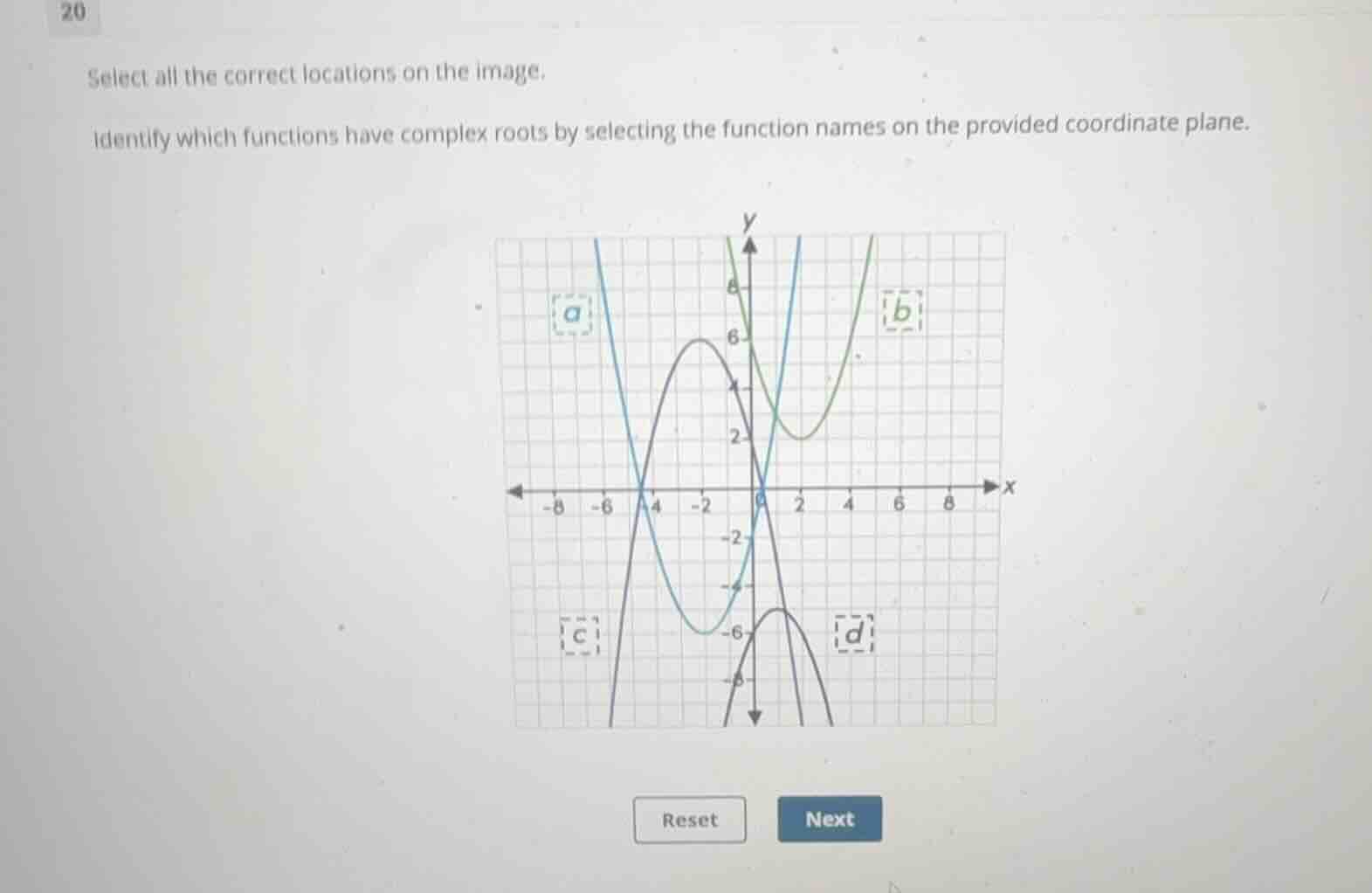
identify which functions have complex roots by selecting the function names on the provided coordinate plane.
Identify real roots from x-intercepts
The real roots of a function correspond to the points where its graph intersects or touches the \(x\)-axis.
- Curve \(a\) (light blue, opening upwards) crosses the \(x\)-axis at \(x = -4\) and \(x = 1\). Thus, it has real roots.
- Curve \(c\) (dark blue/purple, opening downwards) crosses the \(x\)-axis at \(x = -5\) and \(x = 1\). Thus, it has real roots.
Identify functions with no real roots (complex roots)
Quadratic functions that do not intersect or touch the \(x\)-axis have strictly complex (non-real) roots.
- Curve \(b\) (green, opening upwards) has its vertex at approximately \((2, 2)\) and lies entirely above the \(x\)-axis. It does not intersect the \(x\)-axis, meaning it has complex roots.
- Curve \(d\) (grey/dark grey, opening downwards) has its vertex at approximately \((1, -5)\) and lies entirely below the \(x\)-axis. It does not intersect the \(x\)-axis, meaning it has complex roots.
Determine the correct selections
The functions with complex roots are represented by the labels \(b\) and \(d\).

Snap & solve any problem in the app
Get step-by-step solutions on Sovi AI
Photo-based solutions with guided steps
Explore more problems and detailed explanations
- (a)
- (b) (Correct answer)
- (c)
- (d) (Correct answer)