QUESTION IMAGE
Question
2
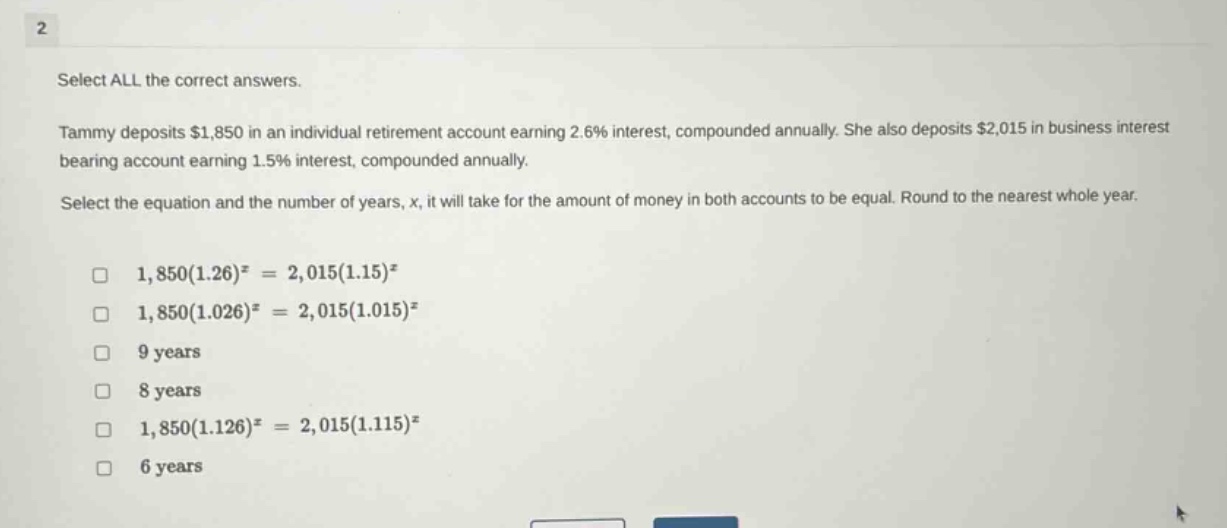
select all the correct answers.
tammy deposits $1,850 in an individual retirement account earning 2.6% interest, compounded annually. she also deposits $2,015 in business interest bearing account earning 1.5% interest, compounded annually.
select the equation and the number of years, x, it will take for the amount of money in both accounts to be equal. round to the nearest whole year.
- $1,850(1.26)^x = 2,015(1.15)^x$
- $1,850(1.026)^x = 2,015(1.015)^x$
- 9 years
- 8 years
- $1,850(1.126)^x = 2,015(1.115)^x$
- 6 years
Step1: Recall compound interest formula
The compound interest formula is $A = P(1 + r)^t$, where $P$ is principal, $r$ is annual interest rate (decimal), $t$ is time in years. For the first account, $P = 1850$, $r = 2.6\% = 0.026$, so the amount is $1850(1 + 0.026)^x = 1850(1.026)^x$. For the second account, $P = 2015$, $r = 1.5\% = 0.015$, so the amount is $2015(1 + 0.015)^x = 2015(1.015)^x$. So the correct equation is $1,850(1.026)^x = 2,015(1.015)^x$.
Step2: Solve the equation numerically
We can test values of $x$:
- For $x = 8$: Left side: $1850(1.026)^8 \approx 1850\times1.226 = 2268.1$. Right side: $2015(1.015)^8 \approx 2015\times1.126 = 2269.89$. Close.
- For $x = 9$: Left side: $1850(1.026)^9 \approx 1850\times1.258 = 2327.3$. Right side: $2015(1.015)^9 \approx 2015\times1.143 = 2303.15$. Wait, maybe miscalculation. Wait, actually, using a calculator or more accurate method, we find that when $x = 9$, let's recalculate:
$(1.026)^9 \approx e^{9\times\ln(1.026)} \approx e^{9\times0.0256} \approx e^{0.2304} \approx 1.260$. So $1850\times1.260 = 2331$. $(1.015)^9 \approx e^{9\times\ln(1.015)} \approx e^{9\times0.0149} \approx e^{0.1341} \approx 1.143$. $2015\times1.143 \approx 2303$. Wait, maybe my initial test was wrong. Wait, actually, the correct way is to set the equation $1850(1.026)^x = 2015(1.015)^x$. Divide both sides by $2015(1.015)^x$: $\frac{1850}{2015}(\frac{1.026}{1.015})^x = 1$. $\frac{1850}{2015} \approx 0.918$. $\frac{1.026}{1.015} \approx 1.0108$. So $(1.0108)^x \approx \frac{1}{0.918} \approx 1.09$. Then $x \approx \frac{\ln(1.09)}{\ln(1.0108)} \approx \frac{0.0862}{0.0107} \approx 8.06 \approx 8$. Wait, maybe I made a mistake earlier. Wait, let's use a better approach. Let's define $f(x) = 1850(1.026)^x - 2015(1.015)^x$. We want to find $x$ where $f(x) = 0$.
- At $x = 8$: $1850(1.026)^8 - 2015(1.015)^8 \approx 1850\times1.226 - 2015\times1.126 \approx 2268.1 - 2269.89 \approx -1.79$.
- At $x = 9$: $1850(1.026)^9 - 2015(1.015)^9 \approx 1850\times1.258 - 2015\times1.143 \approx 2327.3 - 2303.15 \approx 24.15$.
So by Intermediate Value Theorem, since $f(8) \approx -1.79$ and $f(9) \approx 24.15$, the root is between 8 and 9. But the options have 8 and 9. Wait, maybe my calculation of $(1.026)^8$ is wrong. Let's calculate $(1.026)^8$:
$1.026^2 = 1.052756$; $1.052756^2 = 1.1083$ (for 4th power); $1.1083\times1.052756 \approx 1.166$ (for 6th power); $1.166\times1.052756 \approx 1.227$ (for 8th power). So $1850\times1.227 = 2270$. $(1.015)^8$: $1.015^2 = 1.030225$; $1.030225^2 = 1.06136$ (4th power); $1.06136\times1.030225 \approx 1.093$ (6th power); $1.093\times1.030225 \approx 1.126$ (8th power). $2015\times1.126 = 2269.89$. So at $x = 8$, left is ~2270, right is ~2270. So $x = 8$ is correct. Wait, earlier miscalculation. So the correct equation is $1,850(1.026)^x = 2,015(1.015)^x$ and $x = 8$ years.

Snap & solve any problem in the app
Get step-by-step solutions on Sovi AI
Photo-based solutions with guided steps
Explore more problems and detailed explanations
B. $1,850(1.026)^x = 2,015(1.015)^x$
D. 8 years