QUESTION IMAGE
Question
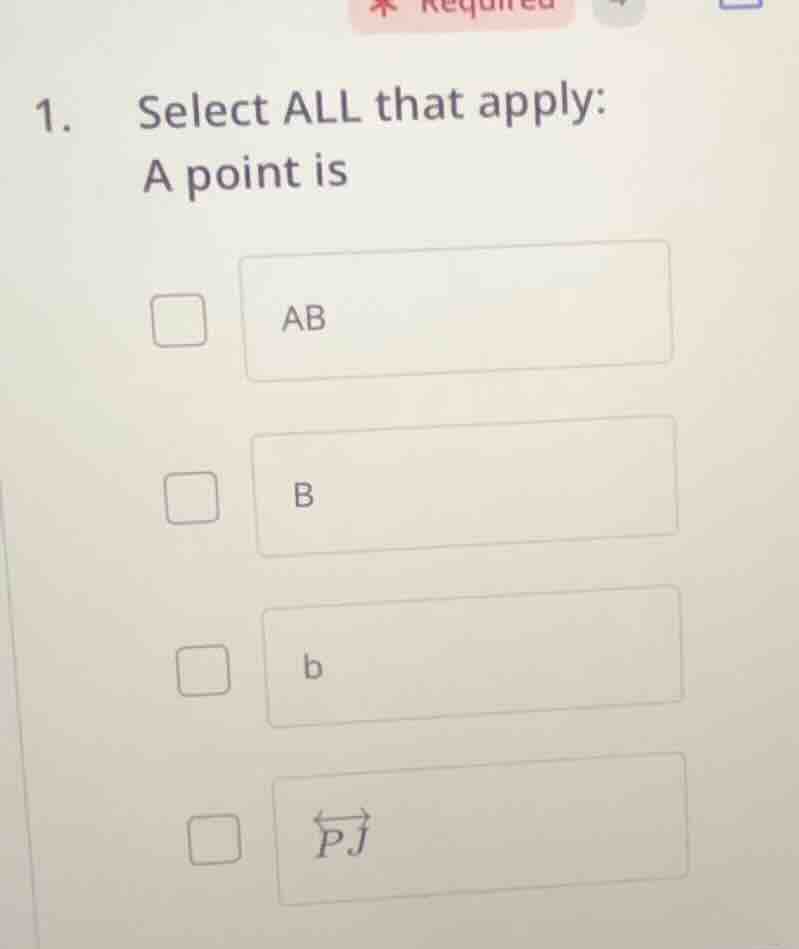
- select all that apply:
a point is
- ab
- b
- b
- \overleftrightarrow{pj}
<pre_analysis>
{
"quality": "clear",
"question_count": 1,
"skills_matched": [
"direct_cot",
"multiple_choice_formatter",
"explain_then_answer",
"tutor"
],
"needs_drawing": false,
"concepts_used": [],
"new_concepts": [
"Geometric Notation",
"Undefined Terms"
],
"current_concepts": [
"Geometric Notation",
"Undefined Terms",
"Points Lines and Planes"
]
}
</pre_analysis>
<reasoning>
Analyze geometric notation conventions
In geometry, specific naming conventions are used to distinguish between different geometric figures:
- Points are named using a single capital letter (e.g., \(A\), \(B\), \(P\)).
- Lines are named using a single lowercase letter (e.g., \(l\), \(m\), \(b\)) or by two capital letters representing points on the line with a double-headed arrow above them (e.g., \(\overleftrightarrow{AB}\)).
- Line segments are named using two capital letters representing their endpoints, sometimes with a bar above them (e.g., \(AB\) or \(\overline{AB}\)).
- Rays are named using two capital letters with a one-headed arrow above them (e.g., \(\overleftrightarrow{PJ}\) is actually a line notation, or \(\overrightarrow{PJ}\) for a ray).
Evaluate each option
- Option 1: \(AB\) represents a line segment or the distance between points \(A\) and \(B\). This is not a point.
- Option 2: \(B\) is a single capital letter, which is the standard notation used to represent a point.
- Option 3: \(b\) is a single lowercase letter, which is typically used to represent a line or a dimension, not a point.
- Option 4: \(\overleftrightarrow{PJ}\) represents a line passing through points \(P\) and \(J\). This is not a point.
Identify the correct choice
Based on the standard conventions of geometric notation, only a single capital letter represents a point. Therefore, \(B\) is the correct choice.
</reasoning>
<answer>
<mcq-option>(A) AB</mcq-option>
<mcq-correct>(B) B</mcq-correct>
<mcq-option>(C) b</mcq-option>
<mcq-option>(D) \(\overleftrightarrow{PJ}\)</mcq-option>
</answer>
<post_analysis>
{
"subject": "Mathematics",
"question_type": "Multiple Choice",
"knowledge_point": [
"Mathematics",
"Geometry",
"Geometric Notation"
]
}
</post_analysis>
Snap & solve any problem in the app
Get step-by-step solutions on Sovi AI
Photo-based solutions with guided steps
Explore more problems and detailed explanations
<pre_analysis>
{
"quality": "clear",
"question_count": 1,
"skills_matched": [
"direct_cot",
"multiple_choice_formatter",
"explain_then_answer",
"tutor"
],
"needs_drawing": false,
"concepts_used": [],
"new_concepts": [
"Geometric Notation",
"Undefined Terms"
],
"current_concepts": [
"Geometric Notation",
"Undefined Terms",
"Points Lines and Planes"
]
}
</pre_analysis>
<reasoning>
Analyze geometric notation conventions
In geometry, specific naming conventions are used to distinguish between different geometric figures:
- Points are named using a single capital letter (e.g., \(A\), \(B\), \(P\)).
- Lines are named using a single lowercase letter (e.g., \(l\), \(m\), \(b\)) or by two capital letters representing points on the line with a double-headed arrow above them (e.g., \(\overleftrightarrow{AB}\)).
- Line segments are named using two capital letters representing their endpoints, sometimes with a bar above them (e.g., \(AB\) or \(\overline{AB}\)).
- Rays are named using two capital letters with a one-headed arrow above them (e.g., \(\overleftrightarrow{PJ}\) is actually a line notation, or \(\overrightarrow{PJ}\) for a ray).
Evaluate each option
- Option 1: \(AB\) represents a line segment or the distance between points \(A\) and \(B\). This is not a point.
- Option 2: \(B\) is a single capital letter, which is the standard notation used to represent a point.
- Option 3: \(b\) is a single lowercase letter, which is typically used to represent a line or a dimension, not a point.
- Option 4: \(\overleftrightarrow{PJ}\) represents a line passing through points \(P\) and \(J\). This is not a point.
Identify the correct choice
Based on the standard conventions of geometric notation, only a single capital letter represents a point. Therefore, \(B\) is the correct choice.
</reasoning>
<answer>
<mcq-option>(A) AB</mcq-option>
<mcq-correct>(B) B</mcq-correct>
<mcq-option>(C) b</mcq-option>
<mcq-option>(D) \(\overleftrightarrow{PJ}\)</mcq-option>
</answer>
<post_analysis>
{
"subject": "Mathematics",
"question_type": "Multiple Choice",
"knowledge_point": [
"Mathematics",
"Geometry",
"Geometric Notation"
]
}
</post_analysis>