QUESTION IMAGE
Question
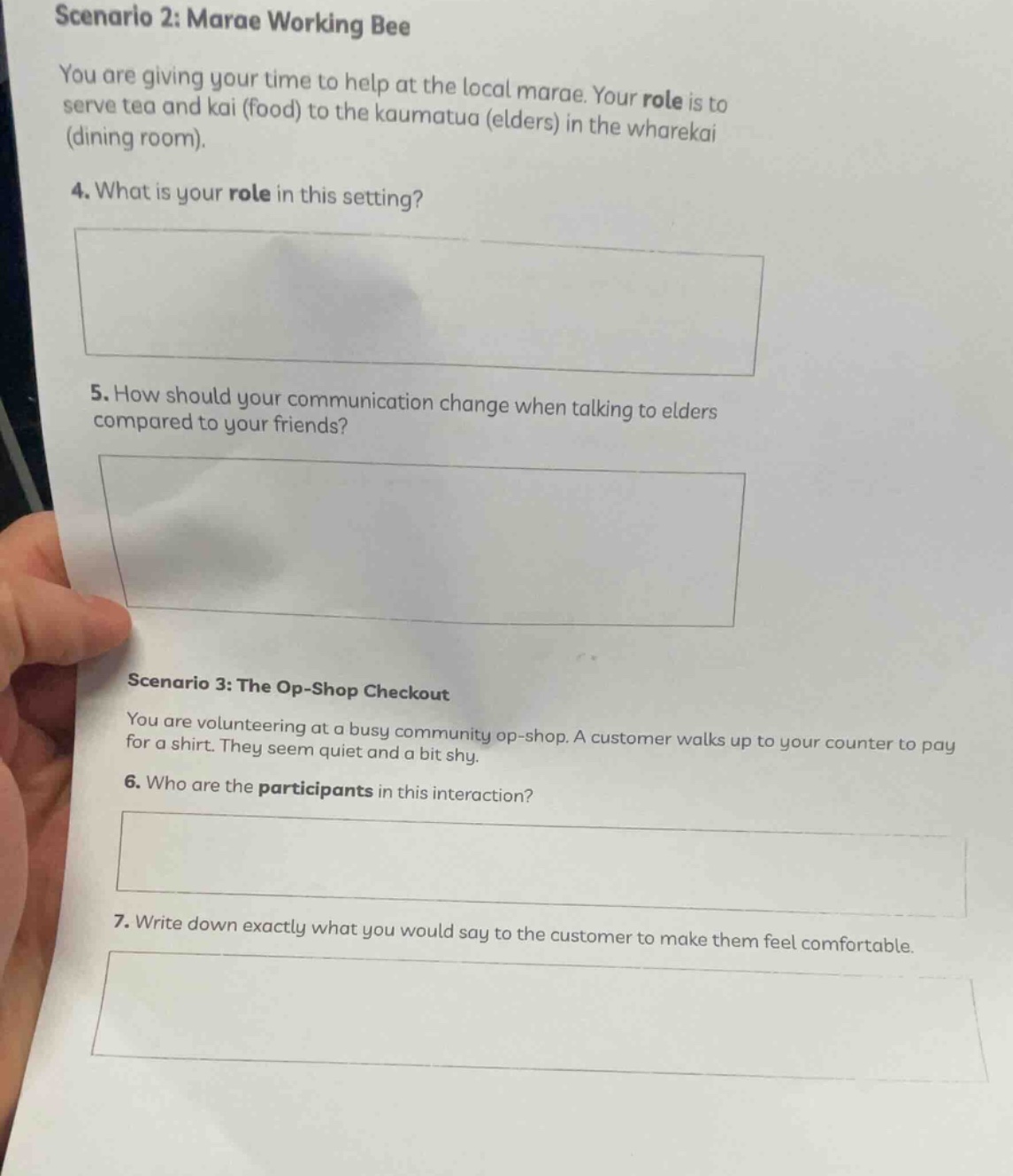
scenario 2: marae working bee
you are giving your time to help at the local marae. your role is to serve tea and kai (food) to the kaumatua (elders) in the wharekai (dining room).
- what is your role in this setting?
- how should your communication change when talking to elders compared to your friends?
scenario 3: the op-shop checkout
you are volunteering at a busy community op-shop. a customer walks up to your counter to pay for a shirt. they seem quiet and a bit shy.
- who are the participants in this interaction?
- write down exactly what you would say to the customer to make them feel comfortable.
Identify role in Scenario 2
The text states: "Your role is to serve tea and kai (food) to the kaumatua (elders) in the wharekai (dining room)." Therefore, the role is serving food and drinks to the elders.
Analyze communication adjustments for elders
When communicating with elders (kaumatua) compared to friends, one should use a more respectful, polite, and formal tone. This includes using appropriate titles, speaking clearly and at a moderate pace, listening attentively without interrupting, and showing cultural respect.
Identify participants in Scenario 3
The scenario description states: "You are volunteering at a busy community op-shop. A customer walks up to your counter..." The participants in this interaction are you (the volunteer/checkout operator) and the customer.
Formulate a welcoming response for a shy customer
To make a quiet and shy customer feel comfortable, the response should be warm, gentle, friendly, and low-pressure. A polite greeting combined with a soft, helpful offer is ideal. For example: "Hi there! How are you doing today? I can help you with that shirt whenever you're ready."

Snap & solve any problem in the app
Get step-by-step solutions on Sovi AI
Photo-based solutions with guided steps
Explore more problems and detailed explanations
Question 4
To serve tea and kai (food) to the kaumatua (elders) in the wharekai (dining room).
Question 5
Communication should become more formal, polite, and respectful. This involves speaking clearly, using respectful language, listening patiently, and avoiding casual slang that you might use with friends.
Question 6
The participants are you (the volunteer/checkout assistant) and the customer.
Question 7
"Hi there! How are you doing today? That's a lovely shirt you've chosen. I can help you scan and pack that whenever you're ready."