QUESTION IMAGE
Question
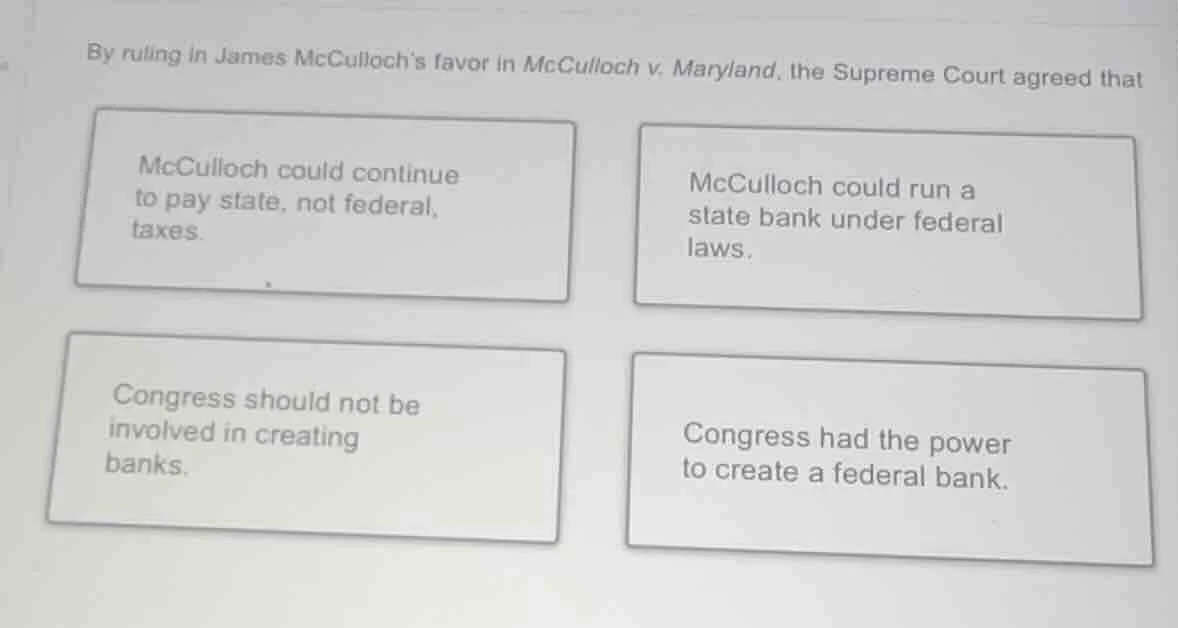
by ruling in james mccullochs favor in mcculloch v. maryland, the supreme court agreed that
mcculloch could continue to pay state, not federal, taxes.
mcculloch could run a state bank under federal laws.
congress should not be involved in creating banks.
congress had the power to create a federal bank.
In the case of McCulloch v. Maryland, the Supreme Court ruled on the constitutionality of the Second Bank of the United States and state taxation of federal institutions. The key outcome was that Congress had the implied power (under the Necessary and Proper Clause) to create a federal bank, and states could not tax federal institutions. Let's analyze each option:
- "McCulloch could continue to pay state, not federal, taxes": The ruling actually held that the state tax on the federal bank was unconstitutional, so this is incorrect.
- "McCulloch could run a state bank under federal laws": The case was about a federal bank, not a state bank run under federal laws, so this is incorrect.
- "Congress should not be involved in creating banks": The ruling upheld Congress's power to create a federal bank, so this is incorrect.
- "Congress had the power to create a federal bank": This matches the outcome of the case, as the Court recognized Congress's implied power to establish a federal bank under the Necessary and Proper Clause.

Snap & solve any problem in the app
Get step-by-step solutions on Sovi AI
Photo-based solutions with guided steps
Explore more problems and detailed explanations
D. Congress had the power to create a federal bank. (Assuming the options are labeled A, B, C, D in the order presented: A. McCulloch could continue to pay state, not federal, taxes. B. McCulloch could run a state bank under federal laws. C. Congress should not be involved in creating banks. D. Congress had the power to create a federal bank.)