QUESTION IMAGE
Question
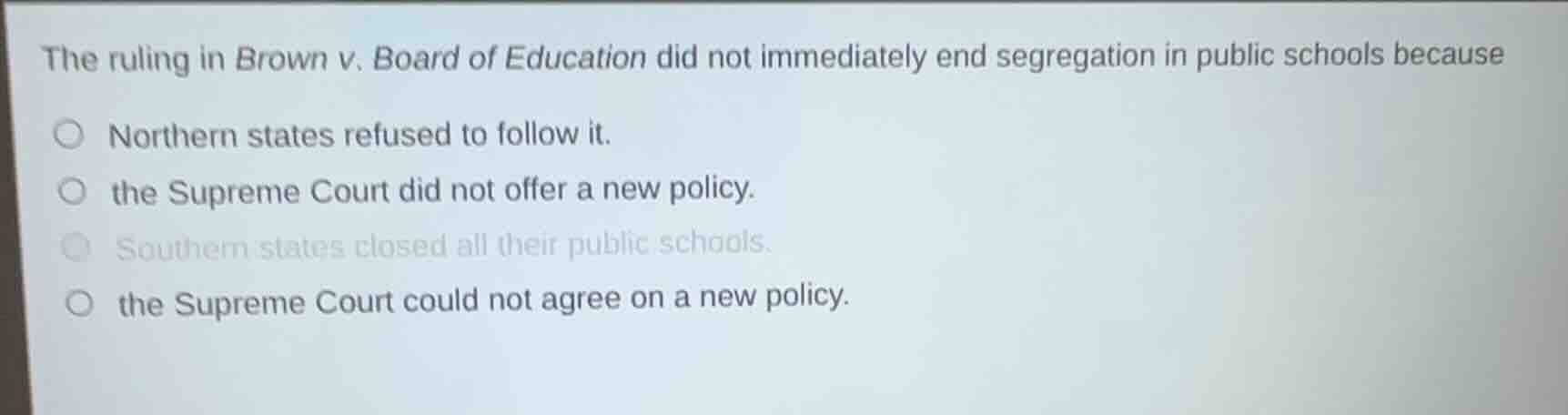
the ruling in brown v. board of education did not immediately end segregation in public schools because
- northern states refused to follow it.
- the supreme court did not offer a new policy.
- southern states closed all their public schools.
- the supreme court could not agree on a new policy.
Analyze the ruling of Brown v. Board of Education
The landmark 1954 Supreme Court decision in Brown v. Board of Education ruled that racial segregation in public schools was unconstitutional, overturning the "separate but equal" doctrine. However, the initial ruling did not establish a specific plan, timeline, or policy for how school districts should integrate.
Examine the implementation challenges
Because the initial 1954 ruling lacked implementation guidelines, the Supreme Court had to issue a second ruling in 1955 (often called Brown II). In Brown II, the Court ordered that desegregation take place "with all deliberate speed." This vague phrasing did not offer a concrete, immediate policy or schedule, allowing many resistant districts to delay integration.
Evaluate the given options
- Northern states refused to follow it: Incorrect. While there was de facto segregation in the North, the primary legal resistance came from Southern states.
- the Supreme Court did not offer a new policy: Correct. The Court declared segregation unconstitutional but left the implementation details and policies open, which delayed actual desegregation.
- Southern states closed all their public schools: Incorrect. While some specific districts (like Prince Edward County in Virginia) closed schools to avoid integration, Southern states did not close all of their public schools.
- the Supreme Court could not agree on a new policy: Incorrect. The Court was actually unanimous (9-0) in its decision, but they deliberately chose to delegate implementation to local federal courts rather than establishing a rigid federal policy.

Snap & solve any problem in the app
Get step-by-step solutions on Sovi AI
Photo-based solutions with guided steps
Explore more problems and detailed explanations
- Northern states refused to follow it.
- the Supreme Court did not offer a new policy. (Correct answer)
- Southern states closed all their public schools.
- the Supreme Court could not agree on a new policy.